
Data centers used to feel invisible. They were the quiet buildings behind email, streaming, cloud backups, search engines, and business software. Then generative AI arrived, and suddenly those buildings became part of a much bigger household-budget conversation: why are electricity bills rising, and who should pay for the power infrastructure needed by the AI boom?
The topic can get technical fast, but the basic story is easy to understand. Data centers need electricity all day, every day. The newest AI-focused facilities can be especially power hungry because they run dense clusters of chips for training and using large models. That demand is not spread evenly across the country. It concentrates in specific utility territories, transmission zones, and counties. So while data center energy demand is a national story, local electricity inflation is where people actually feel it.
To be fair, data centers are not the only reason power bills rise. Fuel costs, weather, aging equipment, wildfire hardening, storm repairs, interest rates, regulations, and new transmission lines all matter. But in places where data centers are arriving quickly, they can become one of the biggest new sources of load growth. That means communities need to ask a practical question: will the companies creating the new demand pay their fair share, or will ordinary customers absorb part of the cost through higher rates?
Why Data Centers Use So Much Electricity
A data center is basically a specialized warehouse for computing. Inside are servers, networking equipment, storage systems, backup power, cooling equipment, and electrical infrastructure. Those servers do the work of storing files, running websites, training AI models, answering chatbot requests, processing video, and keeping business systems online.
The electricity demand comes from two main places. First, the chips and servers need power. Second, the building has to manage heat. Computing turns electricity into heat, and heat is the enemy of reliable electronics. That is why cooling, airflow, pumps, chillers, fans, and sometimes water use become part of the energy story too.
The International Energy Agency says a typical AI-focused data center can use about as much electricity as 100,000 households, while the largest facilities under construction can use far more. That does not mean every data center is that large. Some are small. Some are efficient. Some buy renewable energy or build dedicated power supplies. But the largest new AI campuses are no longer small background loads. They can look more like industrial facilities from the grid’s point of view.
The Scale: From Global Demand to U.S. Grid Pressure
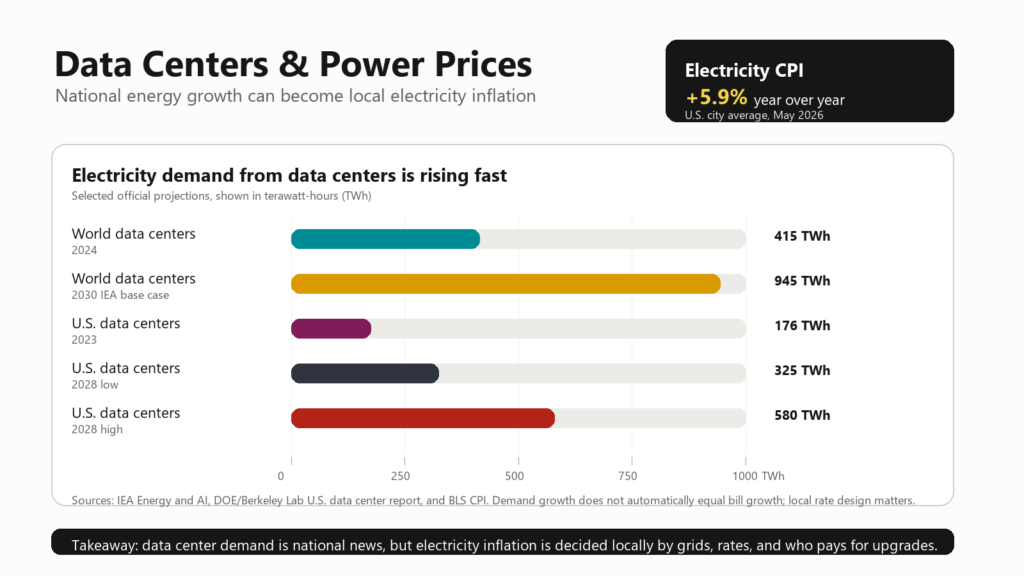
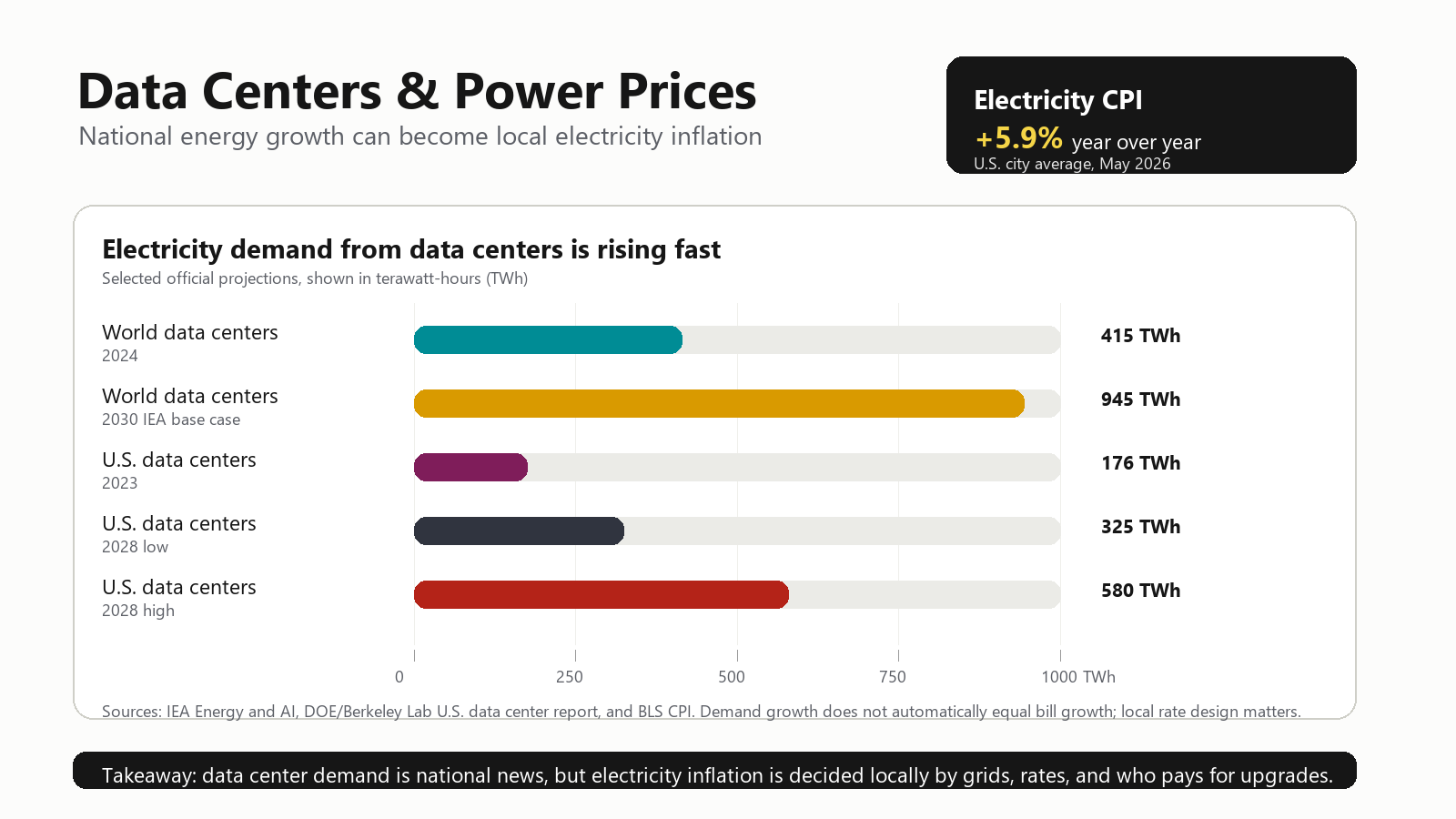
The IEA estimated that data centers used about 415 terawatt-hours of electricity worldwide in 2024, roughly 1.5 percent of global electricity consumption. In its base case, the IEA projects data center electricity use could more than double to about 945 terawatt-hours by 2030. AI is described as the most important driver of that growth, alongside continued growth in other digital services.
The U.S. picture is just as striking. The 2024 United States Data Center Energy Usage Report from Berkeley Lab, prepared for the U.S. Department of Energy, estimated U.S. data center electricity consumption at about 176 terawatt-hours in 2023, or about 4.4 percent of total U.S. electricity use. The same report projected a possible rise to roughly 325 to 580 terawatt-hours by 2028, depending on growth assumptions. That would put data centers somewhere around 6.7 to 12 percent of U.S. electricity consumption in that forecast range.
Those are big numbers, but the local concentration matters even more. A new data center does not ask the whole country for a little bit of power. It asks one grid connection, one utility, one transmission region, and one local community for a lot of power. If several large projects line up in the same region, the result can be new substations, new transmission lines, new generation contracts, new capacity-market costs, and new debates about who pays.
How Data Center Demand Can Become Local Electricity Inflation
Electricity prices are local because electric systems are local. The U.S. Energy Information Administration explains that prices reflect the cost to build, finance, maintain, and operate power plants and the grid. Fuel costs, power plant costs, transmission and distribution systems, weather, demand, and regulations all influence what customers pay.
When a large data center arrives, it can affect several of those cost buckets at once. If the region needs more generation, someone has to finance it. If the transmission system needs upgrades, someone has to pay. If substations or distribution lines need reinforcement, those costs go into utility planning. If the data center gets a special contract, regulators have to decide whether that contract protects other customers or quietly shifts risk onto them.
This is where local electricity inflation can happen. It may not show up as a line item labeled “AI.” Instead, it can appear as a base-rate increase, a grid rider, a capacity-market charge, a transmission charge, or a higher forecast of future demand that raises power procurement costs before every proposed facility is even built.
The BLS Consumer Price Index release for May 2026 showed the U.S. electricity index up 0.6 percent for the month and 5.9 percent over the previous 12 months. That national CPI number does not prove data centers caused the increase. It does show why households are paying attention. Electricity is already getting more expensive for many families, and large new loads make people wonder whether their bill is helping fund someone else’s computing boom.
Why the Impact Is Uneven
Some areas may welcome data centers because they bring tax revenue, construction jobs, lease payments, and local investment. Other areas may worry about land use, water use, transmission lines, backup generators, noise, or higher electric bills. Both reactions can be reasonable because the benefits and costs do not always land on the same people.
That unevenness is the heart of the issue. A data center can be profitable for a technology company, useful for AI users, attractive to a county budget, and still create pressure on ratepayers if the utility system expands faster than planned. The right answer is not automatically “no data centers.” The right answer is better cost allocation, better transparency, and better timing.
Virginia is the clearest U.S. case study because Northern Virginia is one of the world’s largest data center markets. A 2024 report by Virginia’s Joint Legislative Audit and Review Commission warned that, without changes to rate design, typical residential customers of Dominion Energy Virginia could eventually see higher monthly bills because of data center-driven grid investment. The report discussed creating a separate customer class for large data centers so costs could be allocated more directly to the customers causing them.
What Communities Should Ask Before Approving Big New Loads
Communities do not have to become energy-market experts to ask better questions. A few plain-English questions can reveal whether a project is likely to help the local economy without quietly raising costs for everyone else.
- Who pays for grid upgrades? Are new substations, transmission lines, and connection costs paid by the data center, by all ratepayers, or by some combination?
- Is the project financially committed? Utilities and grid operators need serious load forecasts, not speculative requests that inflate demand projections.
- Will the data center receive a special electricity rate? If so, regulators should explain whether the rate protects other customers.
- Can the facility reduce demand during grid stress? Flexible load, backup power, batteries, and demand response can reduce peak pressure if designed well.
- What power source will serve the load? New renewables, firm clean power, natural gas, nuclear, storage, and transmission each have different cost and reliability implications.
- Will the community see durable benefits? Tax revenue, local jobs, infrastructure improvements, and environmental safeguards should be clear, measurable, and public.
Why Efficiency Alone May Not Stop the Pressure
AI chips will get more efficient. Cooling systems will improve. Software will become smarter about routing workloads. Some data centers will use waste heat, better building design, or cleaner power contracts. All of that matters. Efficiency can reduce waste and slow the growth in electricity demand per unit of computing.
But efficiency does not automatically reduce total demand if use expands even faster. Economists call this a rebound effect: when something gets cheaper or more efficient, people often use more of it. If AI tools become cheaper, faster, and more embedded in daily life, total computing demand can keep rising even as each individual task gets more efficient.
That is why grid planning matters. The goal is not simply to make each data center efficient. The goal is to align computing growth with power availability, transmission capacity, clean-energy goals, and household affordability. The IEA notes that around 20 percent of planned data center projects could face delays if grid risks are not addressed. That is a warning for both tech companies and utilities: electricity is not an afterthought. It is the foundation.
Can Data Centers Ever Lower Rates?
It is possible. If a large customer pays its full connection costs, signs a fair tariff, helps finance new generation, uses electricity flexibly, and spreads fixed grid costs across more sales, it could help a utility system. Industrial customers sometimes pay lower rates because they use large amounts of electricity at higher voltages, which can be cheaper to serve than small dispersed homes.
The problem is not large load by itself. The problem is poorly planned large load. If costs are socialized while benefits are privatized, residents will understandably object. If benefits are transparent and costs are assigned fairly, communities have a better chance of making balanced decisions.
So the debate should move beyond slogans. “Data centers are bad” is too simple. “Data centers are free economic growth” is also too simple. The better question is: under what rules do data centers pay for the power system they require?
The Bottom Line
Data center energy demand is rising quickly, and AI is a major reason. Globally, the IEA expects data center electricity use to more than double by 2030. In the United States, DOE/Berkeley Lab projections show data centers could take a much larger share of electricity consumption by 2028. At the same time, households are already seeing electricity inflation, with BLS reporting a 5.9 percent year-over-year rise in the electricity index as of May 2026.
The careful answer is this: data centers are not the only cause of rising electricity bills, but they can intensify local rate pressure where growth is fast, concentrated, and poorly matched with grid capacity. The policy challenge is not to stop technology from growing. It is to make sure the power bill for that growth lands in the right place.
For more on the economics of AI infrastructure, see The Marginal Cost of AI Tokens vs. Human Labor, How People Feel About AI Today, and the Economics section.
Sources and Further Reading
- International Energy Agency: Energy and AI Executive Summary
- Berkeley Lab / DOE: 2024 United States Data Center Energy Usage Report
- U.S. EIA: Factors Affecting Electricity Prices
- BLS: Consumer Price Index Summary, May 2026
- NERC: 2024 Long-Term Reliability Assessment
- Virginia JLARC: Data Centers in Virginia