
Artificial intelligence has moved from the tech section into everyday life. A few years ago, many people talked about AI as something happening somewhere else: in a lab, inside a large company, or behind the scenes of an app. Today, it is in homework, job searches, office workflows, image tools, customer service chats, medical research, search engines, and social media feeds. That sudden shift explains why the public outlook on AI is so mixed. People are curious. They are impressed. They are also tired of hype, worried about jobs, and increasingly aware that powerful tools need serious rules.
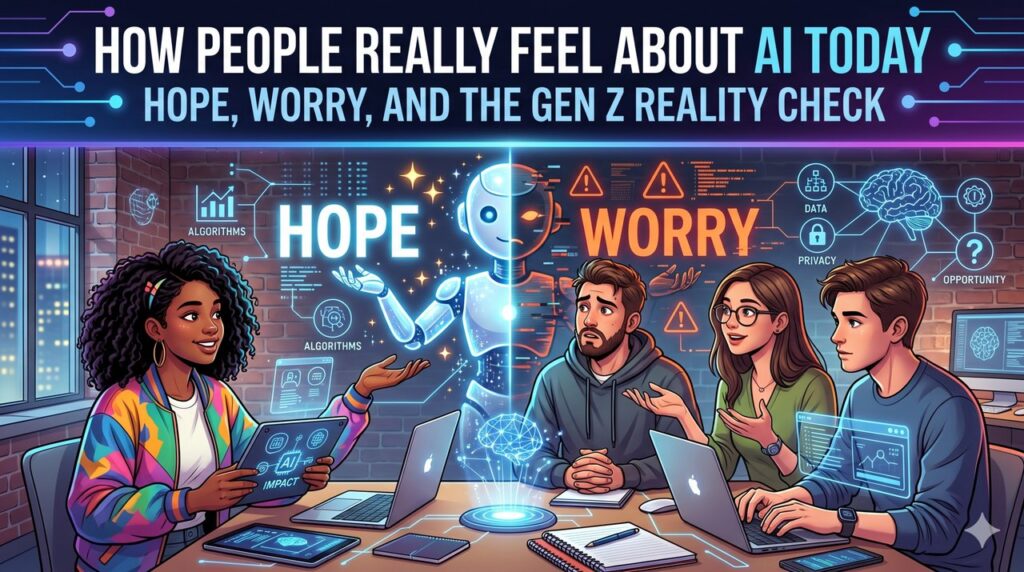
The younger population, especially Gen Z and younger millennials, sits right in the middle of that tension. They are often the quickest to try new AI tools, but they are not blindly cheerful about the future. In fact, their view may be the most realistic one: AI is useful, AI is not going away, and AI could make life better or worse depending on how people, schools, companies, and governments choose to use it.
That is the big story of the AI outlook today. The conversation is no longer just “Is AI amazing?” or “Is AI dangerous?” It is becoming more practical: Who benefits? Who gets left behind? What skills will matter? Can we trust the information we see? And will young people entering school, college, and the workforce get the guidance they need?
Why AI Feels Exciting and Unsettling at the Same Time
Most people can now see at least one obvious benefit of AI. It can summarize long documents, translate language, brainstorm ideas, write code, generate images, organize notes, personalize tutoring, and help workers move faster through repetitive tasks. For many people, that first useful experience changes the conversation. AI stops sounding like science fiction and starts feeling like a very capable assistant.
At the same time, usefulness does not erase concern. Pew Research Center has found that Americans are often more worried than excited about AI in major areas of life, particularly jobs and education. In a 2025 Pew report comparing the public with AI experts, the public was much more concerned about job loss than experts were. That gap matters because ordinary people are not judging AI only by what it can technically do. They are judging it by whether it will make rent easier to pay, whether it will make school fairer, and whether it will create a future that feels stable.
That is especially true in the workplace. AI can make employees more productive, but it can also make people wonder whether productivity gains will be shared with workers or used mainly to reduce headcount. A young person applying for a first job may hear that AI creates new opportunities, but they may also notice that entry-level roles are already competitive. When AI is described as a tool that can do “junior” work, it is reasonable for students and new workers to ask where they are supposed to get experience.
This is why the AI outlook is not simply positive or negative. It is conditional. People tend to like AI when it helps them learn, create, save time, or solve a real problem. They become skeptical when it feels like a black box making decisions about jobs, grades, loans, medical care, or personal data. They are not rejecting technology. They are asking for accountability.
Gen Z Is Using AI, but They Want Guardrails
Younger people are often described as digital natives, but that phrase can hide more than it explains. Gen Z may be comfortable trying new tools, yet comfort is not the same as confidence. Many young people are using AI because it is useful and because the world around them is already changing. That does not mean they feel fully prepared for what comes next.
Recent surveys show just how active younger users have become. Deloitte’s 2025 Gen Z and Millennial Survey reported that many Gen Z and millennial respondents who use generative AI are already using it in daily work to some extent. AP-NORC polling in 2025 also found that adults under 30 were more likely than the overall public to use AI for finding information. Gallup and its partners have reported steady weekly use among Gen Z as well, while also noting that skepticism has grown.
That combination is important: use is high, but trust is not automatic. Young people may ask AI for help outlining an essay, preparing for an interview, learning a technical concept, editing a resume, or exploring a creative idea. At the same time, they are hearing that AI may disrupt the careers they are preparing for. They are being told to master a technology that might also change the value of the work they hope to do.
For students, AI creates a complicated picture. On one hand, it can act like a patient tutor. It can explain algebra in three different ways, help a student practice Spanish, or turn a confusing paragraph into something easier to understand. Used well, AI could make education more personal and more accessible.
On the other hand, schools are still figuring out the rules. Some classrooms encourage AI for brainstorming or feedback. Others ban it entirely. Many students are stuck in the middle, unsure whether using AI makes them resourceful or dishonest. That confusion can create anxiety, especially when the consequences for misuse are serious but the guidance is vague.
Young workers face a similar problem. They know AI skills may help them stand out, but they also know that technical ability alone will not be enough. Deloitte’s 2025 survey found that more than eight in 10 Gen Z and millennial respondents believe soft skills such as empathy and leadership are becoming even more important as people work alongside generative AI. That is a strong signal. Younger generations are thinking about what remains deeply human in a more automated workplace.
This may be the most hopeful part of the AI outlook among young people. Many are asking which human abilities will matter more: judgment, communication, ethics, creativity, taste, adaptability, collaboration, and the ability to ask better questions. In other words, AI literacy is becoming more than prompting a chatbot. It is learning when to use AI, when not to use it, and how to stay responsible for the result.
The Outlook: Practical Optimism, Better Rules, and New Skills
So what is the outlook on AI today? The best answer may be “practical optimism.” People can see the upside, but they want the upside to be managed carefully. They want AI that helps doctors, teachers, small businesses, researchers, workers, and students. They are less enthusiastic about AI that replaces human contact, weakens privacy, spreads false information, or turns important decisions into automated guesses.
For younger generations, the stakes are especially personal. Gen Z is entering college, training programs, and careers during the fastest technology shift in decades. If schools and employers give them clear guidance, AI could become a powerful learning partner and productivity tool. If institutions leave them to figure it out alone, AI could deepen stress and inequality. The support system around the technology matters just as much as the technology itself.
There are three practical things that would improve the AI outlook quickly. First, schools should teach AI literacy openly. Students need to know how these tools work, where they fail, how to cite or disclose AI help, and how to protect their own thinking. Second, employers should be honest about how AI will affect hiring, training, productivity expectations, and career paths. Young workers can adapt, but they need a real ladder to climb. Third, policymakers and companies need rules that protect people from the riskiest uses of AI, especially in decisions involving employment, education, health, finance, and personal data.
None of this means slowing innovation to a crawl. It means making innovation easier to trust. People are more likely to welcome AI when they believe someone is responsible for the outcome. That responsibility cannot fall only on users, especially young users. It has to be shared by developers, schools, employers, platforms, and public leaders.
But today’s public outlook contains a valuable message: people are not asking for a future without AI. They are asking for a future with better AI, clearer rules, and a more human sense of purpose. Younger people, in particular, seem ready to use the tools. What they want in return is guidance, fairness, and a believable path forward.
Sources and further reading: Pew Research Center on public and expert views of AI, Pew Research Center on AI in Americans’ lives, Deloitte’s 2025 Gen Z and Millennial Survey, Gallup on Gen Z AI adoption and skepticism, and AP-NORC reporting on how U.S. adults use AI.