


Are AI entry-level jobs disappearing in 2026? Until recently, that question produced more heat than light. One side predicted that artificial intelligence would wipe out junior office work. The other pointed to a low national unemployment rate and said the panic was overblown. New evidence suggests that both views miss the most important part of the story.
There is no economy-wide collapse in employment. Most businesses using AI say they are augmenting workers, not eliminating them. At the same time, several new studies find unusually weak hiring and earnings for young workers in the industries and college majors most exposed to generative AI. That combination is possible if companies keep most of their experienced employees but hire fewer beginners.
In other words, AI may be changing the labor market first through the front door. The first rung of the career ladder is getting narrower even when the rest of the ladder still looks intact.
This article looks at what the 2026 hiring data actually says, what it cannot prove, which jobs appear most exposed, and what students, new graduates, employers, and colleges can do about it.
The 2026 Job Market Is Not Collapsing, but New Graduates Feel the Squeeze
Start with the broad economy. The Bureau of Labor Statistics reported that the unemployment rate was 4.1% in August 2026 and employers added 162,000 jobs. Those are not depression numbers or even recession numbers. Manufacturing continued to add jobs, healthcare employment edged higher, and average hourly earnings rose 3.1% over the year.
But the headline average hides an uneven market. Information employment fell by 23,000 in August, including losses in data processing, publishing, broadcasting, and related services. These are areas where software and generative AI can change digital workflows quickly.
Recent graduates are also having a rougher experience than the typical worker. The Federal Reserve Bank of New York estimated that unemployment among recent college graduates was about 5.6% in the second quarter of 2026. Their underemployment rate reached 42%, meaning a large share of employed graduates were working in jobs that typically do not require a college degree.
That gap does not prove AI caused the problem. Entry-level hiring was already affected by the pandemic, remote work, higher interest rates, slower white-collar hiring, and a surge of people earning degrees. Still, the timing and concentration of the recent weakness deserve attention.
The Federal Reserve’s latest household well-being report adds some human context. Fifteen percent of adults under 30 who were not working said an inability to find work contributed to their situation. At the same time, one in four workers had used generative AI at work during the previous month, and 81% of those users said it saved them time. AI is not merely a future possibility. It is already part of ordinary production.
The Strongest Evidence That AI Is Reducing Entry-Level Hiring
The most striking evidence comes from a 2026 U.S. Census Bureau working paper with the blunt title “You’re (not) Hired.” Researcher Lee C. Tucker used matched employer-employee administrative data to compare early-career hiring across industries and states with different levels of AI exposure.
The study found that regression-adjusted employment for workers ages 22 to 24 declined 12% over the ten quarters after ChatGPT’s release in the most AI-exposed fifth of industry-state groups. Employment in less-exposed industries remained comparatively stable. The main mechanism was not a sudden wave of dismissals. It was fewer hires.
That distinction matters. A company can introduce AI without firing its current analysts, developers, marketers, or support representatives. It may simply decide that a team of eight experienced workers using AI can handle work that previously required eight experienced workers and two juniors. Nothing dramatic appears in a layoff announcement, but two career openings quietly disappear.
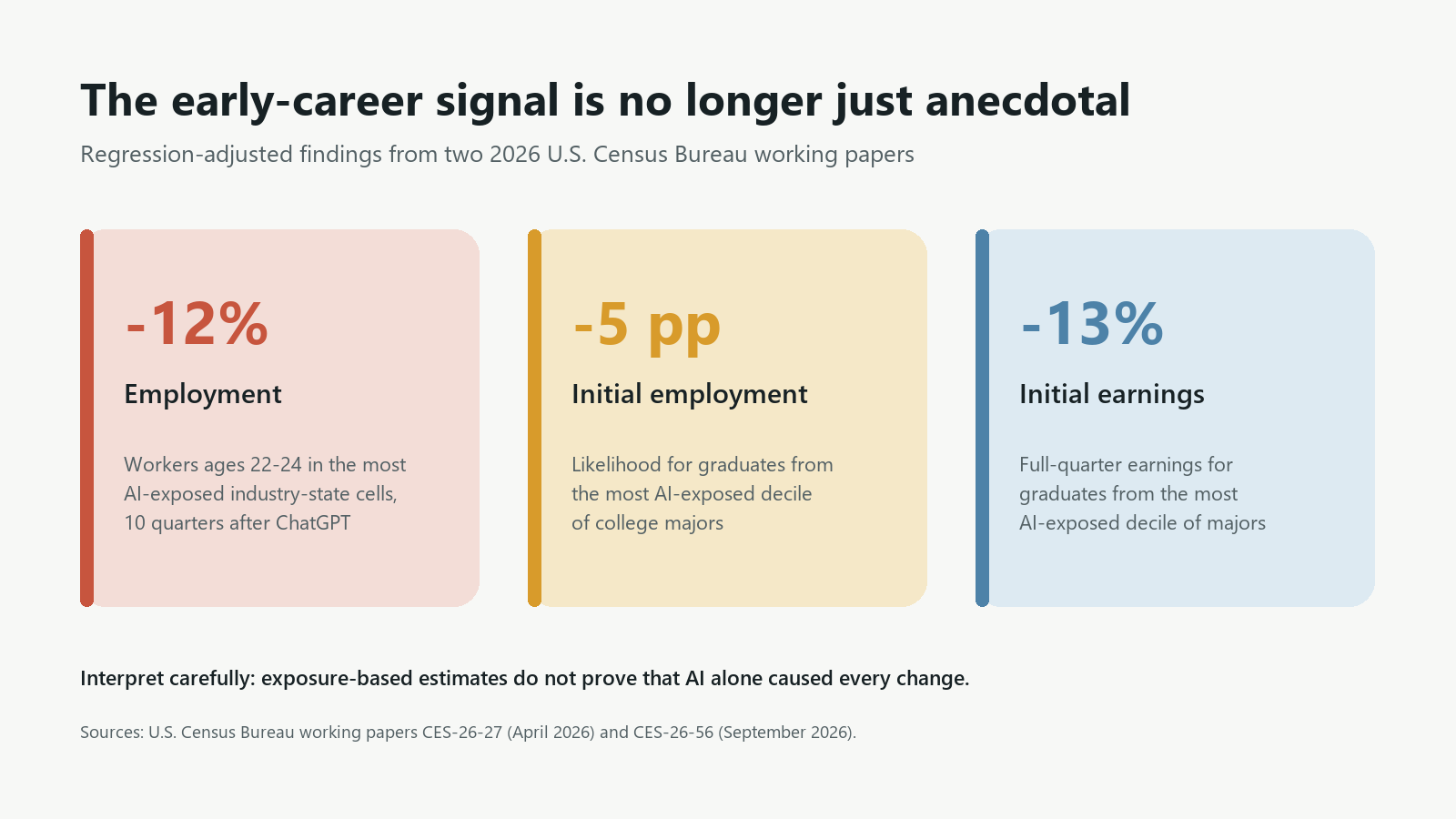
A second Census Bureau paper, “Graduating into Disruption,” followed graduates from college majors with different levels of labor-market AI exposure. Among the most exposed tenth of majors, the regression-adjusted probability of initial employment fell by five percentage points after late 2022, while full-quarter initial earnings fell 13%.
The earnings effect was comparable to the penalty associated with graduating into a large recession. About half came from weaker earnings within the industries employing those graduates. The rest reflected graduates shifting toward lower-wage sectors such as retail and restaurants. The effects became smaller as graduates gained distance from labor-market entry, but they did not disappear immediately.
Together, these studies make the AI entry-level jobs debate more serious. They use administrative employment records rather than anecdotes or online job postings, and they identify larger changes where AI exposure is higher. That is stronger evidence than simply noticing that a technology company stopped hiring.
Why the Research Still Does Not Prove That AI Caused Everything
Good research can be persuasive without being final. Both Census studies are working papers, which means their methods and conclusions should continue to be tested. More importantly, AI arrived during an unusually messy economic period.
Interest rates rose sharply in 2022 and 2023. Technology firms corrected after pandemic-era overhiring. Remote work changed how companies train and supervise beginners. More young adults stayed in school, and employers shifted toward experienced candidates. The first Census study found evidence that some relative declines began around the start of the pandemic, before ChatGPT. Its monetary-policy analysis suggested that interest-rate shocks could explain up to one-quarter of the relative early-career employment decline through mid-2025.
However, those alternative explanations did not fully account for the abrupt hiring decline at the most AI-exposed employers after ChatGPT appeared. The sensible conclusion is neither “AI had no effect” nor “AI caused every missing job.” The data is consistent with AI adding pressure to an entry-level labor market that was already changing.
Most Companies Using AI Are Not Cutting Jobs
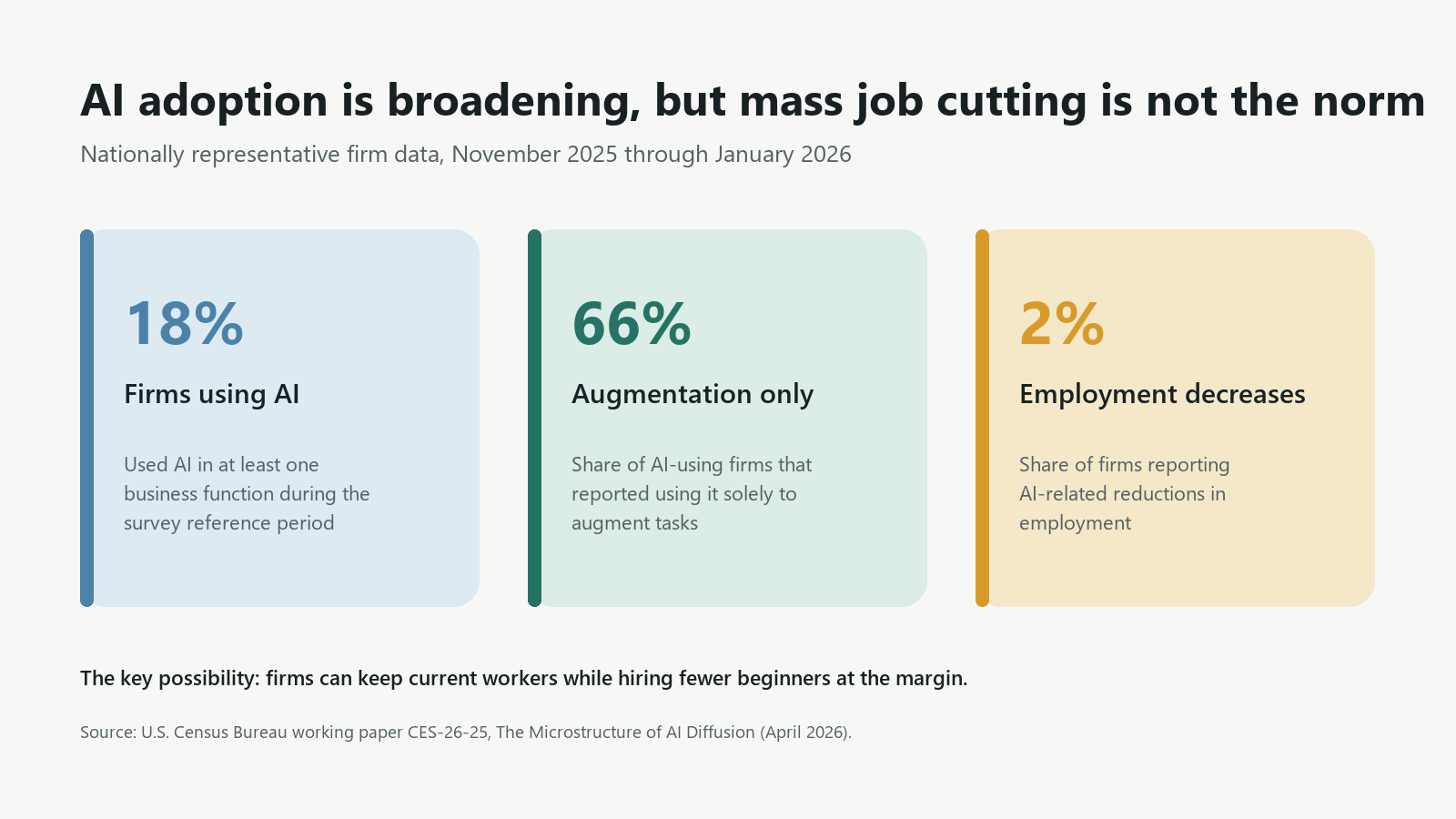
Here is the apparent contradiction. Another 2026 Census Bureau study, “The Microstructure of AI Diffusion,” used nationally representative business survey data collected from November 2025 through January 2026. It found that 18% of firms used AI in at least one business function, rising to 32% when firms were weighted by employment.
Among AI-using firms, 66% said they used it solely to augment tasks. Only 2% reported AI-related employment decreases. Most adopters were also using AI narrowly: 57% had deployed it in three or fewer business functions, and 65% limited use to three or fewer worker tasks.
This is why sweeping claims about AI eliminating all work are premature. Adoption remains partial, augmentation is more common than direct replacement, and many organizations are still experimenting. The World Economic Forum nevertheless estimates that more than one in three young workers globally are in occupations with medium-to-high exposure to AI-driven task change.
The bridge between the two findings is the difference between employment levels and hiring flows. Companies may retain trusted employees who understand their systems, clients, and risks. When a vacancy appears, however, managers can ask whether AI lets the existing team absorb the workload. Entry-level openings are discretionary in a way that many existing jobs are not.
Why Entry-Level Work Is Especially Exposed
Junior office jobs often contain exactly the tasks generative AI handles best: producing first drafts, summarizing documents, searching for information, cleaning spreadsheets, writing routine code, preparing presentation outlines, classifying support tickets, and turning templates into finished-looking work.
That does not mean AI performs those tasks perfectly. It means AI can produce a cheap starting point. A senior worker who already knows what a good answer looks like can review that starting point faster than a beginner can create it from scratch. From an employer’s perspective, the combination may look efficient.
There is a catch. Entry-level work has never been only about output. It is also how beginners become experts. A junior accountant learns by reconciling accounts. A new developer learns by fixing small bugs. A beginning researcher learns by checking sources. A marketing assistant learns by watching which messages customers respond to.
If AI removes every basic assignment, employers may save money today while weakening tomorrow’s talent pipeline. Senior employees do not materialize fully trained. They are produced through repetition, feedback, mistakes, and gradually increasing responsibility.
Which Entry-Level Jobs Face the Most Pressure?
Exposure is generally highest where work is digital, repeatable, language-heavy, and easy to check after the fact. That can include portions of junior software development, basic financial analysis, clerical processing, customer support, market research, document review, copywriting, translation, and administrative coordination.
But job titles can mislead. A junior marketer who only rewrites product descriptions is highly exposed. A junior marketer who interviews customers, analyzes campaign data, visits stores, and coordinates a complicated launch is less so. A new programmer writing routine boilerplate faces more pressure than one who can debug production systems, understand security constraints, and talk to users.
Many fast-growing occupations combine technology with physical work, regulation, trust, or specialized judgment. The latest BLS projections for 2025-2035 include nurse practitioners, solar installers, data scientists, medical and health services managers, information security analysts, industrial machinery mechanics, and logisticians. AI may change all of these jobs, but demand for the underlying service can still grow.
That is why students should not pick a major by asking whether AI can perform one visible task. A better approach is to consider the whole bundle: demand for the service, licensing requirements, physical presence, responsibility for outcomes, customer trust, and whether AI complements the worker. Our guides to the best college majors for career prospects and AI-proof skills in 2026 explore that broader calculation.
What Students and New Graduates Can Do Now
The wrong response is panic. Switching majors every time a new model is released is a good way to spend more tuition without becoming more employable. A better response is to make your value easier to see.
- Learn to use AI without becoming dependent on it. Use it for research plans, drafts, data cleanup, code review, comparison, and practice. Then verify its work. Employers need people who can catch a confident mistake.
- Build proof, not just credentials. Create a portfolio showing the problem, your process, the tools you used, the sources you checked, and the measurable result. A thoughtful case study says more than “proficient in AI” on a resume.
- Add domain knowledge. AI plus accounting, healthcare, energy, logistics, cybersecurity, manufacturing, or public policy is more valuable than generic AI enthusiasm. Tools become powerful when paired with context.
- Seek work with real constraints. Internships, campus organizations, nonprofits, laboratories, local businesses, and freelance projects expose you to deadlines, incomplete information, customer needs, and accountability.
- Practice explaining and defending your work. If an interviewer asks why you chose a method, source, or recommendation, you should be able to answer without asking a chatbot.
- Broaden the first rung. Your ideal title may be scarce. An adjacent role can still build relevant industry knowledge, relationships, and evidence of reliability.
Networking also matters more when formal openings shrink. This does not mean collecting hundreds of shallow online connections. It means talking with professors, former interns, local employers, professional groups, and people doing the work you want to do. When managers are cautious about hiring, a credible referral lowers perceived risk.
Employers Should Redesign the First Rung, Not Remove It
Employers have a responsibility here too, even from a purely self-interested business perspective. Eliminating junior roles can improve this quarter’s productivity numbers while creating a shortage of experienced talent several years later.
A stronger model is an AI-enabled apprenticeship. Let junior workers use AI for the mechanical portion of a task, but make them responsible for verification, source quality, edge cases, customer context, and presenting the conclusion. Rotate them through functions so they understand how the organization works. Measure whether they can reason, not whether they can type a first draft without help.
Managers should also track who receives the productivity benefit. If experienced workers capture all AI-enabled work while beginners lose access to learning opportunities, the company is consuming skills without replenishing them. Mentoring, structured review, and progressively harder assignments are investments in future capacity.
Colleges face a similar choice. Pretending students will never use AI is unrealistic. Allowing AI-generated work with no verification is equally unhelpful. Courses can require students to document their process, check citations, defend decisions orally, reproduce key steps, and work with real data or clients. The goal is not to preserve busywork. It is to preserve learning.
What Evidence Should We Watch Next?
The AI labor market is moving too quickly for one paper or one monthly jobs report to settle the issue. Over the next few years, five indicators will be especially useful:
- Hiring rates for workers ages 22 to 27 in highly exposed occupations
- Starting wages and time required to find a first career-track job
- Whether employers replace junior tasks with better training or simply remove the position
- Promotion rates for young workers who use AI compared with those who do not
- Whether early disadvantages fade with experience or permanently reduce earnings
Worker attitudes are worth following as well. A September 2026 Federal Reserve Bank of Boston analysis found that the share of workers worried about losing their own job to AI doubled from 5% in 2024 to just over 10% in 2025. Sixty percent expected AI-related layoffs or employment reductions somewhere in their industry. Fear is not proof, but it can affect spending, saving, career choices, and political pressure.
The Bottom Line on AI and Entry-Level Jobs in 2026
Is AI replacing entry-level jobs? The most honest answer is: in some highly exposed parts of the labor market, it appears to be reducing hiring opportunities and weakening early earnings. The effect is meaningful enough to take seriously, especially for new graduates. But it is not evidence that AI has caused a universal employment collapse.
Most firms still use AI to augment people. Few report AI-related job cuts. The broader economy continues to add jobs, and many occupations that combine technical knowledge with judgment, physical work, trust, or accountability are projected to grow.
The real danger is subtler than mass unemployment. It is a labor market that becomes efficient at producing work but forgets how to produce experienced workers. If businesses, schools, and young people redesign the first rung instead of pretending nothing has changed, AI can become part of an apprenticeship rather than the end of one.
Sources and Further Reading
- U.S. Census Bureau: You’re (not) Hired
- U.S. Census Bureau: Graduating into Disruption
- U.S. Census Bureau: The Microstructure of AI Diffusion
- BLS Employment Situation, August 2026
- New York Fed: Labor Market for Recent College Graduates
- Federal Reserve: Economic Well-Being of U.S. Households
- World Economic Forum: AI and the Future of Entry-Level Work
- BLS: Fastest-Growing Occupations, 2025-2035