
AI-proof skills in 2026 are not about hiding from artificial intelligence. They are about becoming the kind of person AI makes more valuable. That is a different, calmer, and much more useful goal than trying to find a job no software will ever touch.
The phrase “AI-proof career” is popular because people are anxious. That anxiety is understandable. AI can write drafts, summarize meetings, generate code, analyze spreadsheets, make images, answer customer questions, and automate repetitive office work. If your job is mostly routine digital output, the pressure is real. But the better question is not “What job is safe forever?” It is “What skill stack makes me harder to replace and easier to trust?”
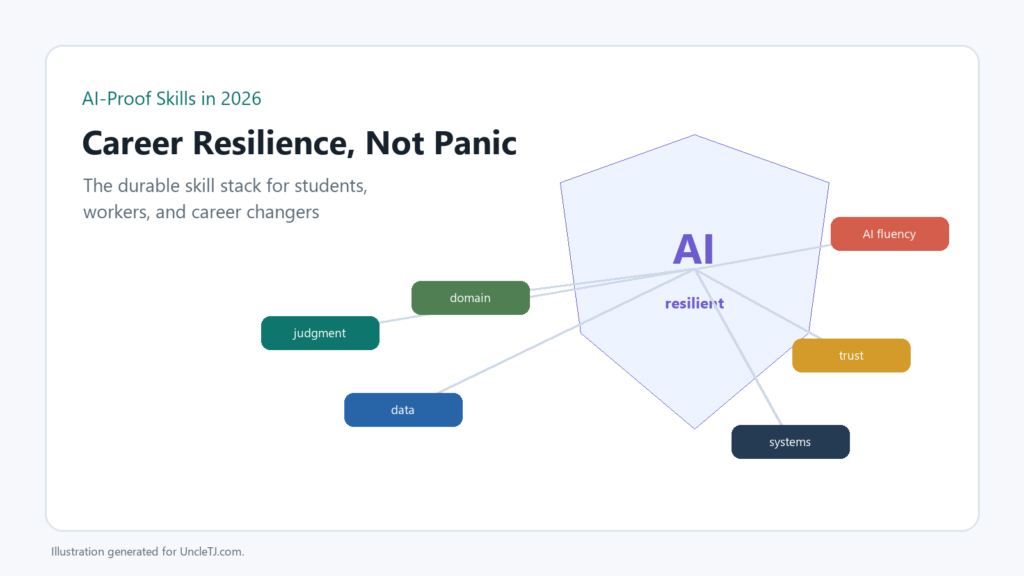
The short answer: the most future-proof workers combine AI fluency, domain expertise, judgment, communication, data literacy, adaptability, and real accountability. No single skill is magic. The advantage comes from the combination.
Why “AI-Proof Job” Is the Wrong Question
Jobs are bundles of tasks. AI usually changes tasks before it replaces entire occupations. A lawyer may use AI to summarize discovery. A nurse may use AI-assisted charting. A teacher may use AI to draft lesson materials. A software developer may use AI to write boilerplate code. In each case, the job changes because some tasks become faster, cheaper, or more automated.
That is why a job title alone is a weak shield. “Marketing,” “accounting,” “software,” “education,” and “design” can all be more or less exposed depending on the actual work. A marketer who only writes generic social posts is more exposed than a marketer who understands customers, analytics, positioning, pricing, and sales strategy. A programmer who only completes small tickets is more exposed than one who can design systems, debug messy failures, talk to users, and secure production code.
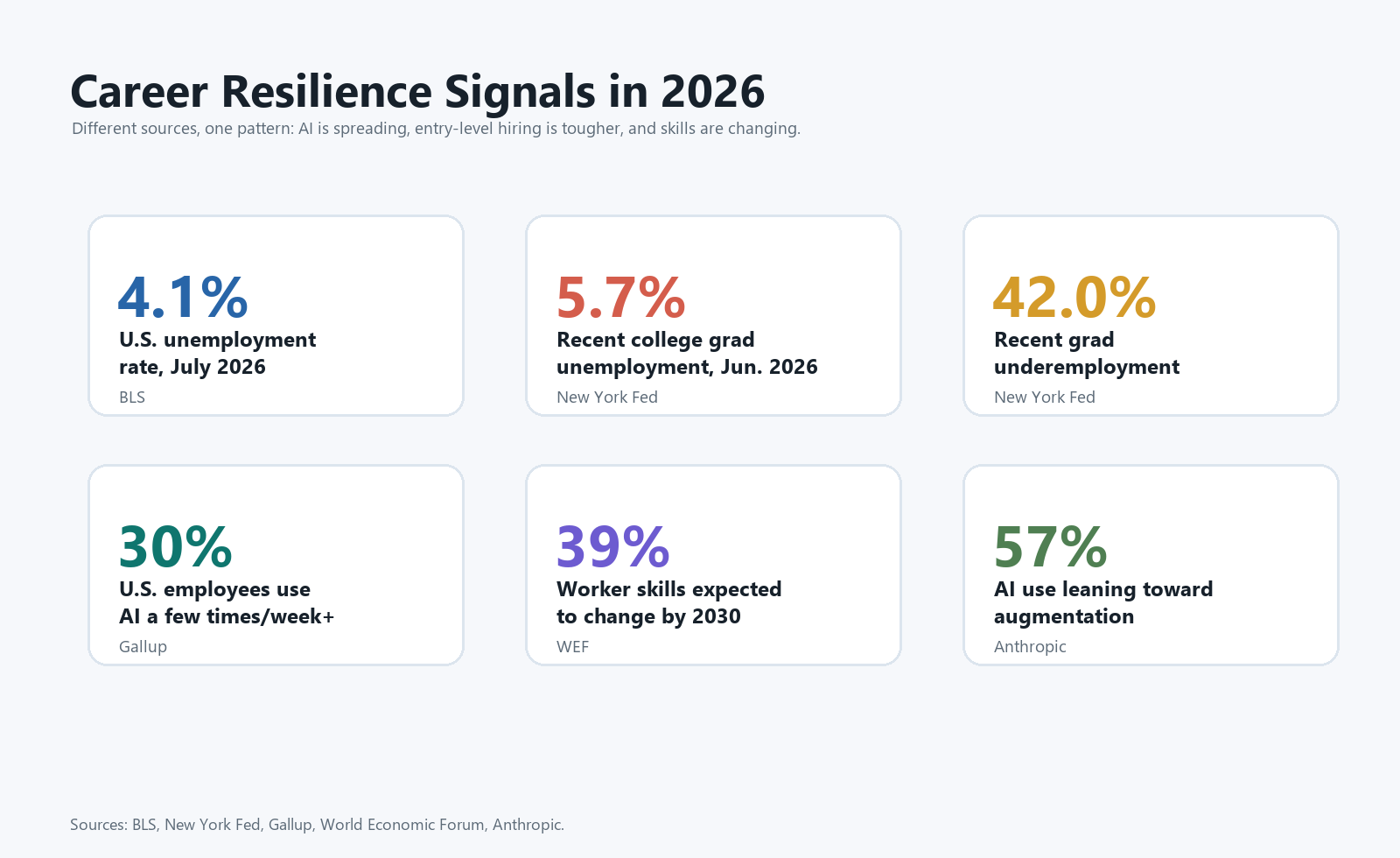
The same pattern shows up in labor-market research. The Anthropic Economic Index found that AI use is concentrated in certain task areas and leans toward augmentation more than full automation. In its early findings, Anthropic reported about 57% augmentation versus 43% automation. That does not mean automation risk is fake. It means many people are already using AI as a collaborator, checker, generator, and accelerant.
The 2026 Job Market Context
The broader labor market is not collapsing, but it is slower and more selective than it was during the hottest post-pandemic hiring years. The Bureau of Labor Statistics Employment Situation for July 2026 reported a 4.1% unemployment rate and little change in payroll employment. Health care continued to trend up, while some other categories weakened.
For new graduates, the transition is especially bumpy. The New York Fed’s Labor Market for Recent College Graduates showed recent-college-graduate unemployment around 5.7% in June 2026 and underemployment around 42.0%. In plain English, many new graduates are working, but a large share are not yet in jobs that fully use a degree.
At the same time, AI is moving from novelty to workplace tool. Gallup’s AI indicator reported that, as of May 2026, 15% of U.S. employees use AI daily in their role, 30% use it a few times a week or more, and 52% use it at least a few times a year. That means AI skills are no longer only for tech workers. They are becoming basic workplace literacy.
The AI-Proof Skill Stack
The most resilient careers in 2026 are built around skill stacks. A skill stack is a group of abilities that reinforce one another. AI fluency is useful. AI fluency plus accounting knowledge is better. AI fluency plus nursing judgment, patient communication, and clinical responsibility is better still. AI fluency plus data literacy, industry context, and leadership is the kind of combination employers notice.
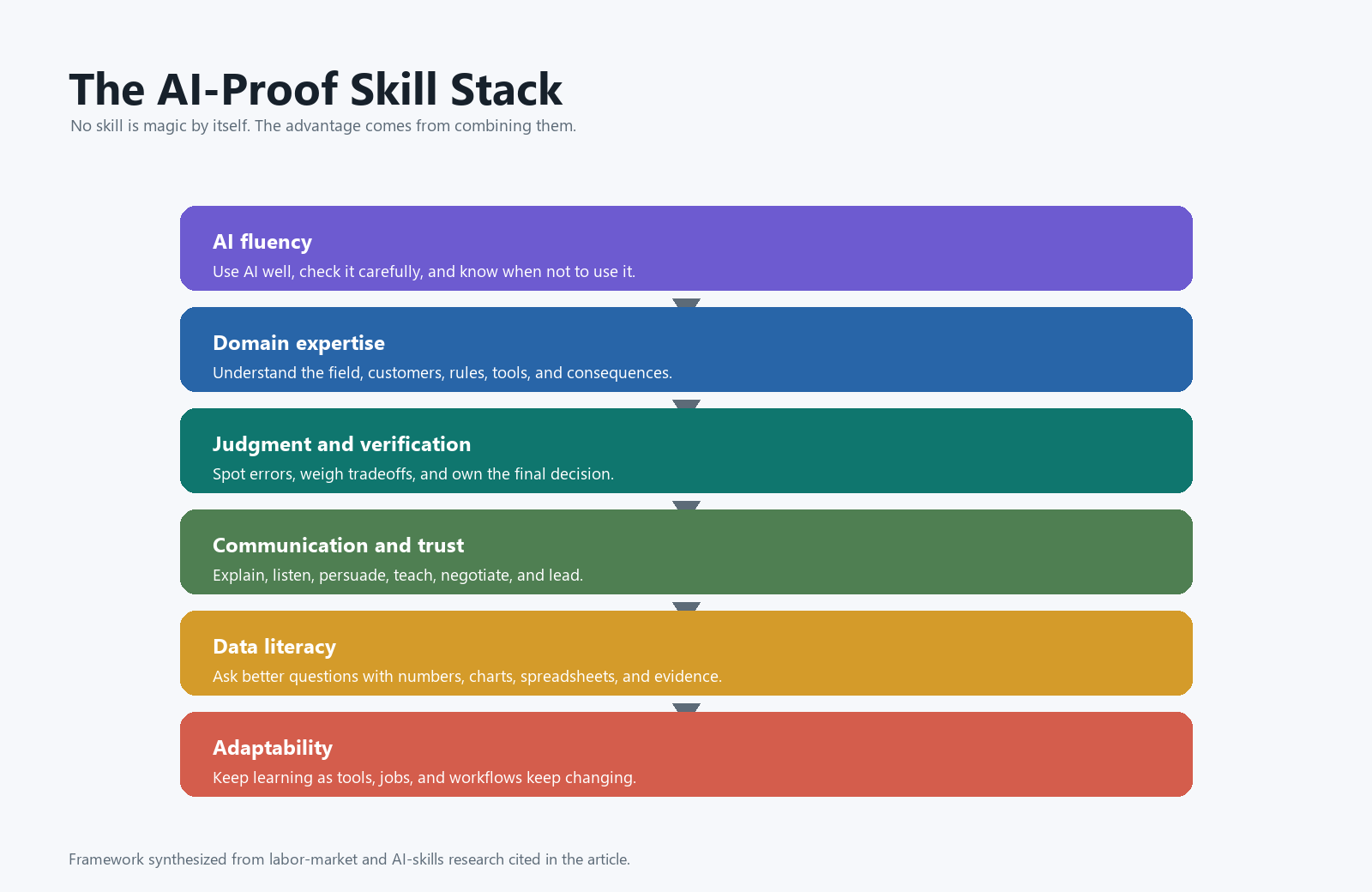
The stack below is not only for college students. It works for mid-career workers, freelancers, managers, tradespeople, teachers, analysts, and small-business owners too. The details change by field, but the pattern stays the same: learn the tool, understand the domain, make better decisions, communicate clearly, and keep improving.
1. AI Fluency Without AI Dependence
AI fluency means knowing how to use AI tools productively, safely, and skeptically. It is not just prompt writing. It includes choosing the right tool, giving useful context, checking outputs, protecting private information, and understanding when a task should stay human.
This matters because employers increasingly expect workers to use AI as leverage. The LinkedIn 2026 labor-market report says jobs requiring AI literacy skills have grown sharply, and that digital and data literacy are becoming baseline expectations across technical and nontechnical jobs.
The mistake is becoming dependent on AI instead of stronger because of it. If you cannot tell whether an AI answer is wrong, you are not AI-proof. You are AI-fragile. The resilient worker uses AI to draft, compare, brainstorm, summarize, test, translate, and speed up work, but still owns the result.
2. Judgment and Quality Control
As AI produces more first drafts, human value shifts toward judgment. Can you tell what is true? Can you spot a missing assumption? Can you decide which tradeoff matters? Can you see the legal, ethical, financial, or customer-service risk hiding inside a polished answer?
Microsoft’s 2026 Work Trend Index makes this point directly. In its research, workers identified quality control of AI output and critical thinking as two of the most important human skills as AI takes on more work. That rings true. AI can sound confident when it is wrong. Someone still has to be responsible for the final decision.
Quality control is not glamorous, but it is powerful. The future belongs partly to people who can say, “This looks good, but here is the hidden problem.” That is true in software, healthcare, finance, law, education, marketing, journalism, engineering, and management.
3. Domain Expertise: Knowing the Field Deeply
Domain expertise is the difference between a generic AI answer and a useful professional answer. AI can describe tax rules, but an experienced accountant knows the client, the documentation, the audit risk, and the gray areas. AI can summarize symptoms, but a clinician knows what to ask next, what cannot be missed, and when a patient does not fit the neat pattern.
This is why “learn AI” is incomplete advice. Learn AI plus something. AI plus nursing. AI plus construction estimating. AI plus supply chain. AI plus cybersecurity. AI plus teaching. AI plus insurance. AI plus manufacturing. AI plus energy. AI plus public policy. The deeper the field knowledge, the more useful the AI becomes in your hands.
Domain expertise also creates accountability. Employers do not only need someone who can produce text or code. They need someone who understands consequences. In regulated fields, safety-critical work, customer-facing roles, and complex operations, consequences are the job.
4. Communication, Trust, and Human Relationships
AI can write a message, but it does not own a relationship. It does not build long-term trust with a client, calm an upset customer, coach an employee through a hard quarter, convince a team to change direction, or explain bad news with empathy.
That is why communication remains one of the most durable skills. Not decorative communication, like stuffing a resume with buzzwords. Real communication: listening, asking better questions, summarizing complexity, adapting to your audience, persuading without manipulating, and making people feel understood.
The World Economic Forum’s Future of Jobs Report 2025 lists analytical thinking, resilience, flexibility, leadership, social influence, curiosity, and lifelong learning among important and rising skills. That is a useful reminder that the future of work is not only technical. People still work with people.
5. Data Literacy and Analytical Thinking
Data literacy does not mean everyone needs to become a data scientist. It means you can read a chart, question a metric, understand averages and outliers, use spreadsheets, spot correlation-versus-causation mistakes, and explain what the numbers do and do not prove.
This is one of the best AI-proof skills because AI often produces plausible analysis without understanding the business decision behind it. A resilient worker can ask: What data is missing? Is the sample biased? What would change my mind? What is the base rate? What does the customer actually care about? What decision are we trying to make?
Data literacy pairs especially well with business, healthcare, education, logistics, marketing, finance, HR, public policy, and operations. You do not have to be the most technical person in the room to be valuable. Sometimes you just need to be the person who asks the clarifying question that saves everyone from a bad dashboard.
6. Systems Thinking and Workflow Design
AI is powerful at individual tasks, but real work happens inside systems. A hospital, school, warehouse, law firm, software company, restaurant, city agency, or small business is a web of people, incentives, tools, rules, bottlenecks, and handoffs. If you understand the system, you can see where AI helps and where it creates risk.
Systems thinkers ask better questions: What happens before this task? What happens after? Who checks it? What failure would be expensive? What should be automated, and what should be reviewed by a person? Where is the real bottleneck? What behavior will this metric encourage?
This is why managers, operations people, product managers, nurses, engineers, accountants, teachers, and experienced administrators can become extremely valuable in AI transitions. They do not just use a tool. They redesign how work moves.
7. Adaptability and Learning Speed
The World Economic Forum estimates that about 39% of workers’ existing skill sets will be transformed or become outdated over the 2025-2030 period. That is not a reason to panic. It is a reason to stop thinking of education as something that ends at graduation.
Adaptability is not vague positivity. It is a practical habit: learn a tool, try it on real work, compare results, ask for feedback, update your process, and repeat. The people who do this every month will look very different after two years. The people who wait for an employer to hand them a perfect training plan may fall behind.
One underrated tactic is to build tiny learning projects. Automate a weekly report. Create a personal knowledge base. Use AI to compare job descriptions and identify missing skills. Build a small dashboard. Rewrite a messy process. Practice explaining technical topics to nontechnical people. Small projects turn “I should learn AI” into evidence.
Which Careers Benefit Most From This Skill Stack?
Some fields naturally reward the AI-proof skill stack. Healthcare workers combine technical knowledge, trust, physical presence, and judgment. Accountants combine rules, verification, risk, and business context. Cybersecurity workers combine technical skill with adversarial thinking. Teachers combine domain knowledge, communication, classroom judgment, and human development. Engineers and construction managers combine math, physical systems, safety, and accountability.
Creative workers can benefit too, but the bar is changing. Generic output is getting cheaper. Taste, point of view, client understanding, editing, strategy, and distribution are becoming more important. A designer who only produces simple visuals is exposed. A designer who understands brand, user behavior, accessibility, business goals, and AI-assisted production is much harder to replace.
The same goes for office jobs. Administrative work that is mostly scheduling, formatting, copying, and routing information is exposed. But an executive assistant who manages relationships, protects priorities, understands operations, handles sensitive communication, and improves workflows is not the same as a calendar bot.
A 90-Day Plan to Build AI-Proof Skills
If you want to start without getting overwhelmed, try this simple 90-day plan.
- Days 1-15: Pick one AI tool and use it for low-risk work: outlines, summaries, brainstorming, spreadsheet explanations, practice interviews, or study guides.
- Days 16-30: Learn one verification habit. Check AI output against primary sources, rerun the math, ask for assumptions, or compare with your own answer.
- Days 31-50: Add data literacy. Build one useful spreadsheet, chart, dashboard, or personal tracker.
- Days 51-70: Apply AI to your field. Make a small project that solves a real problem in healthcare, finance, education, marketing, operations, coding, construction, or your current job.
- Days 71-90: Turn the project into proof. Write a one-page case study: the problem, your process, the tools used, what you checked, and what improved.
That last step matters. Employers do not just want claims. They want evidence. A portfolio, case study, GitHub repository, workflow redesign, dashboard, presentation, or measurable improvement gives you something concrete to talk about.
Quick FAQ: AI-Proof Skills in 2026
What is the most AI-proof skill?
Judgment is probably the most durable single skill, but it works best when paired with domain expertise and AI fluency. The person who can use AI, verify it, and make a responsible decision is much more valuable than someone who only prompts well.
Are creative jobs safe from AI?
Some creative tasks are highly exposed, especially generic writing, simple graphics, quick edits, and basic content repackaging. Creative careers become more resilient when they involve taste, strategy, client trust, storytelling, brand judgment, distribution, and a strong point of view.
Should students still learn technical skills?
Yes. Technical literacy is becoming more important, not less. But students should combine it with a real field: healthcare, accounting, engineering, education, law, cybersecurity, logistics, energy, finance, or operations.
Final Takeaway
The goal is not to become impossible to replace. That is too much pressure and not how careers work. The goal is to become increasingly useful as tools change. AI-proof skills in 2026 are really resilience skills: AI fluency, judgment, domain expertise, communication, data literacy, systems thinking, and adaptability.
If you build that stack, AI becomes less of a threat and more of a lever. You still have to keep learning. You still have to prove your value. But you are no longer waiting to see what automation does to you. You are learning how to direct it.
Sources and Further Reading
- BLS: Employment Situation Summary, July 2026
- Federal Reserve Bank of New York: Labor Market for Recent College Graduates
- Gallup: Artificial Intelligence Indicator
- World Economic Forum: Future of Jobs Report 2025
- Anthropic Economic Index
- Anthropic Economic Index: New Building Blocks for Understanding AI Use
- Microsoft Work Trend Index 2026
- LinkedIn Economic Graph: Labor Market Report 2026
- Pew Research Center: Americans and AI 2026
- Brookings: How AI May Reshape Career Pathways to Better Jobs