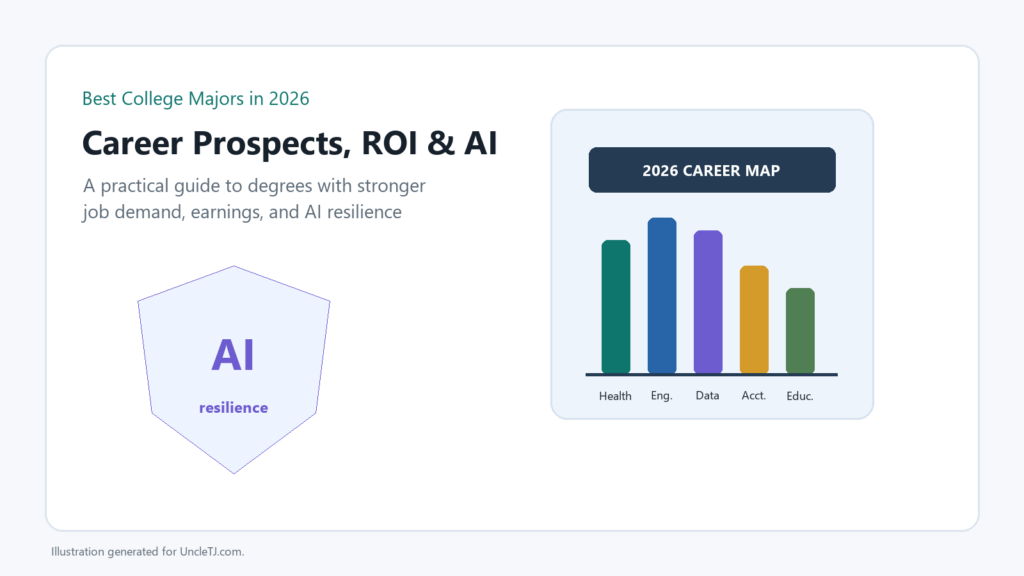

Best college majors in 2026 for career prospects is not the same question as “Which major sounds impressive?” or “Which major pays the most in a viral chart?” A good major in 2026 should help a student get through the first-job bottleneck, earn enough to justify the cost of college, and build skills that artificial intelligence is more likely to amplify than erase.
That makes the decision more nuanced than the old advice of “just pick STEM.” Some STEM fields still look excellent. Some computer-related majors are high-paying but crowded at the entry level. Some lower-paying majors, like special education, have surprisingly strong employment signals. And some flexible majors can work beautifully if the student adds internships, technical skills, licensing, or a graduate-school plan.
So here is the practical answer: the best majors for career prospects in 2026 are nursing and healthcare, engineering, construction and infrastructure-related fields, accounting, business analytics, cybersecurity, data science, computer science with real projects, finance/economics with quantitative skills, and selected education fields. The common thread is not prestige. It is a visible path from classroom to labor market.
The 2026 Job Market: Why Major Choice Feels More Important
The broad labor market is soft but not broken. The Bureau of Labor Statistics Employment Situation for July 2026 reported an unemployment rate of 4.1%, while nonfarm payroll employment changed little, declining by 23,000 jobs. Health care continued to trend up, while local government education and retail trade declined.
The problem for students is that the entry-level market can feel tougher than the headline unemployment rate. The New York Fed’s Labor Market for Recent College Graduates showed recent-college-graduate unemployment at about 5.7% in June 2026, compared with 2.9% for college graduates overall. Recent-grad underemployment was about 42.0%, meaning many graduates were working jobs that typically do not require a college degree.
That is why major choice matters. A student is not just choosing four years of classes. They are choosing a labor-market lane, a set of internships, a network, a skill bundle, and a story they will tell employers. In a slower hiring market, a clear story matters.
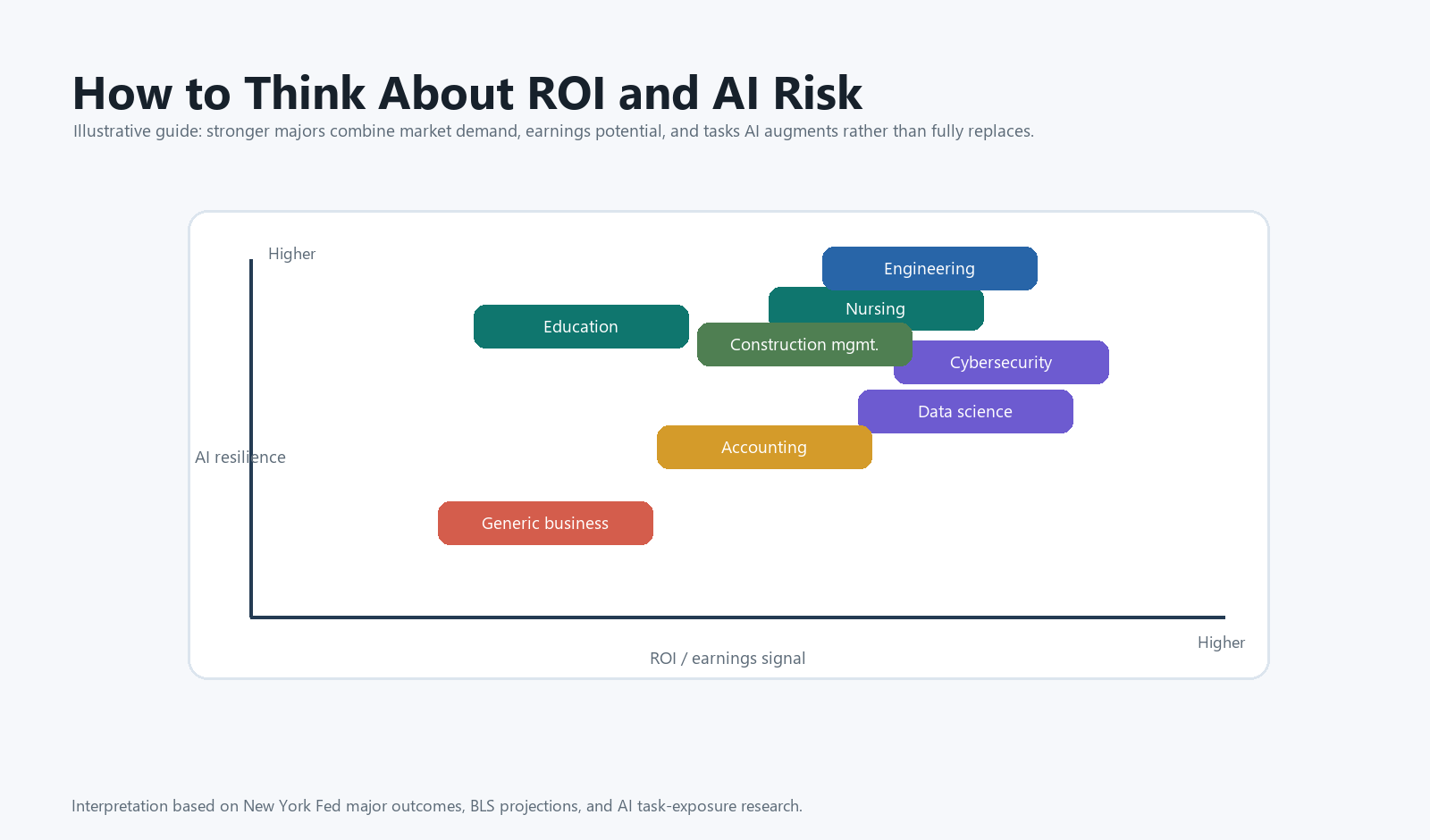
How to Judge a Major in 2026: ROI, Unemployment, and AI Risk
For this guide, “best” does not mean guaranteed. It means the major has a stronger mix of three signals.
- Return on investment: Does the major lead to wages that can justify tuition, debt, and time away from full-time work?
- Job access: Do graduates actually get degree-level jobs, or do many end up underemployed?
- AI resilience: Are the core tasks based on judgment, accountability, physical presence, regulation, human trust, or complex systems?
ROI is not just salary. A $90,000 early-career wage looks great, but if entry-level unemployment is high and the student needs extra bootcamps, unpaid internships, or graduate school, the real payoff is less automatic. Likewise, a lower-paying major can still be a rational choice if tuition is low, jobs are plentiful, benefits are strong, and the work fits the student’s life.
The Georgetown Center on Education and the Workforce’s 2025 Major Payoff report is helpful here. It found that prime-age workers with bachelor’s degrees earn much more than workers with only a high school diploma, but earnings vary widely by major. STEM, business, health, and engineering-related fields tend to sit near the top of the earnings distribution.
Best Overall Major: Nursing and Healthcare
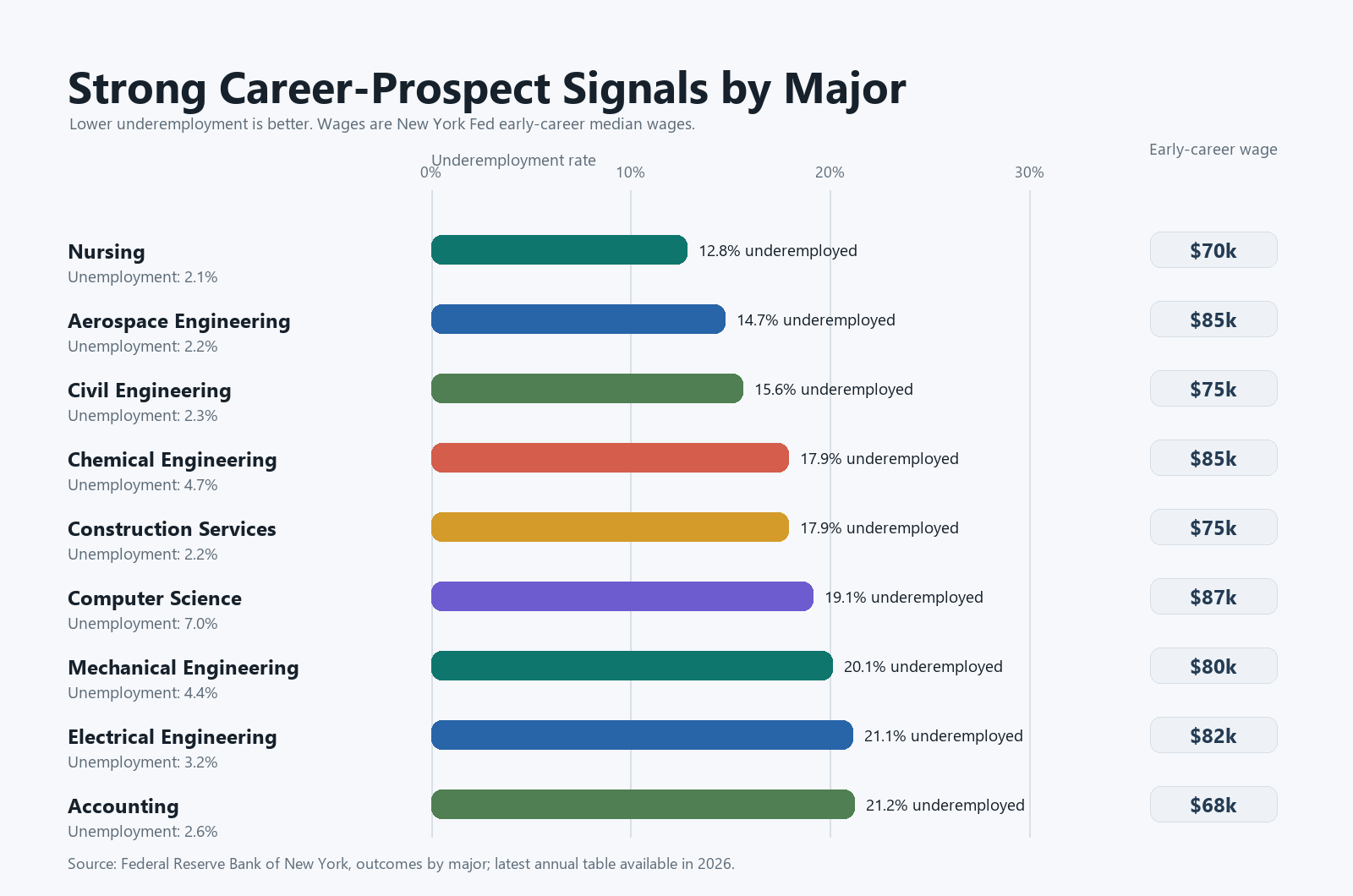
If we are judging by career prospects rather than glamour, nursing is hard to beat. In the New York Fed outcomes-by-major data, nursing has a 2.1% unemployment rate, 12.8% underemployment rate, and $70,000 early-career median wage. That combination is rare: strong job access, solid pay, and a clear credential path.
Healthcare also has demographic momentum. The BLS projects nurse practitioners to be among the fastest-growing occupations from 2024 to 2034, with 40.1% projected employment growth. Medical and health services managers, physician assistants, mental health roles, and health data roles also benefit from an aging population and a complex healthcare system.
AI will change healthcare, but it is unlikely to make human care disappear. Patients need physical exams, trust, communication, monitoring, empathy, and judgment. AI can help with documentation, imaging support, scheduling, triage, and pattern recognition, but licensed professionals remain central. That gives healthcare majors strong AI resilience.
Best High-ROI Majors: Engineering and Construction-Related Fields
Engineering remains one of the strongest choices for students who can handle the math and workload. Aerospace engineering, civil engineering, chemical engineering, mechanical engineering, and electrical engineering all show strong early-career wages in the New York Fed data, with many landing between $75,000 and $85,000 early in a career.
The appeal is not just salary. Engineering maps to real systems: power, water, transportation, buildings, manufacturing, chips, aerospace, energy, defense, and infrastructure. Those systems are expensive, regulated, and physically consequential. AI tools can help engineers design, simulate, draft, and troubleshoot, but they do not remove responsibility for real-world outcomes.
Construction services and construction management also deserve more respect than they usually get. The New York Fed table shows construction services with 2.2% unemployment, 17.9% underemployment, a $75,000 early-career wage, and a $120,000 mid-career wage. That is a strong ROI signal, especially for students who like projects, operations, estimating, scheduling, and physical-world problem solving.
Best AI-Adjacent Majors: Cybersecurity, Data Science, and Computer Science
Technology majors are still attractive in 2026, but the old “learn to code and relax” advice is outdated. Computer science and computer engineering have some of the highest early-career wages in the New York Fed table. Computer science shows an $87,000 early-career median wage, and computer engineering shows $90,000. That is the ROI upside.
The caution is unemployment. The latest major table shows elevated unemployment for recent graduates in computer science and computer engineering. That does not mean these majors are bad. It means the entry-level tech market is competitive, and students need proof of ability before graduation: internships, shipped projects, GitHub work, cloud labs, cybersecurity competitions, data portfolios, or domain-specific applications.
The BLS still projects strong demand for technology occupations. Data scientists are projected to grow 33.5% from 2024 to 2034, information security analysts 28.5%, and software developers much faster than the average occupation. The World Economic Forum’s Future of Jobs Report 2025 also identifies AI and big data, networks and cybersecurity, and technology literacy as among the fastest-growing skill areas.
The best tech major in 2026 is not simply “computer science.” It is computer science plus something: cybersecurity, healthcare data, finance, logistics, manufacturing, energy, product design, statistics, or AI systems. The more a student can connect code to an industry problem, the stronger the career prospects.
Best Business Majors: Accounting, Business Analytics, Finance, and Economics
Business is a huge category, so the specific major matters. Generic business management can be too vague if the student has no internships or technical skills. But accounting, business analytics, finance, supply chain, economics, and actuarial-style math can be much stronger.
Accounting has a particularly practical profile: 2.6% unemployment, 21.2% underemployment, and a $68,000 early-career wage in the New York Fed table. It also has a clear professional ladder through CPA preparation, audit, tax, controllership, forensic accounting, compliance, and financial reporting. AI will automate repetitive bookkeeping tasks, but it also increases the value of people who understand controls, audit trails, regulation, judgment, and accountability.
Business analytics and economics are strong when they are quantitative. Students should learn statistics, spreadsheets, SQL, dashboards, Python or R, and clear writing. The valuable graduate is not the person who can say “data-driven” in an interview. It is the person who can take messy data, ask the right question, test assumptions, and explain what decision should change.
Best Stability Major: Special Education and Selected Teaching Paths
Education is tricky because the pay is often lower than the social value of the work. But if the question is job access, special education deserves attention. The New York Fed data show special education with only 0.7% unemployment and 16.0% underemployment. Elementary and secondary education also show relatively low unemployment.
The ROI depends heavily on state, district, tuition cost, benefits, pension rules, and whether the student can avoid taking on too much debt. A student paying private-college prices for a lower-paid field needs to be careful. But a student using an affordable public university pathway into a high-need teaching certification may find a stable and meaningful career.
Majors That Need Extra Planning
This article is about the best majors, but it is worth saying what makes a major riskier. Majors with high underemployment, unclear first jobs, or heavy exposure to AI-generated content need more planning. Psychology, communications, sociology, criminal justice, fine arts, performing arts, and some general humanities paths can work, but students should build a bridge early.
That bridge might be graduate school, teaching certification, pre-law, UX research, marketing analytics, grant writing, counseling preparation, nonprofit operations, technical writing, public administration, or a strong portfolio. The dangerous plan is “I will figure it out after graduation.” In 2026, that is expensive procrastination.
How to Make Any Major More Employable in 2026
No major works on autopilot anymore. The strongest students build evidence while they are still in school.
- Get work experience early. Internships, co-ops, clinical rotations, part-time work, research assistantships, and campus jobs all help.
- Add AI fluency. Learn how to use AI tools for research, drafting, analysis, coding, documentation, and quality checks without outsourcing your judgment.
- Learn data basics. Spreadsheets, statistics, SQL, dashboards, and clear charting help across business, healthcare, social science, and policy roles.
- Build a portfolio. Projects, writing samples, case studies, lab work, design samples, code, and presentations make ability visible.
- Watch debt. ROI collapses when tuition is too high relative to likely earnings.
The Anthropic Economic Index is a useful reminder that AI exposure is task-based, not major-based. AI is already used heavily in computer, mathematical, writing, business, education, and life-science tasks. The better question is not “Will AI touch my field?” It is “Can I use AI to become more capable than someone who ignores it?”
Quick FAQ: Best College Majors for Career Prospects in 2026
What is the best college major overall in 2026?
Nursing is one of the strongest overall because it combines low unemployment, low underemployment, solid wages, licensing, and long-term healthcare demand. Several engineering fields are also excellent.
Is computer science still worth it in 2026?
Yes, but it is more competitive than it used to be. Computer science has strong wages and long-term demand, but students need internships, real projects, AI tooling, cybersecurity, cloud, data, or domain expertise to stand out.
Which majors have the best ROI?
High-ROI majors tend to include engineering, computer science, data science, nursing, accounting, construction management, finance, economics, and cybersecurity. The exact ROI depends on tuition, debt, scholarships, location, and whether the student finishes the degree.
Final Takeaway
The best college majors for career prospects in 2026 are the ones that connect to real demand and build skills employers can see. Nursing, engineering, construction services, accounting, analytics, cybersecurity, data science, computer science, and selected education paths all have strong arguments.
But the major is only the starting point. ROI depends on cost. Unemployment depends on the first-job search. AI risk depends on whether the student builds judgment and practical skill around the tool. The winning formula is not simply a good major. It is a good major plus proof.
Sources and Further Reading
- Federal Reserve Bank of New York: The Labor Market for Recent College Graduates
- New York Fed: Outcomes by Major CSV
- BLS: Employment Situation Summary, July 2026
- BLS: Fastest Growing Occupations, 2024-2034
- BLS Monthly Labor Review: Employment Projections Overview, 2024-2034
- Georgetown CEW: The Major Payoff
- World Economic Forum: Future of Jobs Report 2025
- Anthropic Economic Index