

The World Cup can lift a host country or region through tourism, jobs, global attention, and infrastructure investment, but the true economic impact depends on what gets built, who pays, and how much visitor spending stays local after the tournament ends.

When people ask about the impact of the World Cup on a host country economy, they usually want a simple answer: is hosting good or bad? The honest answer is more interesting. Hosting the World Cup can absolutely create a short-term burst of spending. Fans fly in, hotel rooms fill, bars get loud, transit systems run overtime, workers pick up temporary hours, and the host country gets a priceless global spotlight.
But the World Cup is not an automatic money machine. A host region can enjoy a strong tournament and still struggle to turn that excitement into lasting growth. The difference comes down to planning. Did the country already have usable stadiums and transport? Were small businesses included? Did the host cities avoid expensive “white elephant” projects? Did regular tourists stay away because of high prices and crowds? And did the public get long-term value for the money spent on security, infrastructure, and event operations?
Think of the World Cup like a giant economic amplifier. It makes good planning louder. It also makes weak planning more expensive.
Why the World Cup Can Feel Like an Economic Jackpot
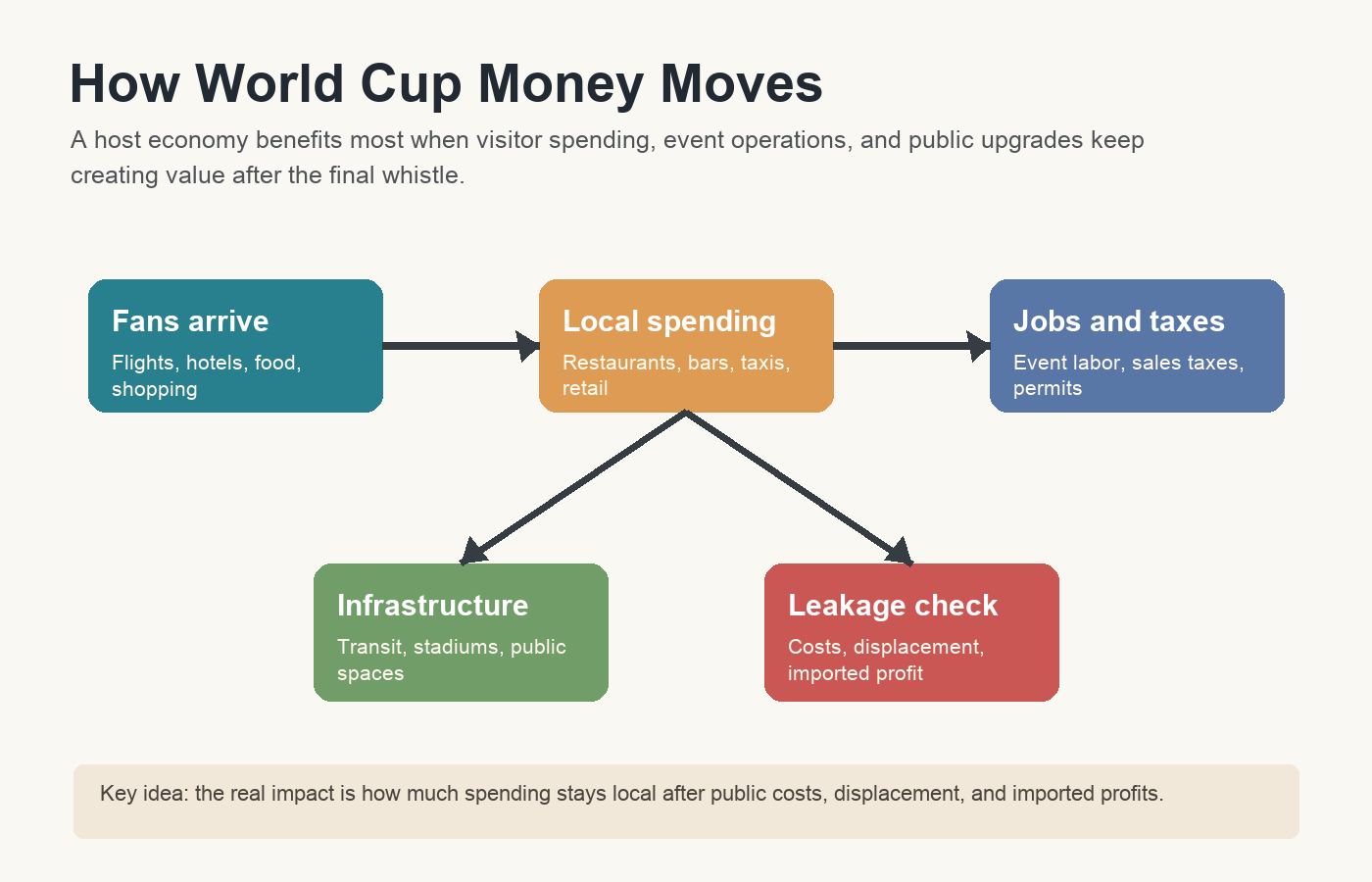
The most visible benefit is tourism. A World Cup brings high-intent travelers who are ready to spend on hotels, restaurants, nightlife, transportation, merchandise, local tours, and match-day experiences. Even fans without tickets often gather in fan zones and city centers. For host cities, that can mean a powerful bump for the hospitality economy.
This is where the effect is easiest to see. A restaurant near a stadium does not need a complicated economic model to know that a month of international visitors is good for dinner service. Hotels can raise occupancy. Ride-share drivers, bartenders, security workers, cleaners, cooks, translators, production crews, and event staff may see more work. Local governments may collect more sales, hotel, and tourism taxes.
There is also a branding effect. A host country gets weeks of global television shots, social media posts, travel stories, and fan memories. That matters because tourism is partly about imagination. If millions of people see a city looking energetic, safe, beautiful, and welcoming, some of them may come back later. A successful World Cup can reposition a place in the minds of travelers and investors.
The infrastructure argument is another big one. Host countries often use the event as a deadline to speed up airport improvements, transit upgrades, public-space renovations, digital systems, and stadium work. Those projects can be valuable if residents use them after the final whistle. A better train station, a more reliable airport, safer sidewalks, and upgraded public spaces can keep paying dividends long after visiting fans go home.
The Hidden Costs: Stadiums, Security, and Crowding Out
The tricky part is that much of the spending required to host the World Cup is paid up front, while many benefits are uncertain or temporary. Stadium upgrades, police overtime, emergency planning, road closures, signage, fan zones, media facilities, and transport service can be very expensive. The bill often lands on national, regional, or city governments.
That is one reason sports economists are cautious. Investopedia’s overview of FIFA’s business model notes that FIFA earns from rights, sponsorships, hospitality, and ticketing, while infrastructure responsibility largely sits with the host. That does not make hosting bad by itself, but it does mean residents should ask a plain question: what are we buying, and will we still use it in five or ten years?
There is also a crowding-out effect. During a mega event, regular tourists may avoid the host city because they expect congestion, high room rates, and limited availability. Local residents may also spend differently. Some people go out more, but others stay home to avoid crowds. If World Cup visitors simply replace normal visitors, the net gain is smaller than the headline numbers suggest.
Another hidden issue is leakage. If a hotel chain, contractor, sponsor, or vendor is based somewhere else, part of the money leaves the host economy. A full hotel is good news, but the local benefit is stronger when wages, supplier contracts, taxes, and profits circulate in the region. This is why local procurement, small-business access, and workforce planning matter so much.
What Past World Cups Teach Us
Past tournaments show why the economic impact is mixed. In a widely cited study, economists Swantje Allmers and Wolfgang Maennig found that the 2006 World Cup in Germany was associated with about 700,000 additional overnight stays and roughly $900 million in net national tourism income, while similar effects were harder to isolate for France 1998. Their Eastern Economic Journal article also points to benefits that are real but hard to price, such as national image and the “feel-good effect.”
That is a useful lesson. Not everything valuable shows up neatly in GDP. A country may get civic pride, better international recognition, and a stronger sports culture. Fans remember the atmosphere. Young athletes get inspired. Cities learn how to manage major events. Those benefits are soft, but they are not imaginary.
At the same time, soft benefits should not be used to excuse waste. Stadiums are the classic warning sign. If a host builds expensive venues that local clubs cannot fill, maintenance becomes a long-term burden. If transport upgrades serve only the stadium district and not daily commuters, residents may wonder why public money was spent there. If promised neighborhood improvements do not arrive, the event can leave frustration instead of pride.
South Africa 2010, Brazil 2014, Russia 2018, and Qatar 2022 all had different economic stories because their starting points were different. A country that needs to build a large amount of infrastructure faces a very different cost-benefit equation than a country that already has stadiums, airports, hotels, and transit. That is why comparing host countries requires context. The World Cup does not land on a blank spreadsheet; it lands in a real economy with existing strengths and constraints.
Why the 2026 World Cup Changes the Math
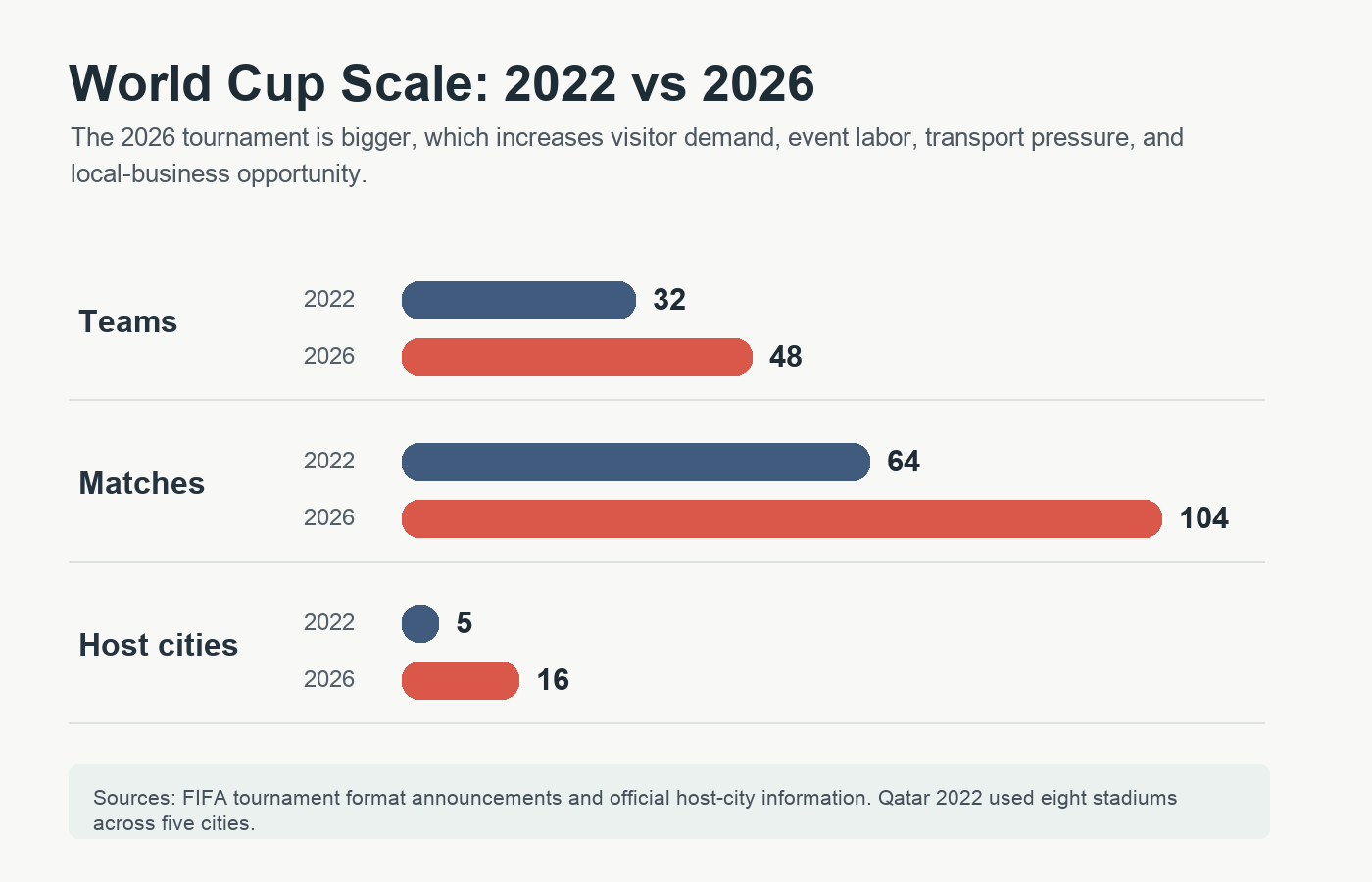
The 2026 World Cup is especially interesting because it is co-hosted by the United States, Canada, and Mexico. It is also bigger than previous editions. The tournament expanded from 32 to 48 teams and from 64 to 104 matches, with games spread across 16 host cities. The Guardian reported on FIFA’s revised 104-match format, and the scale matters for the economy.
More matches mean more ticket holders, more match days, more hotel nights, more fan travel, and more staffing needs. They also mean more pressure on airports, public transit, policing, sanitation, and neighborhoods around venues. In other words, the opportunity is larger and the coordination challenge is larger too.
For North America, the biggest advantage is existing capacity. Many 2026 venues are large stadiums that already host major sports and concerts. That lowers the risk of building brand-new arenas that become underused later. The United States, Canada, and Mexico also have large hotel markets, major airports, and experience with huge events.
Still, the benefits will be local more than national. A packed weekend in Kansas City, Miami, Toronto, Mexico City, Dallas, or New York/New Jersey can be meaningful for local businesses. But for a giant economy like the United States, even a multibillion-dollar event is small compared with total GDP. That does not make the World Cup unimportant. It just means the biggest winners are likely to be specific neighborhoods, hospitality businesses, stadium districts, and tourism agencies rather than the entire national economy.
This is also why host-city planning deserves as much attention as national projections. A national report might talk about billions in economic activity, but the lived experience happens block by block. One neighborhood may see packed cafes and full hotels, while another deals mostly with traffic, security fences, and higher prices. The more carefully organizers spread events, transit options, vendor opportunities, and fan services, the more widely the benefits can be shared.
Jobs Are Real, But Not All Jobs Are Equal
World Cup jobs are one of the most popular selling points for host bids. The event needs construction workers, security teams, hospitality staff, drivers, translators, broadcast crews, cleaning teams, medical workers, customer-service staff, and volunteers. That can be a genuine boost, especially for workers who want extra hours or temporary event income.
But job quality matters. A temporary job that lasts three weeks is helpful, but it is not the same as a permanent career. The best host strategies connect the tournament to training, apprenticeships, tourism credentials, language skills, event-management experience, and small-business growth. That way, workers leave with something more durable than a short paycheck.
There is also a labor-protection side. Big events create hot, crowded, high-pressure work environments. Host cities should care about wages, safety, heat protections, scheduling, and transportation for workers. A World Cup economy that looks good for visitors but feels rough for workers is not a true success.
How Host Regions Can Make the World Cup Pay Off
The best economic strategy is not to ask, “How do we host the biggest event possible?” It is to ask, “How do we use this event to speed up things we needed anyway?” That mindset changes the whole budget.
First, invest in infrastructure residents will use. Airport upgrades, transit reliability, accessible sidewalks, broadband improvements, and public safety systems can create lasting value. Stadium-only spending is riskier unless the venue has a clear post-tournament tenant and calendar.
Second, keep more spending local. Host committees can help small restaurants, food trucks, tour operators, local artists, transportation providers, and neighborhood businesses participate. If the fan experience is captured only by global sponsors and large vendors, the local multiplier shrinks.
Third, manage prices carefully. A spike in hotel rates and short-term rentals may be good for property owners, but it can squeeze residents and push out regular visitors. A smart host region balances revenue with reputation. Fans who feel welcomed are more likely to return.
Fourth, measure honestly. Economic impact reports should separate gross spending from net new spending. They should account for public costs, displacement, and leakage. A $1 billion headline is less useful than a clear answer to how much of that money was new, local, taxable, and durable.
Bottom Line: The World Cup Is a Spotlight, Not a Magic Wand
The World Cup can help a host country or region economy, but it does not suspend the normal rules of economics. Visitor spending matters. So do opportunity costs. Jobs matter. So does job quality. Infrastructure matters most when people use it after the tournament. Global attention is valuable, but it fades quickly if the host does not turn attention into repeat tourism, investment, and community benefit.
So, is hosting the World Cup worth it? It can be. The strongest case is when the host already has much of the needed infrastructure, uses the tournament to improve public systems, protects workers and residents, and gives local businesses a real path into the spending stream. The weakest case is when leaders chase prestige, overbuild, and count every dollar of fan spending as if it were pure profit.
In friendly terms: the World Cup throws a huge party. The host economy benefits most when it owns the kitchen, hires local staff, keeps the neighborhood happy, and still has useful improvements after everyone goes home.