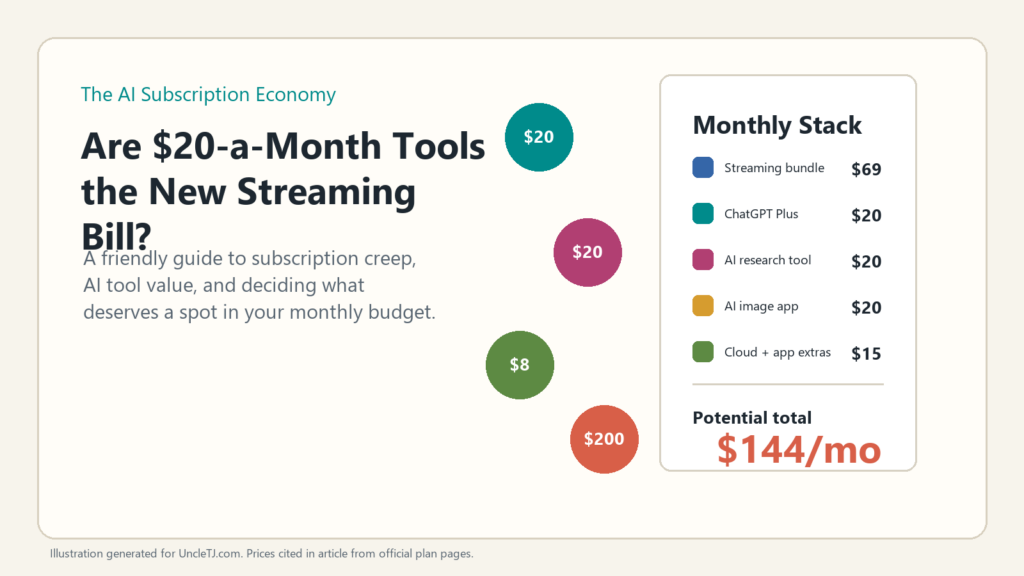

The AI subscription economy is sneaking into household budgets the same way streaming did: one “reasonable” monthly charge at a time. A single $20 AI subscription might be easy to justify. But add a chatbot, an AI search tool, a writing app, a photo tool, a meeting assistant, and maybe a premium streaming bundle, and suddenly the monthly bill feels less like a productivity upgrade and more like a new version of cable.
That does not mean paid AI tools are a bad deal. For many people, they are genuinely useful. A good AI assistant can help plan meals, explain confusing paperwork, summarize research, draft emails, compare purchases, study for a class, practice job interviews, debug code, and organize a family budget. If the tool saves you hours or helps you make better decisions, $20 per month can be a bargain.
The tricky part is that subscriptions are designed to feel small. Twenty dollars here, ten dollars there, a free trial you forgot about, a discounted annual plan you barely use, and a second AI tool because the first one is not quite perfect. The point of this article is not to tell you to cancel everything. It is to help you decide which AI subscriptions deserve a place in your budget, which ones are hype, and how to avoid subscription creep before it quietly drains real money.
Why AI Subscriptions Feel Different From Old Software
For decades, software pricing mostly came in two flavors: you bought a program once, or your employer paid for workplace software. The consumer internet changed that. Music, movies, cloud storage, dating apps, meal plans, fitness apps, news, gaming, and delivery perks all became recurring charges.
AI adds a new twist because it is not only entertainment or storage. It feels like a helper. A streaming service entertains you. A cloud plan stores files. An AI subscription promises something broader: faster work, better writing, easier research, creativity, and maybe even career protection.
That promise is powerful, but it is fuzzy. A single use that helps you negotiate a bill, improve a resume, understand an insurance letter, or avoid a bad purchase could justify the month. Ten casual prompts that replace nothing important might not. So AI subscription cost should be measured by outcomes, not vibes.
The 2026 Data: Paid AI Is Growing, But It Is Still Early
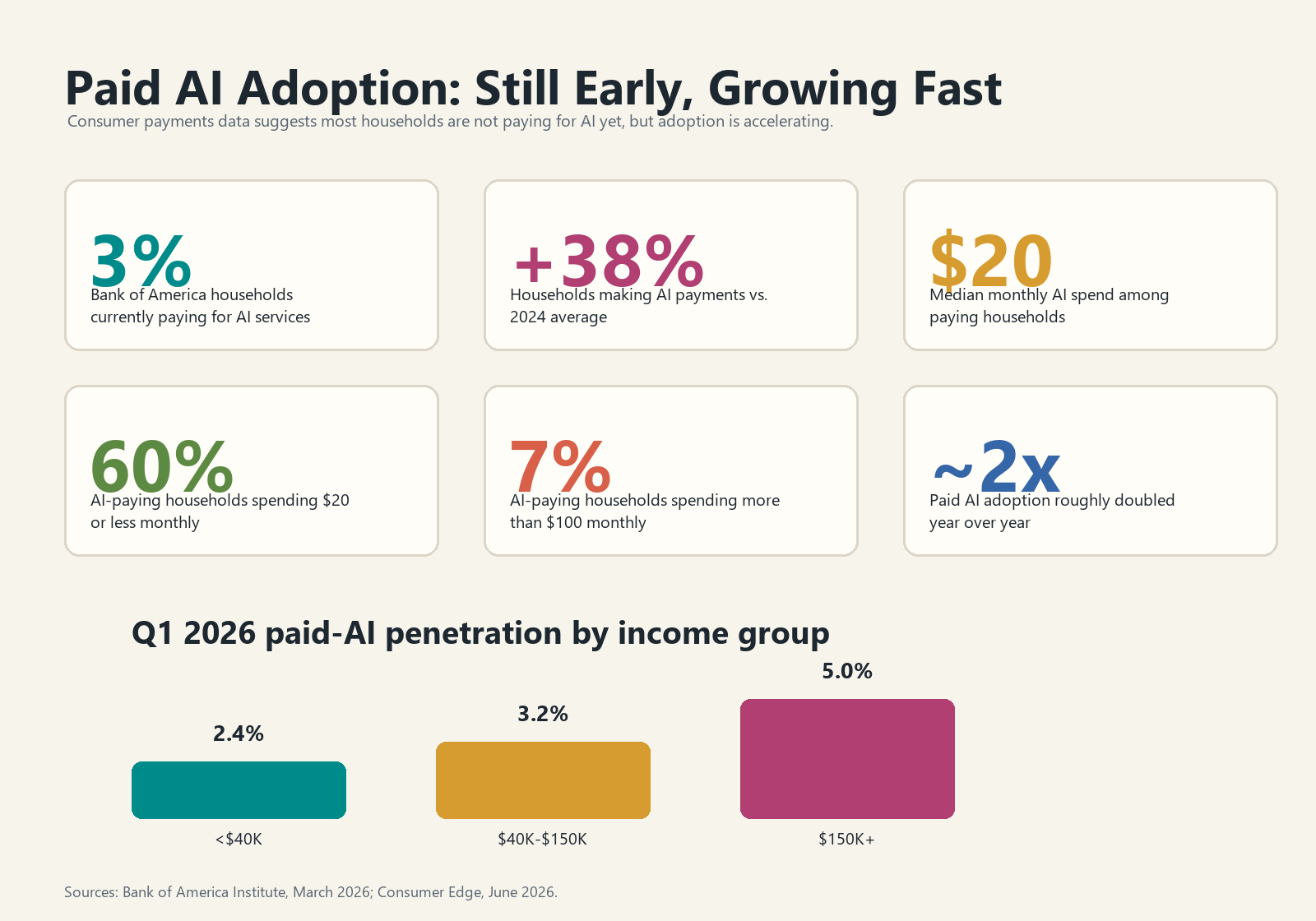
Despite all the attention around artificial intelligence, most households are not paying directly for AI yet. A March 2026 Bank of America Institute analysis found that only around 3% of Bank of America households currently pay for AI services. That is small, but the trend is moving quickly: the number of households making AI payments was up 38% versus the 2024 average, and Bank of America noted that the share of households paying $21 to $40 for AI services had increased 50% since 2024.
The same report found that the median monthly AI spend among paying households was about $20 as of February 2026. Bank of America also found that about 60% of AI-paying households spend $20 or less, while roughly 7% spend more than $100 per month. Most people are still experimenting with one modest tool, but a smaller power-user group is already building a serious AI bill.
Consumer Edge saw a similar pattern in card-spending data. In June 2026, it reported that paid AI subscription adoption had roughly doubled over the prior year, with younger and higher-income consumers leading the way. It also found OpenAI was the most common cross-shop destination among paid AI users.
The practical takeaway is simple: paid AI is not mainstream yet, but it is moving in that direction. Early adopters are sorting out which tools become permanent monthly bills and which ones become forgotten experiments.
Why the $20 Price Point Is Everywhere
If you have browsed AI tools lately, you have probably noticed the pattern. ChatGPT Plus is listed at $20 per month. OpenAI also offers ChatGPT Go at $8 per month in the United States and ChatGPT Pro at $200 per month. Claude Pro is $20 when billed monthly, with higher-capacity Max plans above that. Google AI Pro is $19.99 per month, with a lower-cost AI Plus plan and higher Ultra tiers. Microsoft Copilot Pro is $20 per user per month. Perplexity Pro is $20 per month or $200 per year.
There are a few reasons $20 became the standard. It is high enough to help pay for expensive computing resources, but still low enough to feel like a consumer subscription instead of business software. It also lines up neatly with what people already pay for premium digital services.
The AI industry is borrowing from the streaming playbook: free tier to build habit, $20-ish premium tier for regular users, and expensive tiers for power users. The difference is that streaming competes for leisure time, while AI competes for work, learning, creativity, and decision-making. That can make people more willing to pay, but it also raises the stakes.
The New Streaming Bill: AI Joins the Subscription Stack
Streaming is the warning label for the AI subscription economy. It started with a beautiful promise: pay a little each month, watch what you want, cancel anytime. Then popular shows scattered across apps, prices rose, ad-free tiers became more expensive, and many households found themselves managing a bundle that looked suspiciously like the cable bill they thought they had escaped.
Deloitte’s 2026 Digital Media Trends survey shows how mature subscription markets behave. According to Deloitte, the average subscribing household reports spending $69 per month on streaming video services. More than 6 in 10 respondents said they would cancel their favorite service if its monthly price rose by $5, 68% of streaming subscribers had at least one ad-supported tier, and 73% said they were frustrated that entertainment services keep raising prices.
Inflation data shows the same pressure from another angle. The Bureau of Labor Statistics Consumer Price Index release for July 2026 reported that video and audio services were up 3.7% over the prior 12 months, while subscription and rental of video and video games was up 13.4%.
Now imagine AI subscriptions layered on top. A household paying around $69 for streaming that adds one $20 AI subscription is at $89. Add three $20 AI tools and the combined monthly bill becomes $129. Add a high-end $200 power-user plan, and the total jumps into a different category. Small monthly costs become large annual numbers quickly.
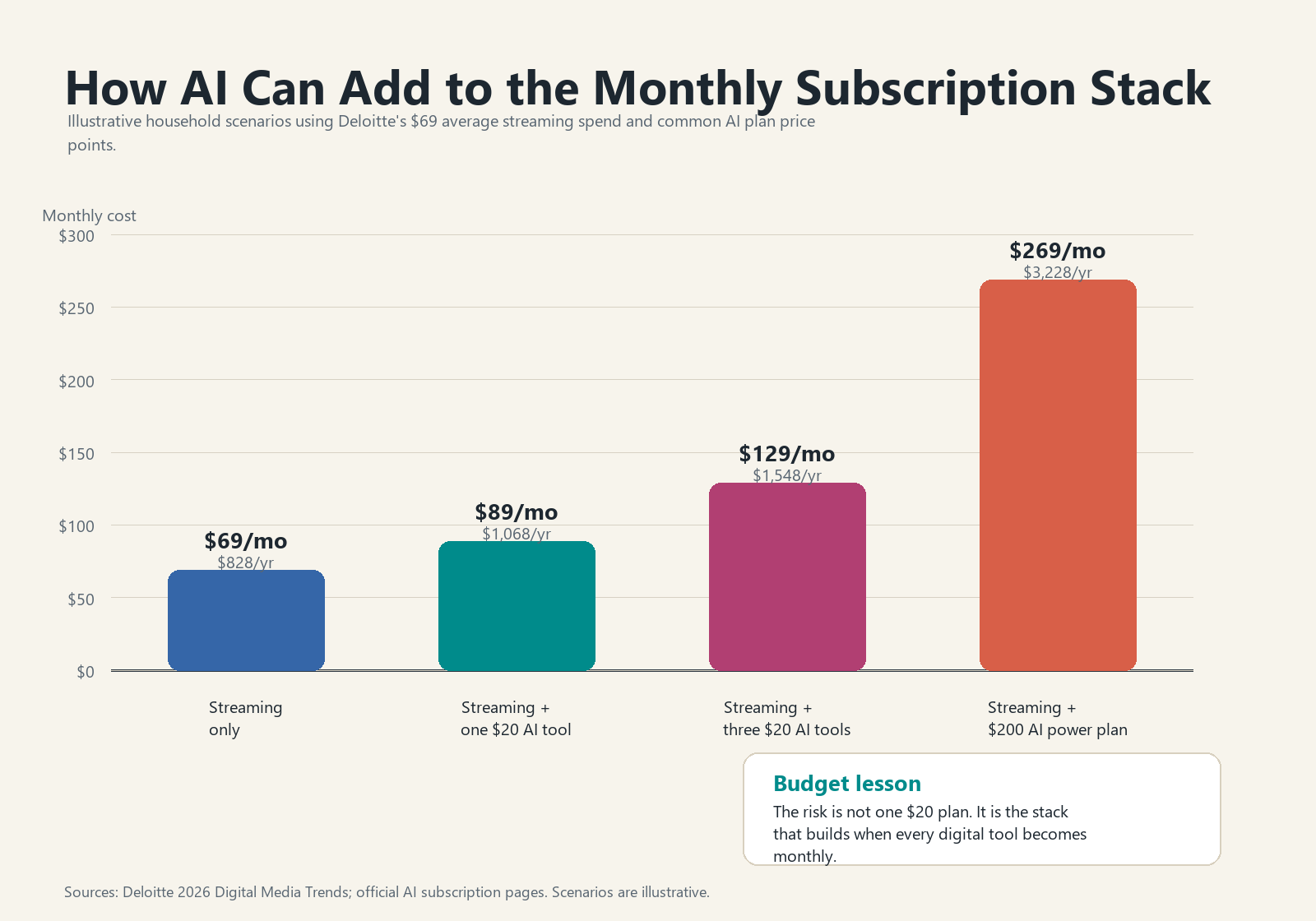
This is why the question “Are AI subscriptions worth it?” has to be personal. A student using one AI plan to study and prepare for internships may get real value. A freelancer using AI to win more clients might see a huge return. A family paying for three overlapping assistants because each sounded useful during a free trial may simply be recreating the streaming mess in a new category.
When an AI Subscription Is Worth It
A paid AI subscription is worth considering when it helps you do something valuable that you would not otherwise do as well, as quickly, or as consistently. The best use cases usually fall into five buckets.
- Time savings: It helps you summarize long documents, draft routine messages, plan projects, study faster, organize notes, or prepare work that used to take hours.
- Better decisions: It helps you compare options, ask smarter questions, understand tradeoffs, and avoid expensive mistakes.
- Skill building: It acts like a patient tutor for math, coding, writing, budgeting, job interviews, language learning, or professional development.
- Income support: It helps you run a side hustle, improve client work, create content, build tools, write proposals, or speed up repetitive business tasks.
- Creative leverage: It helps brainstorm, edit, storyboard, revise, research, or experiment without replacing your taste and judgment.
Here is a plain-English return-on-investment test. If a $20 subscription saves you two hours per month, it only needs to make those hours worth more than $10 each to break even. If it helps you avoid one bad fee, improve a job application, prepare for an interview, or close one freelance project, the math can become favorable fast.
Be honest about the “saved time” claim. Did the tool reduce work, or did it create a new hobby of endlessly tweaking prompts? AI can absolutely save time, but the saved time should show up somewhere: a finished assignment, a better budget, a cleaner email, a useful chart, a stronger resume, or an avoided purchase mistake.
When It Is Probably Not Worth It
An AI subscription is probably not worth it if you cannot name the job it performs in your life. “I should probably have one” is not a budget category. A tool can be impressive and still unnecessary for you.
Watch for duplicate value. If you already pay for ChatGPT Plus, do you also need Claude Pro, Perplexity Pro, Gemini Pro, Copilot Pro, and three specialty writing tools? Some heavy users may benefit from comparing tools. The average household probably needs one primary general-purpose assistant, maybe one specialty tool, and a willingness to cancel experiments quickly.
It is also worth asking whether a free tier is enough. Many AI products offer useful free access, especially for occasional questions, brainstorming, or learning. Paid tiers usually buy higher limits, better models, faster access, file handling, deeper research, image generation, integrations, or priority availability. If you rarely hit the free limits, paying for premium access may be more about fear of missing out than actual need.
Privacy is another reason to slow down. Do not casually upload tax returns, medical records, legal documents, confidential work files, customer data, or a child’s personal information without understanding the service’s privacy settings, data-use policy, and your employer’s rules.
The Psychology of Subscription Creep
Subscription creep works because each decision feels reasonable in isolation. A $20 AI assistant is not outrageous. A $10 design tool is fine. A $4.99 trial is barely a coffee. But budgets do not care whether charges felt small when you approved them. They care about totals.
Self Financial’s 2026 subscription survey is a good reminder of how easily recurring charges fade into the background. Self Financial found that the average respondent had 3.4 active paid subscriptions, while 59.9% admitted they had at least one paid subscription going unused each month. Among unused subscriptions, the average monthly value was $26.79.
That number is close to the price of a typical paid AI plan after taxes in many places. One forgotten tool can become a meaningful leak. The danger is not that one subscription ruins your finances. The danger is that a dozen small leaks make your budget feel tighter without one obvious culprit.
The Federal Trade Commission has paid attention too. In 2024, the FTC announced a final click-to-cancel rule intended to make cancellation as easy as signup for many recurring subscriptions and memberships. The agency said recurring-subscription complaints had risen to nearly 70 per day on average in 2024, up from 42 per day in 2021.
A Simple AI Subscription Audit
If your digital bills feel messy, try a 30-minute subscription audit. You do not need a fancy app. A notebook, spreadsheet, or notes app is enough.
- List every recurring digital charge. Include streaming, cloud storage, apps, AI tools, gaming, news, delivery memberships, fitness apps, and annual subscriptions.
- Mark the purpose of each one. Use plain labels like entertainment, work, school, family organization, side hustle, storage, health, or “unclear.”
- Circle duplicate jobs. If three tools all help with writing, decide which one actually earns its keep.
- Calculate the annual cost. Multiply monthly charges by 12. A $20 AI tool is $240 per year. Three are $720 per year.
- Use the 30-day value test. For one month, write down every meaningful time you use the tool. If the list is empty, cancel it.
- Set renewal reminders. Add calendar reminders a week before annual renewals or trial endings.
- Keep one experimental slot. If you enjoy trying new tools, budget for one rotating experiment and cancel the previous one before adding another.
This approach keeps the good part of the AI subscription economy: flexibility. You can try tools, learn what helps, and keep the ones that pay for themselves. The key is treating subscriptions like choices, not background weather.
How Families Should Think About AI Tools
For families, AI subscriptions can be useful, but they deserve the same conversation as any other paid digital service. Who is using it? What is it for? What information is allowed? Are there school rules about AI homework? A family AI plan can make sense for tutoring, organization, language practice, budgeting, college planning, accessibility, or creative projects. But start with one shared or parent-approved tool and add another only when there is a clear reason.
For Workers and Small Businesses: Measure the Cost Per Useful Outcome
At work, the AI subscription question changes. A $20 tool that saves several hours per month can be incredibly cheap. For a small business, AI might help write proposals, respond to customers, draft job posts, analyze reviews, create basic graphics, or document processes.
Businesses can also overspend when every department buys its own tools without a plan. Seat-based pricing looks simple until there are unused seats, overlapping vendors, unclear data rules, and employees using consumer accounts for business information.
The best business question is not “How many AI licenses do we have?” It is “What useful outcomes are we buying?” If the outcome is vague, the subscription is vulnerable.
Quick FAQ: Are AI Subscriptions Worth It?
How many AI subscriptions should the average person pay for?
For most people, one general-purpose AI subscription is plenty, and many people can get by with free tiers. Add a second paid tool only if it does something specific that your main tool does not do well enough.
Is ChatGPT Plus worth $20 per month?
It can be, especially if you use it regularly for work, learning, writing, coding, research, files, planning, or analysis. It is less compelling if you only ask occasional questions and rarely hit free-tier limits. The right test is whether it produces at least $20 of monthly value for you.
Will AI subscriptions replace streaming subscriptions?
Probably not directly. They serve different needs. But they do compete for the same household budget. A family that adds $40 or $60 per month in AI tools may need to trim entertainment, app, or cloud subscriptions to keep the total reasonable.
Final Takeaway
The AI subscription economy is still young, but the outline is already visible. Most households are not paying for AI yet. The people who do pay often cluster around the $20 monthly tier. Younger and higher-income consumers are adopting faster. Higher-priced plans are emerging. And AI is arriving on top of an already crowded subscription stack.
That means the winning move is not to reject AI subscriptions or blindly collect them. The winning move is to be intentional. Pick tools that save time, improve decisions, build skills, support income, or make life easier in a way you can actually see. Cancel tools that only create guilt, clutter, or vague future usefulness.
A $20 AI assistant can be a bargain. Three unused AI tools can be a waste. The difference is not the technology. It is whether the subscription earns a real job in your life.
Sources and Further Reading
- Bank of America Institute: Not quite mAInstream: A consumer AI profile
- Consumer Edge: AI Goes Mainstream as Adoption Doubles
- OpenAI: ChatGPT Pricing
- OpenAI: Introducing ChatGPT Go
- Anthropic: Claude Pricing
- Google Gemini: AI Pro and Ultra subscriptions
- Microsoft: Copilot Pro pricing
- Perplexity: Pro plan information
- Deloitte: 2026 Digital Media Trends
- BLS: Consumer Price Index, July 2026
- Self Financial: Cost of Unused Paid Subscriptions 2026
- Federal Trade Commission: Click-to-Cancel Rule