

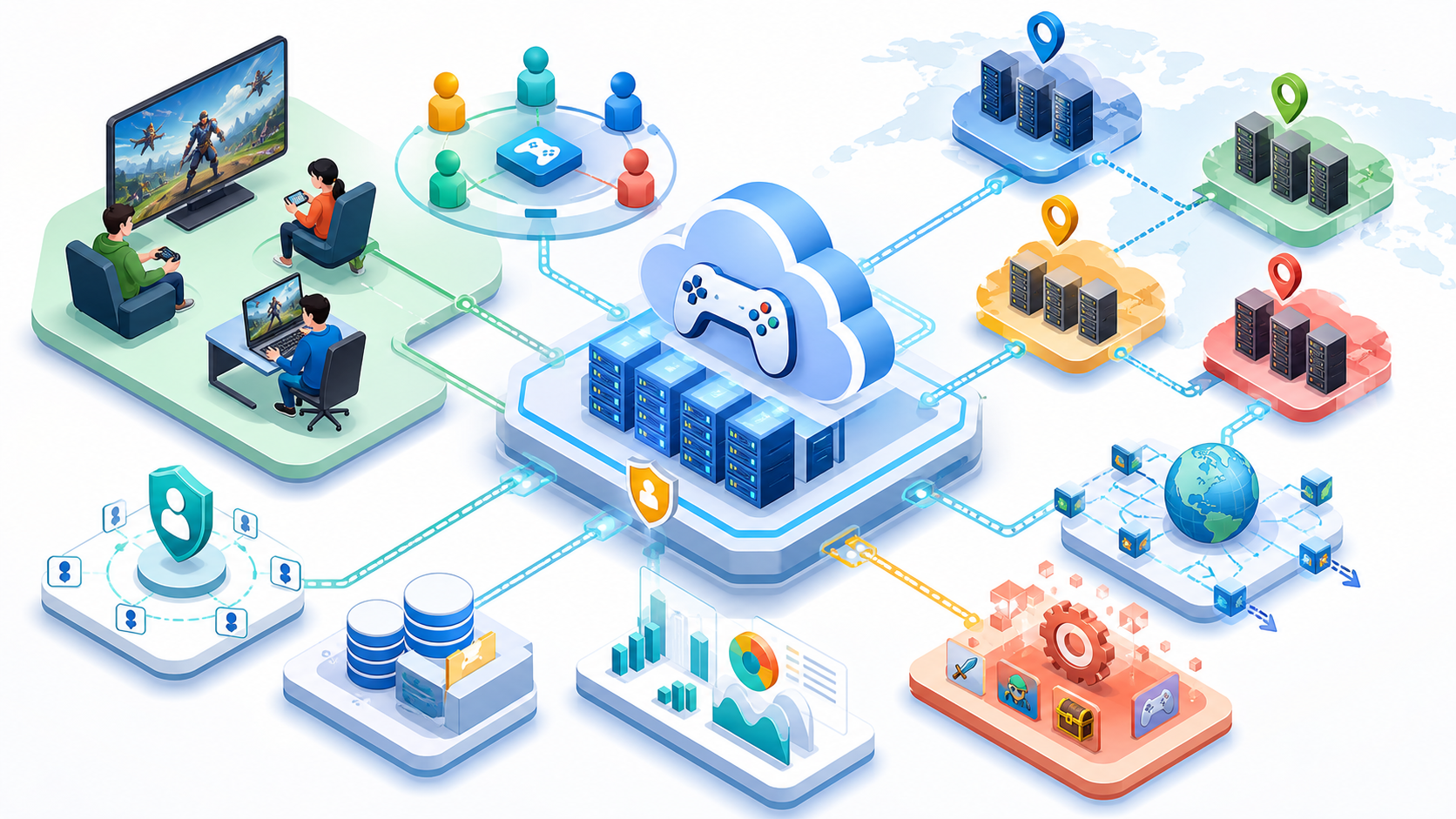
Modern games are not just files that run on a console, PC, or phone. The game you see on screen is only one part of the experience. Behind the scenes, cloud services may be handling sign-ins, matchmaking, multiplayer sessions, cloud saves, leaderboards, inventory, telemetry, patches, events, moderation, and security. For many studios, understanding key cloud technologies for game development is now almost as important as understanding the game engine itself.
That does not mean every game needs a massive cloud platform. A cozy single-player puzzle game has very different needs from a competitive shooter, a mobile RPG, or a cross-platform survival game. But once your game has accounts, online play, live events, player progression, shared economies, or downloadable content, the cloud becomes part of the product.

The friendly way to think about it is this: the game client creates the moment-to-moment fun, while the cloud keeps the world around that fun reliable. It makes sure the right players find each other, the right save file loads, the right event starts on time, and the team can understand what is happening after launch. The best cloud stack is usually the one players never notice because it simply works.
Cloud technology starts with the player account
The first cloud technology many games need is identity. Before you can store progress, enforce entitlements, create friends lists, run matchmaking, or moderate behavior, you need to know who the player is. That sounds simple, but identity can become complicated quickly when players use multiple platforms, switch devices, play offline, or expect account linking across console, PC, and mobile.
Game identity systems usually handle authentication, session tokens, player profiles, platform account linking, parental controls, privacy rules, and permission checks. Services such as Microsoft PlayFab, Unity Authentication, Epic Online Services, and custom cloud identity stacks can all play a role, depending on the studio’s platform strategy.
A good identity design should answer a few practical questions early. Can the player recover an account? Can one person play on multiple devices? What happens if a platform login changes? Can the game support guest accounts and later upgrades? What data is stored, and where? What permissions does a child account have? These questions are not glamorous, but they matter because identity becomes the front door to every other cloud feature.
Multiplayer needs dedicated servers, matchmaking, and session control
For online games, multiplayer infrastructure is often the most visible part of the cloud stack. When it works, players jump into a fair match and forget about the plumbing. When it fails, they see long queues, lag, disconnects, empty lobbies, bad skill matches, or obvious cheating. That is why multiplayer deserves careful architecture.
The main building blocks are matchmaking, lobby/session management, game server hosting, and network transport. Matchmaking decides who should play together. Lobby or session services gather players before the match starts. Dedicated server hosting runs the authoritative simulation. Network transport moves game state between client and server as quickly and safely as possible.
Managed options include Amazon GameLift Servers, PlayFab Multiplayer, and Unity Multiplay Hosting. Open-source or self-managed approaches often use Kubernetes, containers, and projects like Agones, which is designed for running dedicated game servers on Kubernetes. Some real-time web games may use edge-oriented systems such as Cloudflare Durable Objects with WebSockets, especially when sessions are small and stateful.
The key design choice is authority. In a competitive game, the server should usually be authoritative: it decides what really happened. Clients send input, not final truth. That reduces cheating and keeps the game consistent. In a casual co-op game, you may be able to use relay, host migration, or lighter validation. The right answer depends on genre, budget, fairness, and latency tolerance.
Player data is the heart of long-term engagement
Once a game has progression, the cloud must protect player data. Cloud saves, inventories, achievements, currency balances, cosmetics, character stats, quest state, battle pass progress, and unlock history all need a reliable home. Losing this data is one of the fastest ways to lose player trust.
Cloud save and player data systems can be built on managed game services, traditional databases, document stores, key-value stores, object storage, or a combination of all of them. Unity Cloud Save, PlayFab Player Data, Firebase, DynamoDB, Cloud Firestore, Cosmos DB, and custom database-backed APIs are all common patterns. The important part is not the brand name. The important part is that the data model matches the game.
Fast-changing match state should not be stored the same way as long-term player progression. A live match may need in-memory state, snapshots, or server logs. A player inventory needs validation, auditability, and careful conflict handling. A leaderboard needs ranking queries, anti-cheat checks, and reset rules. A cloud save needs versioning and merge behavior when a player uses more than one device.
Economy data deserves extra care. If coins, gems, skins, or tradeable items have value to players, the server should validate important changes. Do not trust the client to say, “I earned 10,000 premium coins.” The client can request an action. The server should decide whether that action is allowed.
CDNs and asset delivery keep updates smooth
Players may think of cloud technology as multiplayer, but content delivery is just as important. Games are large. Updates are frequent. Seasonal events need new assets. Mobile players may be on unreliable networks. A content delivery network, usually called a CDN, helps distribute game files from locations closer to players so downloads are faster and origin servers are protected from spikes.
CDNs are useful for patches, downloadable content, asset bundles, trailers, store images, localization files, and remote configuration payloads. They also reduce stress on launch day, when everyone tries to download the same build at once. Services such as Amazon CloudFront, Cloudflare, Akamai, Fastly, platform CDN tools, and engine-specific content delivery systems can all appear in a game delivery pipeline.
The practical question is how often content changes and how safely it can be cached. A character texture can often sit on a CDN with a long cache lifetime if the file name is versioned. A balance patch or event configuration may need shorter caching, validation, and rollout controls. Good teams plan their asset versioning before launch so emergency updates do not become a manual scramble.
LiveOps turns a shipped game into an evolving service
LiveOps is the set of tools and habits that let a team operate a game after release. That includes remote configuration, event scheduling, A/B testing, offers, seasonal content, store rotation, difficulty tuning, reward calendars, messages, and player segmentation. In a live game, the launch build is not the end. It is the beginning of operating a living system.
Remote config is one of the most useful cloud technologies for game developers because it lets teams change some behavior without shipping a new build. Maybe a boss has too much health. Maybe a daily reward is too generous. Maybe an event should start at noon in each region. With the right guardrails, remote config lets teams respond quickly while avoiding risky client updates.
Analytics and telemetry sit next to LiveOps. They answer questions like: Where do players quit? Which tutorial step is confusing? Are matchmaking wait times rising? Which device models are crashing? Did the new event improve retention? Are economy sources and sinks balanced? Without telemetry, teams are guessing. With telemetry, they can still be wrong, but at least they are wrong with evidence.
Observability is the engineering side of the same idea. Logs, metrics, traces, crash reports, alerts, dashboards, and incident response help the team keep the game running. A launch-day dashboard should show the basics clearly: active users, error rates, server capacity, matchmaking wait times, regional latency, payment issues, database health, and crash spikes.
Containers and automation make scaling less painful
Cloud game infrastructure should be repeatable. If a team has to manually click through a dashboard to create servers, deploy backend code, update secrets, or scale capacity, mistakes will happen. Containers, infrastructure as code, CI/CD pipelines, and automated testing help make deployments more predictable.
Containers are especially useful for dedicated game servers because they package the server build and its dependencies in a consistent way. Kubernetes can schedule and scale containers across machines, while game-specific systems such as Agones add concepts like game server fleets and allocation. Managed services may hide much of this complexity, but the underlying idea is the same: the team needs a reliable way to place server capacity close to players and scale it up or down as demand changes.
Automation also helps with cost. Game traffic is spiky. Evenings, weekends, holidays, new seasons, influencer streams, and launch days can all change demand. Autoscaling can add capacity when players arrive and remove it when traffic falls. The hard part is tuning autoscaling so it reacts quickly without wasting money or causing cold-start delays.
Security and trust are game features too
Security is not just a backend checklist. It directly affects player experience. Account theft, cheating, item duplication, payment fraud, harassment, and denial-of-service attacks can damage a game community. Trust and safety systems are cloud technologies because they depend on identity, telemetry, rules, moderation tools, storage, reporting flows, and response workflows.
Competitive games may need anti-cheat, server authority, replay review, anomaly detection, and device signals. Social games may need chat moderation, user reports, block lists, parental controls, and privacy workflows. Games with purchases need secure payment validation and fraud monitoring. Games with user-generated content need content scanning and moderation queues.
The best time to design these systems is before a public launch. It is much harder to bolt them on after an exploit is already spreading. A practical starting point is to list every valuable action in the game, then decide which actions must be validated server-side. Purchases, premium currency changes, trades, ranked results, reward claims, and inventory grants usually deserve strong validation.
Cloud streaming and edge computing are optional, but important
Cloud streaming is different from cloud backend services. In a streamed game, the game runs in a remote data center and sends video to the player, while player input travels back to the server. That can make high-end games available on lower-power devices, but it also creates strict latency and bandwidth requirements. Amazon’s GameLift Streams is one example of a managed cloud streaming service aimed at game delivery.
Most games do not need full cloud streaming. But many games benefit from edge computing in smaller ways. Edge services can handle WebSocket fan-out, regional matchmaking hints, lightweight validation, redirects to the best server region, or low-latency social features. The rule is simple: put time-sensitive work closer to players, but keep authoritative state in systems that are secure, observable, and recoverable.
How to choose the right cloud game stack
The best stack depends on the game, team size, budget, platform requirements, and live roadmap. A small indie team may get more value from managed services than from running Kubernetes. A large studio may need custom infrastructure because scale, compliance, or gameplay requirements are unusual. A mobile game with daily events needs strong LiveOps. A fast shooter needs strong regional server placement. A single-player game with cross-device saves may only need identity, storage, and a CDN.
Here is a practical way to map features to cloud technologies:
| Game need | Useful cloud technology | Design priority |
|---|---|---|
| Cross-platform account | Identity and profile services | Recovery, linking, privacy |
| Online matches | Matchmaking, lobbies, dedicated servers | Latency, fairness, capacity |
| Progression | Cloud save and player data | Durability, conflict handling |
| Inventory and currency | Economy service and server validation | Security, auditability |
| Fast updates | CDN and asset versioning | Cache strategy, rollout safety |
| Events and tuning | Remote config and LiveOps tools | Control, testing, rollback |
| Learning from players | Analytics and observability | Signal quality, alerts |
| Community protection | Moderation, anti-cheat, trust systems | Prevention, evidence, response |
A good architecture usually starts small and leaves room to grow. Choose managed services when they remove real operational burden. Build custom systems when the game’s needs are specific enough to justify the cost. Avoid building a complex platform before proving that players need it. At the same time, do not ignore fundamentals like account recovery, data durability, server validation, and observability. Those are expensive to fix later.
The practical takeaway for developers
Cloud technology is not magic, and it is not a replacement for good game design. It is a toolbox. Used well, it helps players connect faster, keep their progress, receive updates smoothly, compete fairly, and come back for new experiences. Used poorly, it becomes a source of lag, outages, surprise bills, and frustrated communities.
For most teams, the key cloud technologies for game development are identity, multiplayer hosting, matchmaking, cloud saves, player data, CDN delivery, LiveOps, analytics, observability, automation, and security. You do not need every piece on day one. You do need to understand which pieces your game depends on and which pieces will become painful if ignored.
The simplest test is this: ask what would break the player experience if it failed for an hour. Login? Matchmaking? Cloud saves? Purchases? Patches? Leaderboards? Chat? That list tells you where the cloud stack deserves the most attention. Build those systems carefully, monitor them honestly, and keep the player experience at the center of every architecture decision.