
Side hustles are having an interesting moment. A few years ago, the online conversation made it sound like everyone was launching a business, buying vending machines, flipping houses, or becoming a full-time creator by next Tuesday. Today, the mood is more practical. People still want extra income, but they also want side hustles that fit real life: a job, family, errands, sleep, and maybe a little time to sit down without turning every hobby into a spreadsheet.
That is a healthy reset. A good side hustle does not need to be glamorous. It needs to be understandable, repeatable, legal, and worth the time after expenses. For the average person, the best side hustle is usually not the trendiest idea on social media. It is something you can start small, learn quickly, and improve over time.
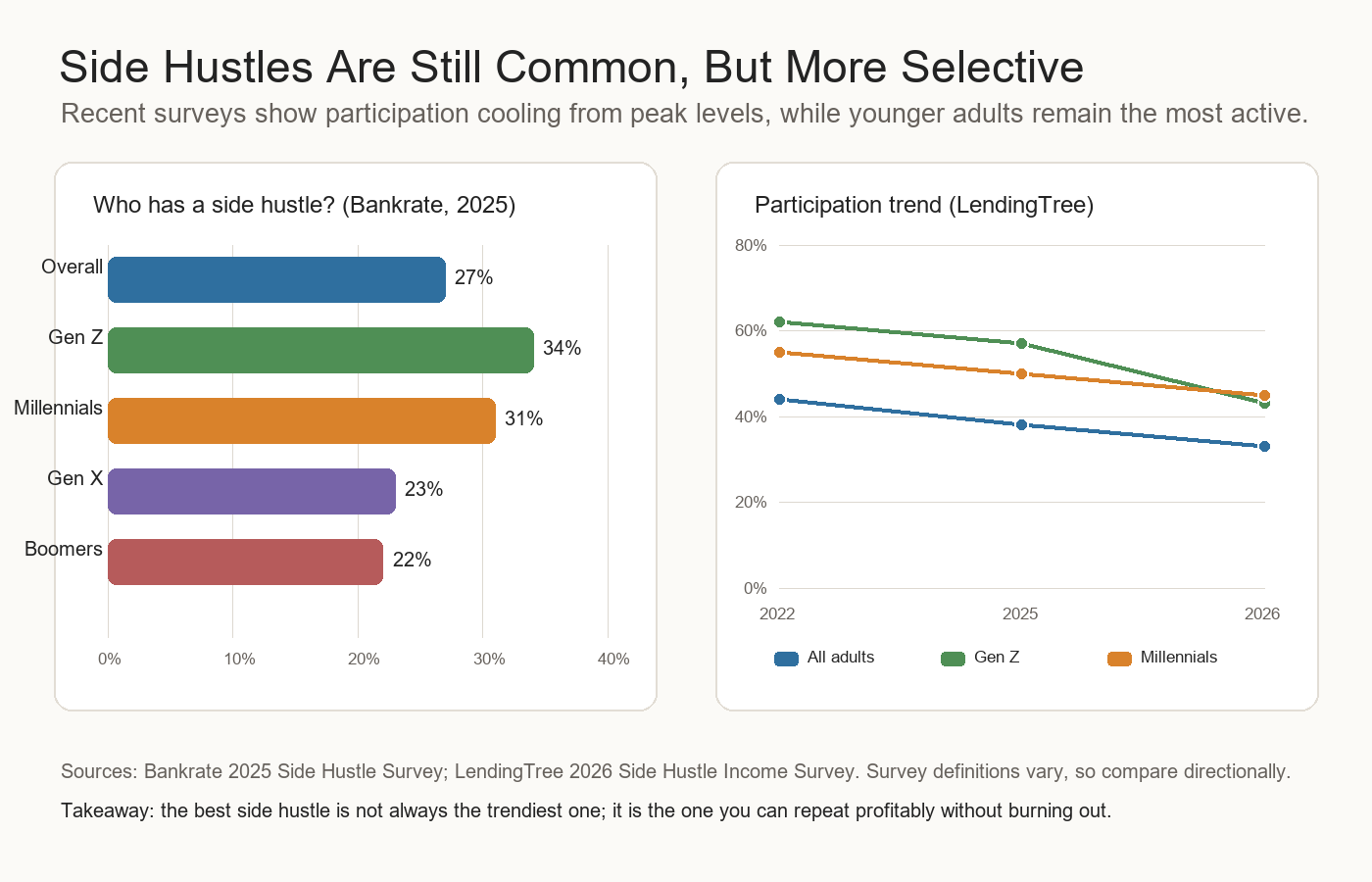
Recent data backs up that more grounded view. Bankrate’s 2025 Side Hustle Survey found that 27% of U.S. adults had a side hustle, down from 36% in 2024, while younger adults remained the most likely to have one. LendingTree’s 2026 survey found that 33% of Americans reported a side hustle, down from 44% in 2022, but average monthly earnings among side hustlers had risen to $1,242. In plain English: fewer people may be dabbling, but serious side hustlers are still finding meaningful money.
Why Side Hustles Still Matter Today
The biggest reason side hustles matter is simple: one paycheck can feel fragile. Prices, rent, groceries, insurance, student loans, and family expenses can move faster than wages. A side hustle can help build an emergency fund, pay down debt, cover a specific bill, or create breathing room. It can also help someone test a business idea without quitting a stable job.
There is also a skills angle. A side hustle can teach sales, scheduling, customer service, bookkeeping, writing, marketing, negotiation, and basic business judgment. Those skills travel well. Even if the hustle itself never becomes a full-time business, the experience can make a person more confident and employable.
Still, it helps to keep expectations sane. The Bureau of Labor Statistics tracks multiple jobholding separately from informal side hustles, and its data reminds us that extra work is a normal but not universal part of the labor market. Surveys also define “side hustle” differently. Some count freelance design; others count delivery apps, selling online, babysitting, or a weekend retail shift. So the exact percentage matters less than the broader trend: people are using flexible extra work to patch budgets, build options, and create a little control.
One warning belongs near the top: income is not the same as profit. If a delivery gig brings in $300 but costs $90 in gas, maintenance, platform fees, and extra insurance risk, the real return is lower. If selling online takes six hours of sourcing, photographing, packing, and shipping for $45 profit, the hourly rate may disappoint. The goal is not just to make money. The goal is to make money in a way that respects your time.
Good, Accessible Side Hustles for Average People
1. Local service jobs. Start with boring, useful work: lawn cleanup, snow shoveling, basic house cleaning, garage organizing, pressure washing, furniture assembly, moving help, and simple errands. These are accessible because you can often begin with tools you already own and find customers through neighbors, Facebook groups, community boards, or referrals. Local services work best when you are reliable, clear about pricing, and willing to do small jobs other people keep putting off.
2. Pet sitting and dog walking. This is one of the friendliest entry points for people who like animals and have a dependable schedule. The startup cost can be low, but trust is everything. References, meet-and-greets, clear instructions, and good communication matter more than fancy branding. It is also smart to check local rules and consider insurance if the work becomes regular.
3. Tutoring or homework help. If you are strong in math, writing, science, test prep, music, or a second language, tutoring can be a practical side hustle. The BLS Occupational Outlook Handbook notes that tutors work in schools, tutoring centers, private instruction, and self-employment settings. You do not need to be a professor to help a middle school student with algebra or a high school student organize essays. Patience, preparation, and consistency are the product.
4. Freelance admin, writing, design, or tech help. Small businesses often need help with email newsletters, basic websites, social media scheduling, data cleanup, slide decks, spreadsheets, proofreading, customer support, or simple automation. Upwork’s Future Workforce Index reported that 28% of skilled knowledge workers operate as freelancers or independent professionals, and its 2025 in-demand skills report highlighted growth in AI-related work as well as human-centered roles like coaching and training. For beginners, the key is to sell a specific outcome, not a vague talent. “I clean up messy spreadsheets for local businesses” is easier to buy than “I can do admin stuff.”
5. Reselling useful items. Reselling can work for people who enjoy thrift stores, yard sales, estate sales, books, tools, clothes, electronics, or vintage items. Start with categories you already understand. The risk is buying too much inventory before learning what sells. A good rule: list what you already own first, track what actually moves, and reinvest only a small portion of profits.
6. Handmade, digital, or print-on-demand products. Etsy, eBay, Shopify, Facebook Marketplace, and print-on-demand services can help creative people test products without renting a storefront. This is not passive income. Product photos, titles, descriptions, customer service, shipping, fees, and competition all matter. But it can be a good fit for people who already make things or know a niche audience well. Etsy’s 2024 Global Seller Census is useful background for understanding how many sellers treat online shops as real small businesses.
7. Childcare, elder help, and household support. Babysitting, after-school pickup, meal prep, companionship visits, and light household help are valuable in many communities. These jobs rely heavily on trust, references, and boundaries. They can be especially good for retirees, students, parents with compatible schedules, or anyone with caregiving experience.
8. Delivery, rideshare, and on-demand apps. These are accessible because platforms already have customers, payment systems, and demand. The tradeoff is that your net income depends on location, vehicle costs, timing, tips, and platform rules. Track mileage and expenses from day one. If the hourly profit after costs is weak, treat it as a temporary bridge rather than a long-term plan.
9. Bookkeeping and basic money organization. Many small businesses need help categorizing transactions, organizing receipts, sending invoices, and keeping records clean. You may need training and attention to detail, but this can grow into steady monthly work. It pairs well with tools like QuickBooks, spreadsheets, and simple recurring packages.
10. Content repurposing for local businesses. Plenty of small businesses have raw material but no time: long videos, customer questions, before-and-after photos, reviews, menus, event announcements, or tips. Turning that into short posts, email updates, flyers, or website copy can be useful work. AI tools can speed up drafts, but human judgment still matters for accuracy, tone, and local flavor.
How to Choose the Right Side Hustle
Pick a side hustle by matching three things: your available time, your existing skills, and your tolerance for uncertainty. If you need money quickly, local services, tutoring, babysitting, and delivery apps may beat a product business that takes months to build. If your schedule is unpredictable, online freelancing or reselling may be easier than appointments. If you hate selling, choose a service where referrals and repeat customers can do more of the work over time.
Before you start, write down the real math. What can you charge? What will it cost? How many hours will it take, including travel, messages, setup, cleanup, bookkeeping, and customer service? A side hustle that earns $25 an hour for five predictable hours each week may be better than a flashy idea that earns $300 once and then disappears.
Also, do not ignore taxes. The IRS Gig Economy Tax Center says income from part-time, temporary, or side work generally must be reported, even if it is paid in cash or not reported on a 1099 form. Keep simple records of income, fees, mileage, supplies, and other expenses. If the side hustle grows, talk to a tax professional before you are surprised in April.
The Bottom Line on Side Hustles in 2026
The best side hustle for average people is not a magic trick. It is a small, useful offer delivered consistently. Walk dogs. Tutor algebra. Clean garages. Fix spreadsheets. Sell items you understand. Help a local business show up online. Start with one offer, one type of customer, and one simple way to measure whether the work is worth repeating.
Side hustles are still a smart tool in 2026, but the winners are usually practical rather than flashy. Choose something accessible, watch your costs, protect your time, and improve as you go. Extra income is helpful, but so is peace of mind. A good side hustle should give you more options, not quietly take over your life.
Sources and further reading: Bankrate 2025 Side Hustle Survey, LendingTree 2026 Side Hustle Income Survey, BLS multiple jobholders data, IRS Gig Economy Tax Center, Upwork Future Workforce Index, Upwork 2025 In-Demand Skills, BLS Occupational Outlook for Tutors, and Etsy 2024 Global Seller Census.