


Are Black Friday deals real? Yes, many of them are. But the giant percentage on the banner is not always the same thing as the savings in your bank account. A product advertised as “40% off” may have sold at roughly the sale price for much of the year. A bargain television may be a special model with fewer features. Free shipping may require a membership, and a generous rebate may be useful only if you remember to claim it.
The good news is that you do not need a finance degree or six browser extensions to separate a real deal from a clever presentation. You need a short list, the exact model number, a realistic comparison price, and a willingness to ignore a countdown timer long enough to do five minutes of arithmetic.
This guide explains the economics and psychology behind Black Friday pricing, what is different in 2026, how AI shopping tools can help, and the practical test I would use before clicking “buy.” The goal is not to make holiday shopping joyless. It is to make sure the sale serves your budget instead of quietly rewriting it.
Black Friday 2026 Will Be Huge, but Spending Is Not the Same as Saving
Retailers have good reason to compete for attention this year. Adobe expects U.S. online holiday sales to reach $275.1 billion during November and December 2026, up 6.7% from a year earlier. Its forecast puts Black Friday online spending at $12.9 billion and Cyber Monday at $15.1 billion. Cyber Week alone could account for $47.5 billion.
Those enormous totals tell us that the sales matter to shoppers and retailers. They do not prove that every purchase is cheaper. Mastercard forecasts 5.5% growth in U.S. holiday retail spending between November 1 and December 24, but estimates that 2.8 percentage points of that growth will come from inflation. In other words, almost half the projected increase reflects higher prices rather than a larger pile of gifts.
Visa reaches a similar conclusion from a different dataset. It projects holiday retail sales to rise 4.5%, while holiday-related goods prices rise about 3.4%. The inflation-adjusted increase is only 1.1%. That distinction is useful: a record sales season can coexist with households feeling as if their dollars do not stretch very far.
A discount is not money saved unless you wanted the item, chose the right version, and paid less than you otherwise would have paid.
What Counts as a Real Black Friday Deal?
A real deal has three parts. First, the final price is meaningfully below the product’s recent normal price. Second, the product is the same model and condition you intended to buy. Third, the purchase still makes sense after shipping, memberships, accessories, financing, and return restrictions are included.
Notice what is missing from that definition: the manufacturer’s suggested retail price. A list price can provide context, but it may not describe what shoppers usually pay. If a blender lists for $199, spends most of the year at $129, and appears on Black Friday for $119, the honest savings is closer to $10 than $80. Ten dollars is still a discount. It simply is not the 40% triumph suggested by the sign.
Federal guidance recognizes this exact problem. The FTC’s Guides Against Deceptive Pricing say a former-price comparison has a legitimate basis when that former price was genuine and offered regularly for a reasonably substantial period. An artificially inflated former price can make an ordinary selling price look like an exceptional bargain.
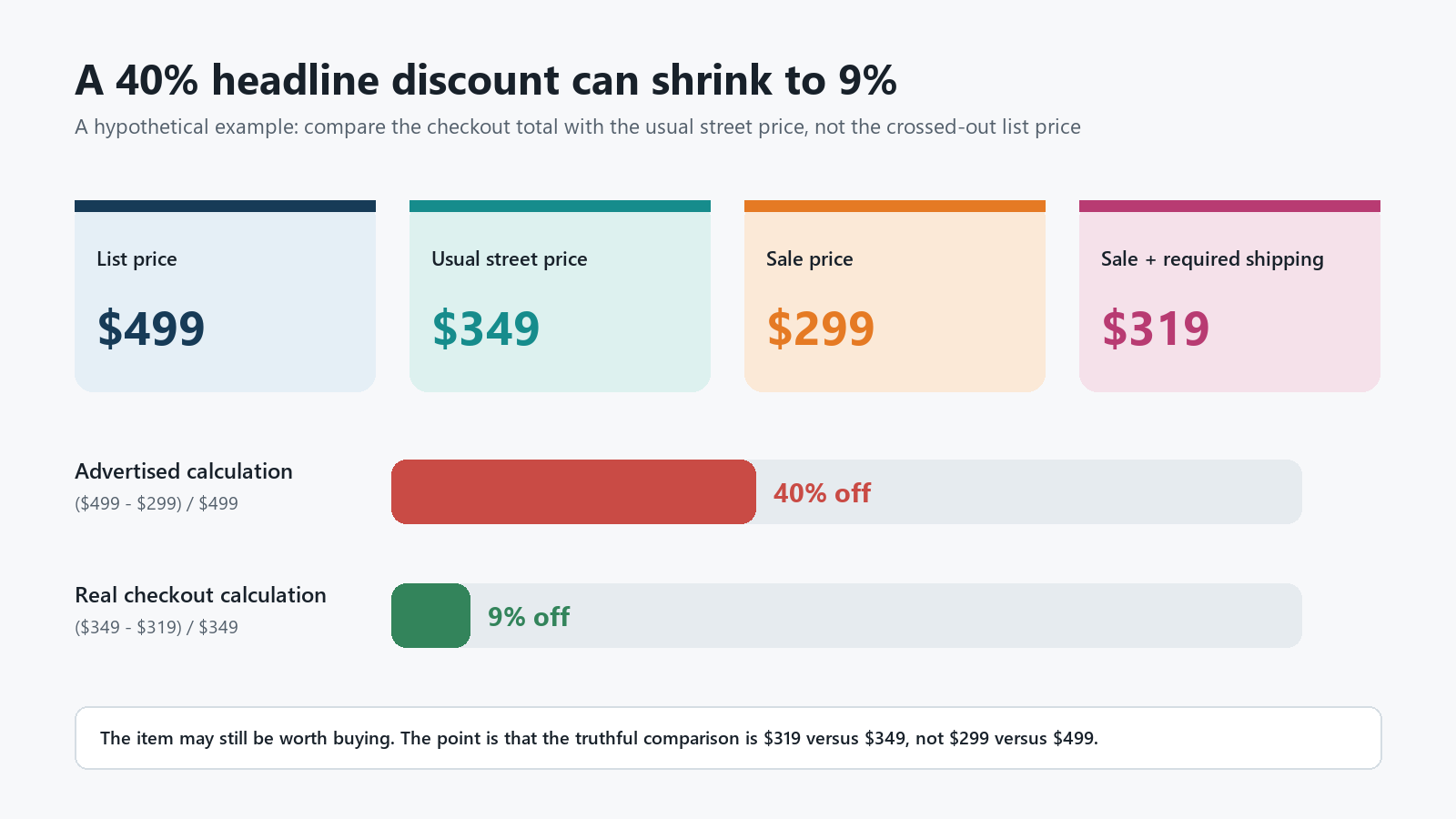
Consider the hypothetical example above. The retailer compares a $299 sale price with a $499 list price, producing a headline discount of about 40%. Yet the item normally sells for $349, and the sale requires $20 shipping. The checkout total is $319, which is only about 9% below the usual price. It may still be worth buying, but the second comparison is the one that belongs in your budget.
Why the Big Percentage Feels So Persuasive
Human beings judge prices relative to a reference point. Put “was $499” next to “now $299,” and $499 becomes the starting point in our head. The lower number feels attractive before we have asked whether anyone routinely paid the higher one.
This is often called anchoring or reference-price framing. A meta-analysis published in the Journal of Retailing found that both the dollar amount and percentage of a discount affect perceived savings, with the percentage having the larger influence. The presence of a regular price can also increase the value consumers perceive in an offer.
Retail pages add more pressure with red labels, “only three left” notices, expiring coupons, carts that reserve an item for ten minutes, and a progress bar toward free shipping. None of those details tells you whether the price is historically low. They answer a different question: how can the store make postponing the decision feel uncomfortable?
Scarcity can be legitimate. A doorbuster may have limited inventory because the retailer is willing to lose money on only a few units. The mistake is treating urgency as evidence of value. A timer tells you the offer may end. It does not tell you the offer is good.
The Retail Economics Behind Doorbusters, Bundles, and Special Models
Black Friday is not one pricing strategy. It is several strategies happening at once.
- Loss leaders: A retailer prices a popular item aggressively to bring shoppers into the store or app, expecting some of them to add profitable accessories, warranties, or unrelated products.
- Inventory clearance: Older colors, last year’s models, and overstock can receive genuine discounts because the retailer values shelf space and cash more than the remaining margin.
- Bundles: A package makes direct comparison harder. The bundle is useful only if you value the extra pieces at something close to their claimed price.
- Store-specific models: A television or appliance may have a unique suffix, stand, remote, port count, or component. That does not automatically make it bad, but it prevents a lazy model-to-model comparison.
- Dynamic promotions: Coupons, loyalty credits, app-only offers, and targeted emails can produce different effective prices for different shoppers.
The common theme is comparison friction. When two sellers offer an identical model with identical terms, price competition is easy. When one sells a bundle, another offers store credit, and a third changes the model suffix, the shopper has to do more work. That extra work is not accidental; it reduces price transparency.
Compare value per useful unit. If a $90 bundle contains an item you would pay $70 for and two accessories you would never buy, it is not a $120 value in your household. It is a $70 product surrounded by clutter.
Which Categories May Have the Best Discounts in 2026?
Adobe expects discounts during Cyber Week to reach as much as 30% off listed prices, although the peak varies by category. Electronics are forecast to reach 30%, toys 29%, and televisions, computers, and apparel about 23%. Sporting goods, appliances, and furniture are expected to have somewhat smaller category-wide peaks.
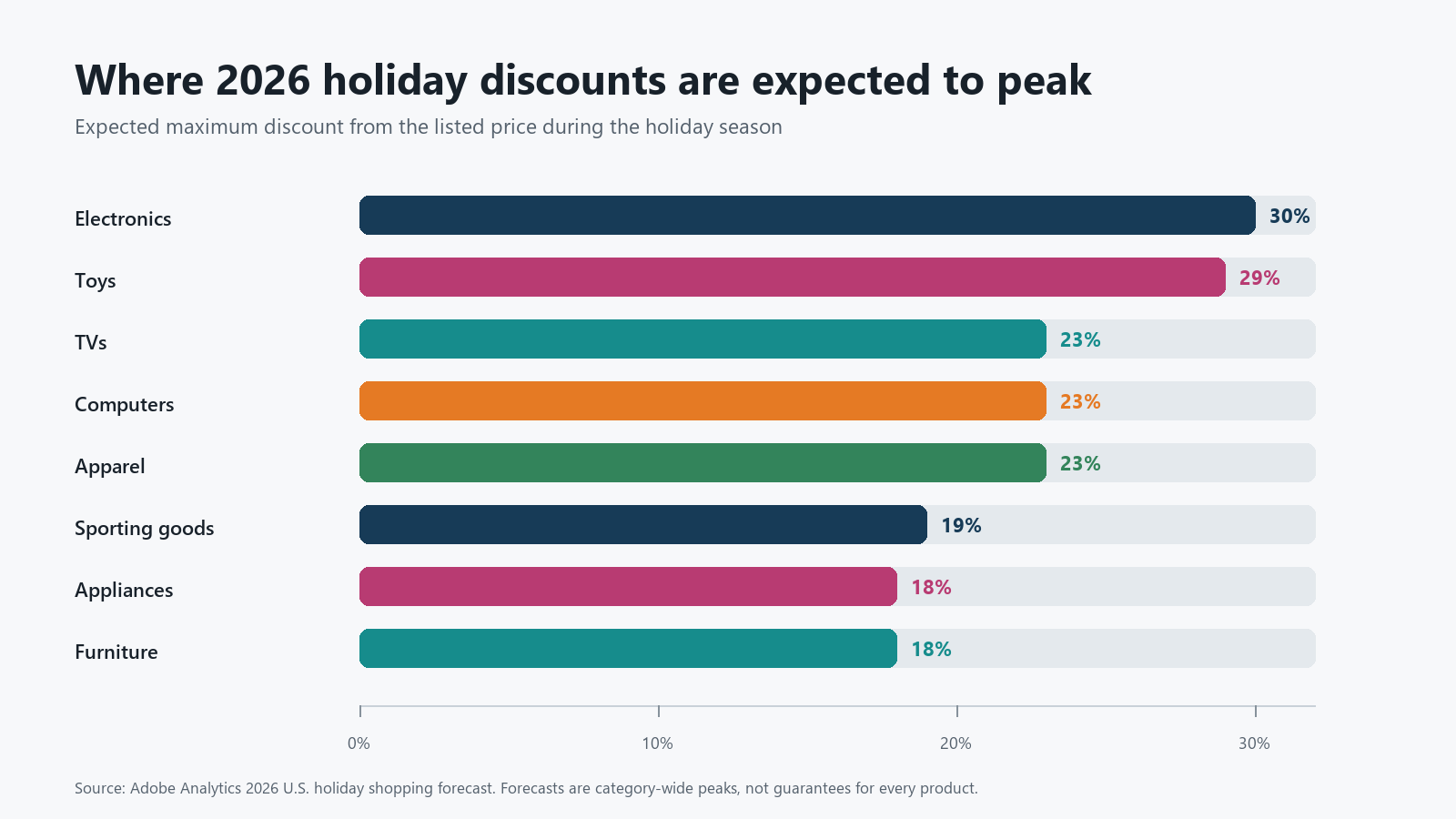
Timing may vary too. Adobe expects the strongest television, toy, apparel, appliance, and furniture discounts on Black Friday. Its forecast points to Cyber Monday for electronics and computers, and Thanksgiving for sporting goods.
Treat these numbers as a weather forecast, not an appointment. They describe broad category peaks against listed prices, not a guaranteed low for every item. A specific laptop might sell out before Cyber Monday. A television’s “discount” might be calculated from a price it rarely commands. If you find the exact product at or below a target price you established in advance, taking a good deal can be wiser than gambling for another $10.
Can AI Find Better Black Friday Deals?
AI is becoming part of the shopping journey. Adobe forecasts traffic from AI chat and browser services to U.S. retail sites will rise 130% this holiday season. In its July 2026 consumer survey, 77% of respondents who had used AI for online shopping said it made them more confident in a purchase.
Used carefully, an AI assistant can save real research time. Give it your requirements and ask it to produce a comparison table: exact model, capacity, dimensions, warranty, return window, necessary accessories, and known compromises. It can also turn a pile of product descriptions into a shortlist or help you write questions to ask a seller.
But do not ask, “What is the best laptop deal?” and treat the first answer as a live market quote. Prices and inventory change by the minute. Product pages can be stale, affiliate results may be incomplete, and AI can merge specifications from similar models. Use the assistant for structure, not final authority.
- Ask the AI to show the exact model numbers behind every comparison.
- Require links to the retailer and manufacturer, then open them yourself.
- Verify price, stock, condition, warranty, and return terms on the live page.
- Never give a chatbot your store password, payment card, or full financial-account information.
- Ask what evidence would change the recommendation. That often exposes missing assumptions.
This is the same “ask, verify, decide” approach described in our guide to using AI for personal finance. AI is a capable research assistant. You remain the buyer and the fact-checker.
The Seven-Step Real Deal Test
Before buying, run the offer through this sequence. It takes longer to read than to use.
1. Decide what you need before opening the sale page
Write down the product category, must-have features, acceptable models, maximum total price, and deadline. This turns shopping from “show me something exciting” into “does this offer meet my plan?”
2. Find the normal street price
Look beyond the crossed-out number. Check price-history tools, recent listings from established sellers, and the manufacturer’s own page. If the item has spent months at $349, use $349 as the comparison even if the box says $499.
3. Match the exact product
Compare the complete model number, storage, size, year, color, condition, and included parts. For electronics and appliances, one letter at the end of a model can mark a retailer variant. For marketplace listings, distinguish new, open-box, refurbished, and used.
4. Calculate the delivered price
Add shipping, handling, required memberships, mandatory accessories, installation, and any fee that changes because of the promotion. Subtract a rebate only if you are eligible, understand the conditions, and will actually claim it. Store credit is not cash unless you already planned another purchase at that store.
True discount = (normal street price – final required cost) / normal street price
5. Put a price on the return policy
A $15 saving can disappear if returning the item costs $30 or a clearance policy makes the sale final. Check the deadline, return shipping, restocking fee, and whether a marketplace seller or the platform handles problems. The FTC’s online-shopping guidance recommends comparing the total cost and reading sale-item return terms before purchasing.
6. Separate the product from the payment plan
Four payments of $75 are still $300. Buy Now, Pay Later can smooth timing, but it does not reduce the price. The Consumer Financial Protection Bureau notes that many BNPL plans charge late fees and advises shoppers to review the loan’s costs and credit implications. Adobe expects BNPL to drive $21.3 billion in online holiday spending this season, so expect the installment amount to be displayed prominently.
Our deeper guide to Buy Now, Pay Later risks explains why several harmless-looking installments can claim the same future paycheck. Judge affordability using the full price and your existing obligations, not the smallest number on the checkout screen.
7. Ask the question no coupon can answer
Would I buy this today if there were no percentage sign and no countdown clock? If the answer is no, the sale may be creating the desire instead of satisfying it. The cheapest unnecessary purchase is the one left in the cart.
Cash Back, Coupons, and Loyalty Points: Stack Carefully
Stacked promotions can create excellent prices, but use a conservative value for each layer. An instant coupon is close to cash. A mail-in rebate is worth less because it requires paperwork and time. Store points are worth only what you will redeem without buying extra. A credit-card reward is not a saving if carrying the balance creates interest.
Also check the order in which discounts apply. Ten percent off after a $50 coupon is different from ten percent off before it. Some cash-back portals exclude gift cards, premium brands, taxes, or purchases made with an unlisted coupon. Screenshot the terms and order confirmation while the details are visible.
A useful rule is to make the purchase work without the least certain reward. If the deal is attractive at checkout and a rebate later improves it, wonderful. If the entire case depends on perfect tracking six weeks from now, the bargain is fragile.
Do Not Let a Bargain Become an Emergency
A real discount can still be wrong for your finances. If buying the item would require missing a bill, carrying expensive credit-card debt, or draining the money reserved for an emergency, the timing is not affordable. Our emergency fund guide explains why cash reserves are valuable precisely when an unavoidable expense arrives without a sale schedule.
This does not mean every holiday purchase must be paid from a perfectly optimized budget. It means the budget should decide the spending limit before the retailer does. Set a total gift amount, assign rough amounts to people or categories, and track purchases as they post. “I saved $80” is not useful if the cart is $300 larger than the plan.
Watch for Fake Stores and Too-Good-to-Be-True Prices
Price skepticism is also a security habit. A social-media ad may copy a legitimate store’s logo and product photography while sending shoppers to a look-alike domain. Before ordering from an unfamiliar seller, search the seller’s name and website address with words such as “review,” “complaint,” or “scam.” Read several sources rather than relying on the star rating displayed by the seller.
- Type the retailer’s address yourself when an ad looks suspicious.
- Check the domain spelling, contact information, return address, and independent history.
- Use a credit card when possible; it generally offers stronger dispute rights if the order never arrives or is not what was promised.
- Do not trust a site merely because it uses HTTPS. Encryption protects the connection, not the seller’s honesty.
- Walk away if a seller insists on gift cards, wire transfers, payment apps, or cryptocurrency.
- Keep the product page, receipt, confirmation, promised shipping date, and return policy.
These steps follow the FTC’s consumer guidance. They are especially important when a price is dramatically below every established seller. Sometimes you found a rare bargain. Sometimes the “discount” is bait for a product that is counterfeit, materially different, or never shipped.
Frequently Asked Questions About Black Friday Deals
Are Black Friday deals actually real?
Many are genuine price reductions. The advertised percentage can still exaggerate the practical savings when it uses a high list price instead of the recent normal price. Compare the final cost with price history for the exact model.
Is Black Friday or Cyber Monday cheaper?
Neither day wins every category. Adobe’s 2026 forecast favors Black Friday for televisions, toys, apparel, appliances, and furniture, while Cyber Monday is expected to have deeper electronics and computer discounts. Your target price matters more than the label on the day.
Should I wait if an item is already at my target price?
Usually not for a small possible improvement, especially if the model or delivery deadline matters. Once an item reaches a price you independently decided was good, buying removes the risk of it selling out. Check whether the retailer offers holiday price matching or a price-adjustment window.
Can AI shopping assistants be trusted?
Trust them to organize research, not to authorize the purchase. Verify the live price, exact model, seller, return terms, and availability. An AI answer can become stale even when it was accurate minutes earlier.
What is the fastest way to check a deal?
Search the full model number, check recent price history, compare the delivered price at two reputable sellers, and read the return policy. Then ask whether the item was already on your list. That quick test catches most fake savings without turning shopping into a research project.
The Bottom Line: Buy the Product, Not the Percentage
So, are Black Friday deals real? Often yes, and some are excellent. The strongest discounts usually appear where retailers have excess inventory, intense competition, a loss-leader strategy, or a product generation to clear. The weakest “deals” rely on a flattering reference price, an unusual model, uncertain rewards, or urgency that keeps you from comparing.
The practical defense is simple: decide first, compare the exact item, calculate the total, and keep financing separate from price. If the offer survives those tests and fits the budget, enjoy the bargain. If it does not, closing the tab is not missing out. It is a 100% discount on something you did not need.
Sources and Further Reading
- Adobe Analytics: 2026 U.S. holiday shopping forecast
- Mastercard Economics Institute: Forecasting the 2026 holiday season
- Visa Business and Economic Insights: 2026 U.S. holiday spending outlook
- 16 CFR Part 233: Guides Against Deceptive Pricing
- Federal Trade Commission: Online shopping guidance
- Journal of Retailing: Meta-analysis of price presentation and perceived savings
- Consumer Financial Protection Bureau: What is a Buy Now, Pay Later loan?
This article is for general educational purposes and is not individualized financial, legal, or purchasing advice. Prices, promotions, inventory, and return policies can change quickly; verify current terms before buying.