


How much emergency fund should I have? For many households, three months of essential expenses is a reasonable baseline and six months provides a stronger cushion. But the honest answer is a range, not a magic number. A household with two stable paychecks, low fixed costs, and good insurance may need less cash than a freelancer supporting children, a homeowner with a large deductible, or someone working in an industry where job searches routinely take months.
An emergency fund is not about predicting the exact disaster headed your way. It is about buying time and choices. Cash can turn a broken transmission into an annoying repair instead of a high-interest balance. It can let you search for a suitable job instead of accepting the first offer out of panic. It can pay the insurance deductible that stands between a covered loss and an actual repair.
This guide explains how to calculate an emergency fund for your real life in 2026: which expenses count, how many months to use, where to keep the money, how to balance saving with debt repayment, and how to build the fund when the final target looks intimidating.
Why the Three-to-Six-Month Emergency Fund Rule Exists
The familiar advice to save three to six months of expenses is a rule of thumb, not a law of finance. Its purpose is to cover a temporary loss of income while also leaving room for the smaller emergencies that do not stop simply because a paycheck did.
The time frame is not arbitrary. In September 2026, the Bureau of Labor Statistics reported a median ongoing unemployment duration of 12.1 weeks, roughly three months. The average was much longer at 25.4 weeks because a substantial group had been unemployed for an extended period. More than 1.9 million unemployed people had been looking for work for 27 weeks or longer.
Those figures do not tell us how long a future job search will last, and the BLS measures people who are still unemployed rather than completed spells. They do explain why a one-paycheck cushion can disappear quickly. Three months may cover a typical gap; six months offers more room for a slower search, delayed benefits, health problems, or a weak hiring market.
FINRA likewise describes three to six months as a good goal while emphasizing that any amount a household can afford to set aside is helpful. That second point matters. Someone with $700 saved is not failing because the final target is $18,000. That $700 has already prevented $700 of potential borrowing.
What the Latest Emergency Savings Data Shows
The Federal Reserve’s latest national household survey shows both resilience and vulnerability. In 2025, 63% of adults said they would cover an unexpected $400 expense using cash, savings, or a credit card paid in full at the next statement. That share was unchanged from recent years.
The other side of the number deserves attention. Fifteen percent said they would put the expense on a credit card and pay it over time. Twelve percent said they could not pay it by any method. And while 70% could handle an expense of at least $500 using savings right now, 18% said their maximum savings-funded emergency was below $100.
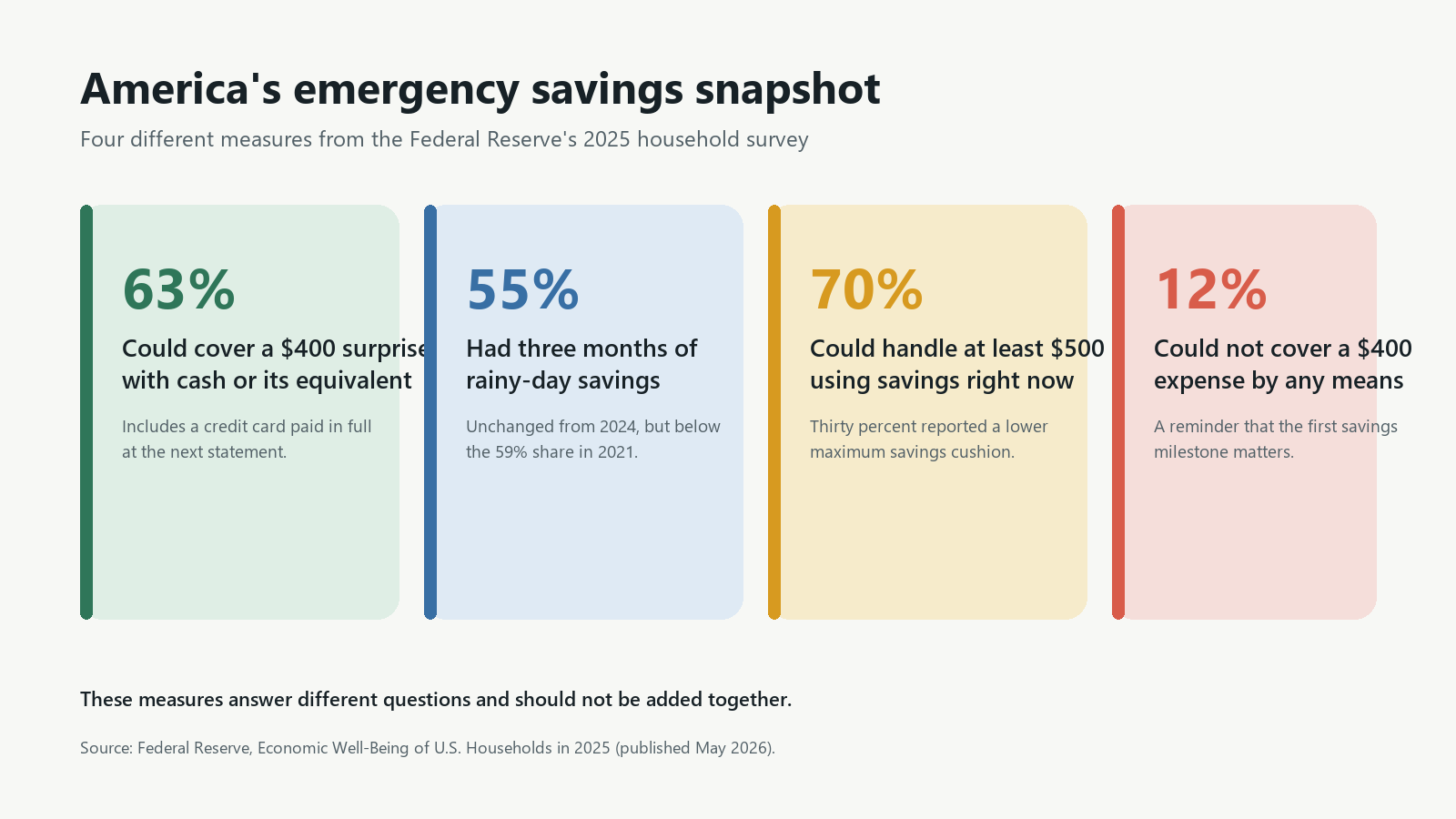
For a longer income interruption, 55% of adults reported having a rainy-day fund that could cover three months of expenses. That was unchanged from 2024 but below the 59% recorded in 2021. Another 15% said they could cover three months by borrowing, selling assets, or drawing on other savings. The remaining 30% could not cover three months through any of those methods. These figures come from the Federal Reserve’s 2025 household economic well-being report, published in May 2026.
Emergencies are not rare edge cases. A separate section of the same survey found that 59% of adults experienced at least one major unexpected expense during the prior year. The case for emergency savings is not that everything will go wrong. It is that something eventually will.
Emergency Fund vs. Sinking Fund: Know the Difference
An emergency fund is for necessary, urgent, and unplanned expenses or a loss of income. A sinking fund is for a cost that is irregular but predictable. Mixing the two makes the emergency balance look healthier than it really is.
- Emergency fund: a sudden job loss, urgent medical bill, essential car repair, emergency travel, storm damage, or a failed furnace in winter.
- Sinking fund: annual insurance premiums, holiday gifts, routine car maintenance, school supplies, property taxes, a planned appliance replacement, or next year’s vacation.
A roof will eventually wear out. Tires will eventually need replacement. Those expenses can feel painful without being surprising. Setting aside a little each month in separate categories keeps them from repeatedly draining the emergency fund.
One useful test is: Is this expense necessary, urgent, and genuinely unplanned? If all three answers are yes, using the emergency fund is probably consistent with its purpose. If the expense was foreseeable, create or replenish a sinking fund for the next occurrence.
How to Calculate Your Emergency Fund Target
Start with essential monthly expenses, not your salary and not every dollar you currently spend. The question is what your household would need to keep functioning during a temporary financial disruption.
- Rent or mortgage, property taxes, association fees, and basic maintenance
- Utilities, phone service, and necessary internet access
- Groceries and essential household supplies
- Health, home, renters, auto, and other necessary insurance premiums
- Transportation needed for work, school, caregiving, or medical care
- Minimum required debt payments
- Childcare, elder care, prescriptions, and other unavoidable family costs
Pause or reduce discretionary categories in the emergency version of the budget: restaurant meals, optional shopping, travel, extra debt payments, entertainment, and nonessential subscriptions. Do not make the estimate unrealistically austere, however. A job search still needs transportation, phone service, food, and enough normal life to remain sustainable.
Simple formula: essential monthly expenses × target months + a reasonable near-term shock allowance = emergency fund target.
Suppose a household’s essential expenses are $3,400 per month. Three months equals $10,200; six months equals $20,400. If the household also has a $2,000 homeowners deductible and very little room elsewhere in the budget, it might choose a target around $12,000 to $22,000 rather than blindly treating $10,200 as complete.
Do not automatically add every insurance deductible. A health plan, home policy, and auto policy could have large maximums, but all three are unlikely to hit at once. Add a reasonable amount for the most plausible near-term shock, then review the target when your risks change. Our guide to rising homeowners insurance costs explains why deductibles and exclusions deserve as much attention as the premium.
Should You Save Three, Six, or Twelve Months?
Choose the number of months by looking at how quickly income can stop, how quickly it can restart, and how many people and obligations depend on it.
| Possible target | When it may be reasonable |
|---|---|
| About three months | Two reliable incomes, strong job mobility, low fixed expenses, good insurance, and no unusual health or caregiving risk |
| About six months | One primary income, children or dependents, homeownership, specialized employment, meaningful deductibles, or limited family backup |
| Nine to twelve months | Highly variable self-employment income, seasonal work, commission-heavy pay, approaching retirement, chronic health uncertainty, or a job that may take a long time to replace |
Income stability matters more than income size. A high earner in a narrow specialty may need a larger fund than a moderate earner with two stable household incomes and easily transferable skills. Higher earners can also face longer searches because there are fewer comparable positions.
Household structure matters. A dual-income couple may have natural redundancy if either paycheck can cover most essentials. A single parent has no second income to absorb a layoff. Dependents increase necessary spending and can make relocation or rapid schedule changes harder.
Assets and access matter. Reliable disability insurance, paid leave, severance, unemployment benefits, a taxable brokerage account, or family support can provide backup. But a credit-card limit is not savings. A lender can reduce the limit, interest can exceed 20%, and borrowing becomes harder precisely when income disappears.
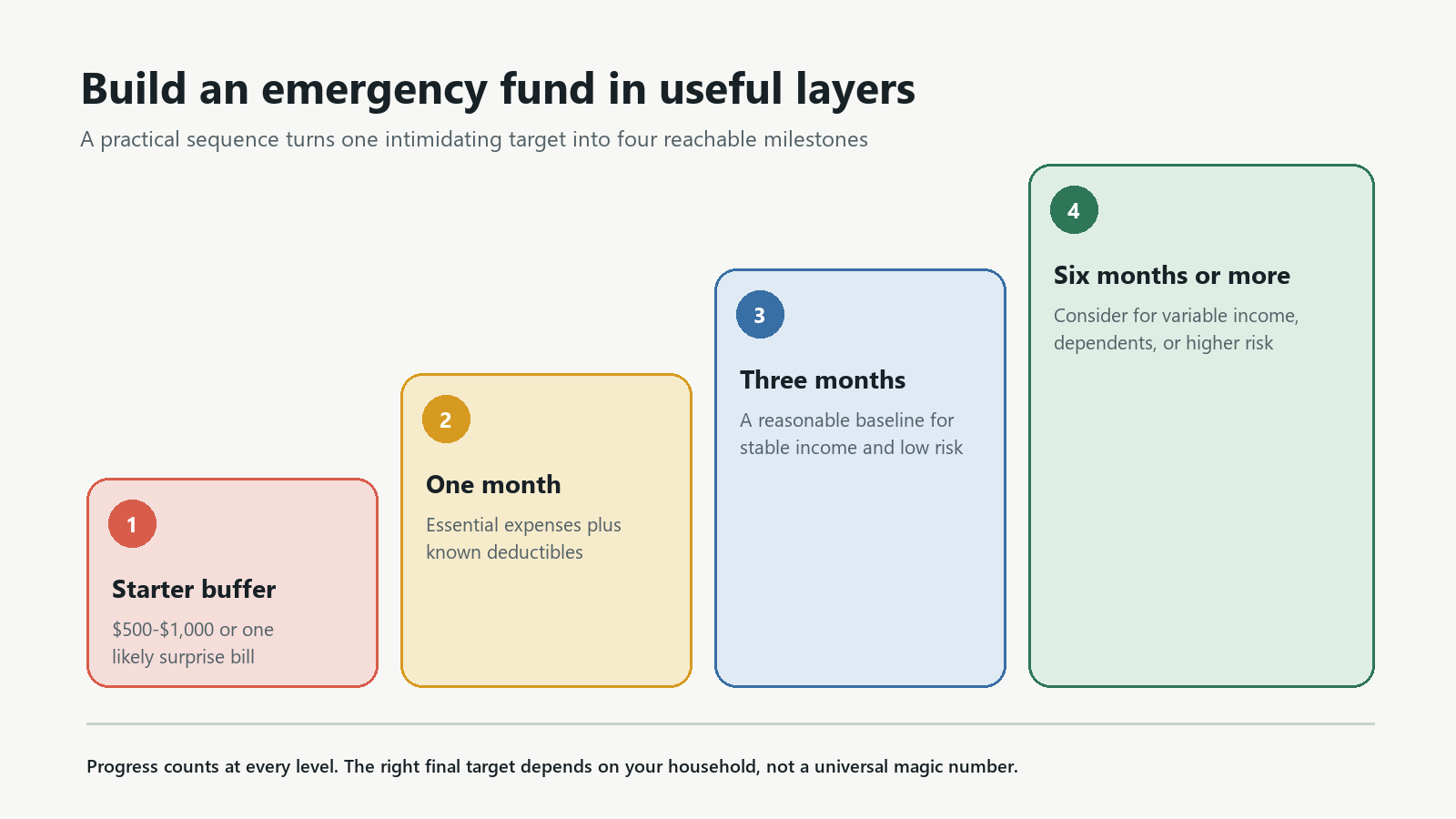
The ladder is psychologically useful because each level solves a different problem. A starter buffer can handle a tire, copay, or appliance repair. One month can prevent a delayed paycheck from becoming a crisis. Three months begins to address job loss. Six months or more buys resilience for households with greater uncertainty.
Special Considerations for Different Households
Homeowners
Homeowners face repairs that renters can call a landlord to handle. Add a realistic allowance for the most likely systems to fail and understand percentage-based wind or hurricane deductibles. Keep predictable roof, HVAC, and appliance replacement in sinking funds when possible so the emergency reserve remains available for true surprises.
Freelancers and business owners
Separate personal and business reserves. A personal emergency fund covers rent, food, and family obligations. A business reserve covers payroll, software, insurance, taxes, and slow-paying clients. Mixing them makes one balance appear to do two jobs. Base the target on a conservative income month, not last year’s best quarter.
Parents and caregivers
Childcare and care for an older relative may continue even when income stops. Medical travel, unpaid leave, or a school closure can create costs without resembling a traditional emergency. A larger cushion can protect both the household and the person receiving care.
Retirees and near-retirees
Retirees may not need job-loss protection, but they do need liquidity. Cash can prevent selling investments during a market decline to pay for a roof, car, or medical expense. The right amount depends on guaranteed income, withdrawal strategy, insurance, and upcoming large expenses.
Where Should You Keep an Emergency Fund?
An emergency fund has three jobs: remain safe, remain accessible, and earn a reasonable return without taking meaningful principal risk. It is insurance before it is an investment.
- High-yield savings account: usually the simplest home for most of the fund. Compare annual percentage yield, fees, minimums, transfer times, and withdrawal access.
- Bank money market deposit account: can offer savings-like interest with transaction features. Confirm that it is a deposit account, not a money market mutual fund.
- Federally insured credit-union account: another practical option, particularly if the credit union offers competitive rates and convenient access.
- Short certificates or Treasury bills: potentially useful for the upper layers of a large fund, but only when maturities are staggered and enough money remains immediately accessible.
The FDIC automatically insures qualifying deposits to at least $250,000 per depositor, per insured bank, for each ownership category. Federally insured credit unions provide similar protection through the National Credit Union Share Insurance Fund. Verify the institution and understand how accounts in the same ownership category are combined.
Do not put the core emergency fund in stocks, cryptocurrency, or another asset that could fall sharply when you need it. A money market mutual fund is an investment and is not FDIC-insured, even if purchased through a bank. Treasury bills are backed by the federal government, but selling a bill held directly in TreasuryDirect before maturity requires transferring it to a bank, broker, or dealer. That is not ideal for money you may need tonight.
Keeping the fund at a separate institution can reduce casual spending, but test the transfer process before relying on it. The perfect interest rate is not useful if access takes several days and the repair shop needs payment now.
Emergency Savings vs. Paying Off Debt or Investing
This is where reasonable people disagree because the math and the risk point in different directions. Paying a 24% credit-card balance creates a powerful guaranteed interest saving. Holding cash earning much less appears inefficient. But sending every spare dollar to the card leaves the household vulnerable to the next repair, which may go straight back onto the card.
A balanced sequence often looks like this:
- Build a starter buffer large enough to prevent common surprises from becoming new debt.
- Capture any valuable employer retirement match if the budget allows.
- Attack high-interest debt while continuing a small automatic savings contribution.
- Expand the emergency fund toward one month and then the risk-adjusted target.
- Increase long-term investing after the short-term foundation is stable.
The order can change for imminent job risk, an unsafe vehicle, overdue necessities, or a promotional debt rate that will soon expire. The central idea is to avoid treating liquidity and debt reduction as enemies. A modest cash buffer helps the debt payoff plan survive real life.
Raiding retirement should usually be a last resort. The IRS notes that hardship distributions are generally taxable and may also face an additional early-distribution tax unless an exception applies. A limited emergency personal expense exception may apply to eligible distributions, but the money still leaves a tax-advantaged account and loses future growth. Our compound-interest guide shows why replacing those lost years can be difficult.
How to Build the Fund Without Feeling Overwhelmed
Do not begin with “I need $20,000.” Begin with the next useful milestone. The Consumer Financial Protection Bureau emphasizes that even a small amount can provide security and recommends strategies such as managing cash flow, saving part of one-time inflows, automating transfers, and splitting direct deposit.
- Automate a survivable amount. Twenty dollars that transfers every payday is better than an ambitious transfer that repeatedly causes overdrafts.
- Use windfalls deliberately. Direct part of a tax refund, bonus, gift, or side-hustle payment to the next milestone.
- Save the payment after a debt ends. When a loan is paid off, redirect some or all of that old payment before lifestyle spending absorbs it.
- Keep the goal visible. Track progress by milestones rather than staring only at the distant final number.
- Rebuild after using it. An emergency fund that paid for an actual emergency succeeded. Replenishment is the next job, not a reason for guilt.
If the monthly budget has no room, start by mapping the cash flow rather than hunting for a dramatic cut. Due-date changes, canceled subscriptions, insurance shopping, a temporary spending pause, or a small income increase may create a repeatable gap. The site’s real-world budgeting case study demonstrates how to assign every dollar a purpose.
Be cautious about using Buy Now, Pay Later as a substitute for savings. A short 0% plan can help with timing, but several plans can claim the same future paycheck. Our guide to BNPL risks in 2026 explains how harmless-looking installments stack.
Emergency Fund FAQ
Is $1,000 enough for an emergency fund?
It is a useful first milestone, not a universal finish line. One thousand dollars can cover many repairs and deductibles, but it will not replace several months of income for most households.
Should a credit card count as an emergency fund?
No. Credit can be a secondary backup, but it is borrowed money with changing limits, approval risk, and potentially high interest. An emergency fund is money you already own.
Should I keep emergency savings separate from checking?
Usually. A separate account makes the balance easier to track and harder to spend casually. Keep enough in checking to prevent timing problems, then hold the reserve somewhere safe and reasonably quick to access.
How often should I update the target?
Review it at least annually and after a move, job change, marriage, divorce, birth, major insurance change, home purchase, or large increase in essential expenses. Inflation and life changes can quietly make an old target too small.
The Bottom Line
The answer to “How much emergency fund should I have?” begins with essential monthly expenses and ends with household risk. Three months is a sensible baseline for many people. Six months may be better for a single-income family, homeowner, caregiver, or specialized worker. A freelancer or household facing unusual uncertainty may reasonably choose more.
Build it in layers. Reach the first useful buffer, then one month, then the target that fits your life. Keep the money safe, accessible, and separate from routine spending. Most importantly, remember what the balance is buying: not merely interest, but breathing room when life refuses to follow the budget.
This article provides general educational information, not individualized financial, tax, or legal advice.
Sources and Further Reading
- Federal Reserve: Emergency Savings and Unexpected Expenses
- Federal Reserve: Economic Hardships in 2025
- BLS: Unemployed People by Duration of Unemployment
- CFPB: An Essential Guide to Building an Emergency Fund
- FINRA: How to Prepare for and Survive Financial Hardship
- FDIC: Deposit Insurance
- NCUA: Share Insurance Coverage FAQ
- IRS: Retirement Plan Hardship Distributions