

Buy Now, Pay Later can be a useful budget tool, but the biggest Buy Now, Pay Later risks appear when several “small” installments begin competing for the same paycheck. The offer sounds almost frictionless: take the item home today, pay 25% now, and divide the rest into three payments. If the plan charges no interest and you pay on time, what could go wrong?
Often, nothing does. Most BNPL loans are repaid, and a carefully planned pay-in-four purchase can be cheaper than carrying a credit-card balance. But “interest-free” does not mean consequence-free. Automatic withdrawals can trigger bank fees, returns can become awkward, different plans can overlap, and the tiny number displayed at checkout can make the full purchase price feel less important than it really is.
This is not a lecture about never financing anything. It is a practical guide to how Buy Now, Pay Later works in 2026, why merchants offer it, who uses it, where people get into trouble, and how to decide whether those four easy payments actually fit your life.
How Does Buy Now, Pay Later Work?
Buy Now, Pay Later, usually shortened to BNPL, describes several kinds of point-of-sale installment credit. This article focuses on the familiar pay-in-four version. A purchase is split into four equal payments over about six weeks. The first payment is generally due at checkout, followed by three automatic payments every two weeks.
For a $400 purchase, that usually means $100 today, $100 in two weeks, $100 in four weeks, and $100 in six weeks. The plan commonly advertises 0% interest when payments arrive on time. Approval may use a soft credit inquiry and the provider’s own history with the borrower rather than the traditional underwriting used for a large personal loan.
Pay-in-four is not the same as every financing offer labeled BNPL. Longer installment plans may charge interest, sometimes at rates that deserve the same scrutiny as a credit card or personal loan. Before accepting any offer, look for the annual percentage rate, total of payments, late-fee policy, payment dates, return process, and whether autopay is required. The cheerful button at checkout is not the contract.
The market has grown remarkably quickly. The Federal Reserve, citing CFPB market data, reports that the number of pay-in-four loans from major providers grew from 19.8 million in 2019 to 335.8 million in 2023. Dollar volume increased from $2.7 billion to $45.2 billion over the same period. Monthly use of major BNPL apps rose from about 10 million users in early 2021 to roughly 45 million by the end of 2024.
Why Retailers Love Four Easy Payments
Retailers do not put BNPL buttons beside the checkout total as a public service. They offer them because financing can help turn hesitation into a sale. A shopper who pauses at “$240” may feel comfortable with “four payments of $60,” even though the underlying price is identical.
The merchant typically pays the BNPL provider for delivering that convenience and receives its money without waiting for the customer to finish all four installments. The provider then manages repayment and takes the lending risk. From the store’s perspective, the fee can be worthwhile if more shoppers complete purchases or choose a more expensive item.
Research supports that logic, with an important caveat. A study published through the National Bureau of Economic Research found that adding BNPL increased a merchant’s sales by 20%, with larger effects among less-creditworthy customers and products where the merchant had more pricing power. The study examined a delayed-payment product at a German online furniture retailer, not every U.S. pay-in-four plan, so 20% should not be treated as a universal rule. It does show why sellers are willing to subsidize financing: the payment option can change what people buy.
This is a form of price framing. Our brains do not always evaluate “$240 total” and “$60 today” with the same emotional weight. The installment becomes the focal number, while the remaining obligation gets pushed into a future that feels less urgent. BNPL did not invent this quirk; car dealers, subscription services, and phone carriers have long emphasized monthly payments. Digital checkout simply places the technique one tap away.
That does not make the offer dishonest. It does mean the shopper should mentally reverse the framing. Ask, “Would I still buy this at the full price?” before asking whether the installment fits.
Who Uses BNPL, and Who Is Most Likely to Pay Late?
The latest nationwide snapshot comes from the Federal Reserve’s 2025 Survey of Household Economics and Decisionmaking, published in May 2026. It found that 16% of U.S. adults had used BNPL during the previous year, up from 10% when the survey first asked about it in 2021.
Use was not evenly distributed. Twenty-two percent of adults ages 18 to 29 used BNPL, compared with 9% of adults age 60 or older. Adults with family income between $25,000 and $49,999 had the highest reported use at 23%. The survey also found higher use among women and among Black and Hispanic adults, even after accounting for factors such as income and age.
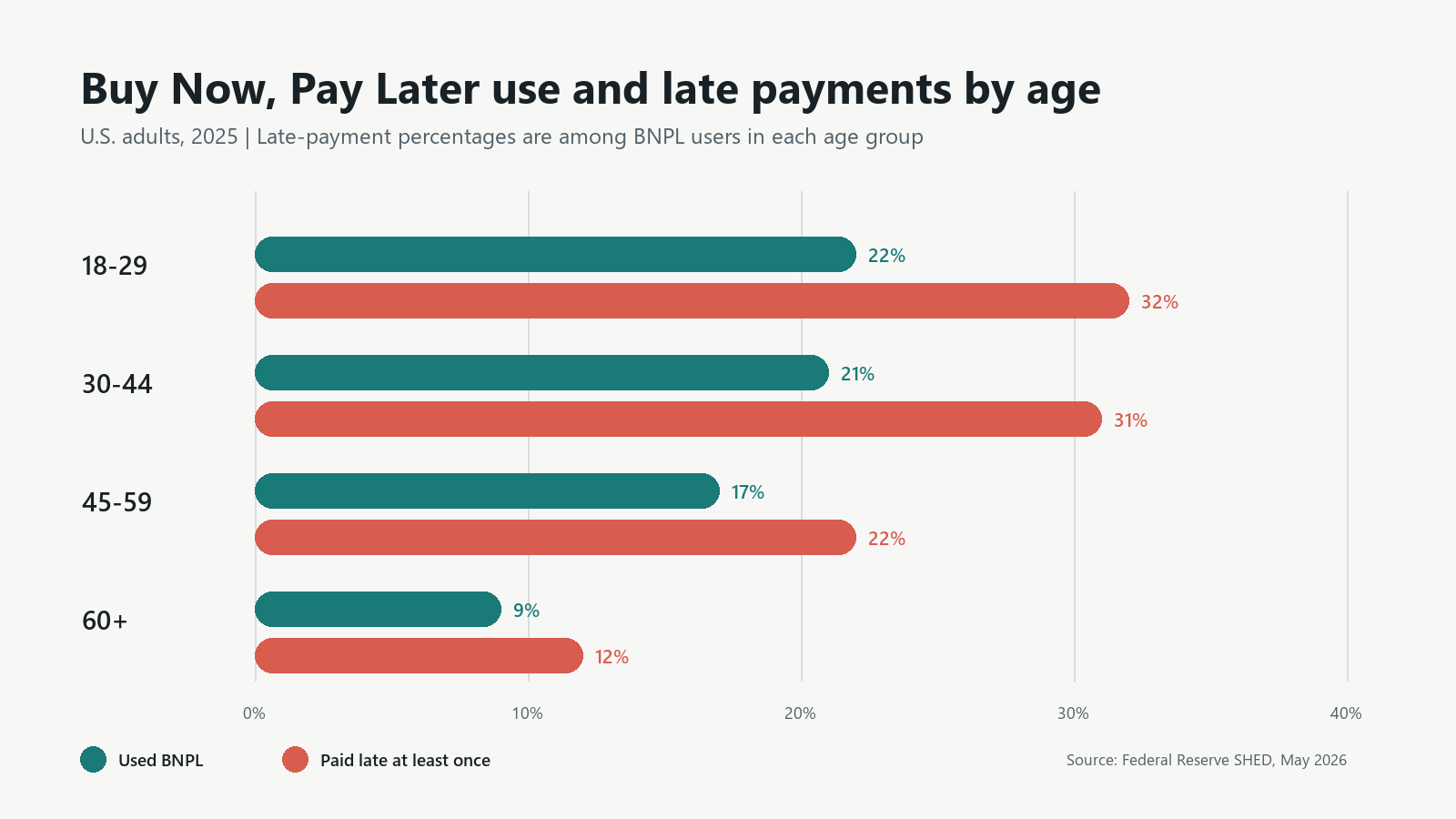
The repayment gap is more revealing than the adoption gap. Overall, 26% of users said they had paid late at least once during the prior year. That figure was 32% among users ages 18 to 29 and 31% among those ages 30 to 44, versus 12% among users age 60 or older. Among users with family income below $25,000, 40% reported a late payment; among those with income of $100,000 or more, 11% did.
Those numbers do not prove that BNPL caused financial distress. People who already have less savings or tighter budgets are more likely to need short-term credit in the first place. The direction can run both ways: financial pressure leads to BNPL use, and poorly managed BNPL obligations can add pressure. The practical lesson is still clear. The people who most need flexibility have the least room for an automatic payment to land at the wrong moment.
The Biggest Buy Now, Pay Later Risks
1. Several harmless-looking plans can become one large bill
A $30 installment may fit easily. So might a $20 installment. A $90 appliance payment can feel manageable too. The trouble appears when they overlap. Unlike one credit-card statement, BNPL schedules may be scattered across providers, apps, merchants, and different days of the month.
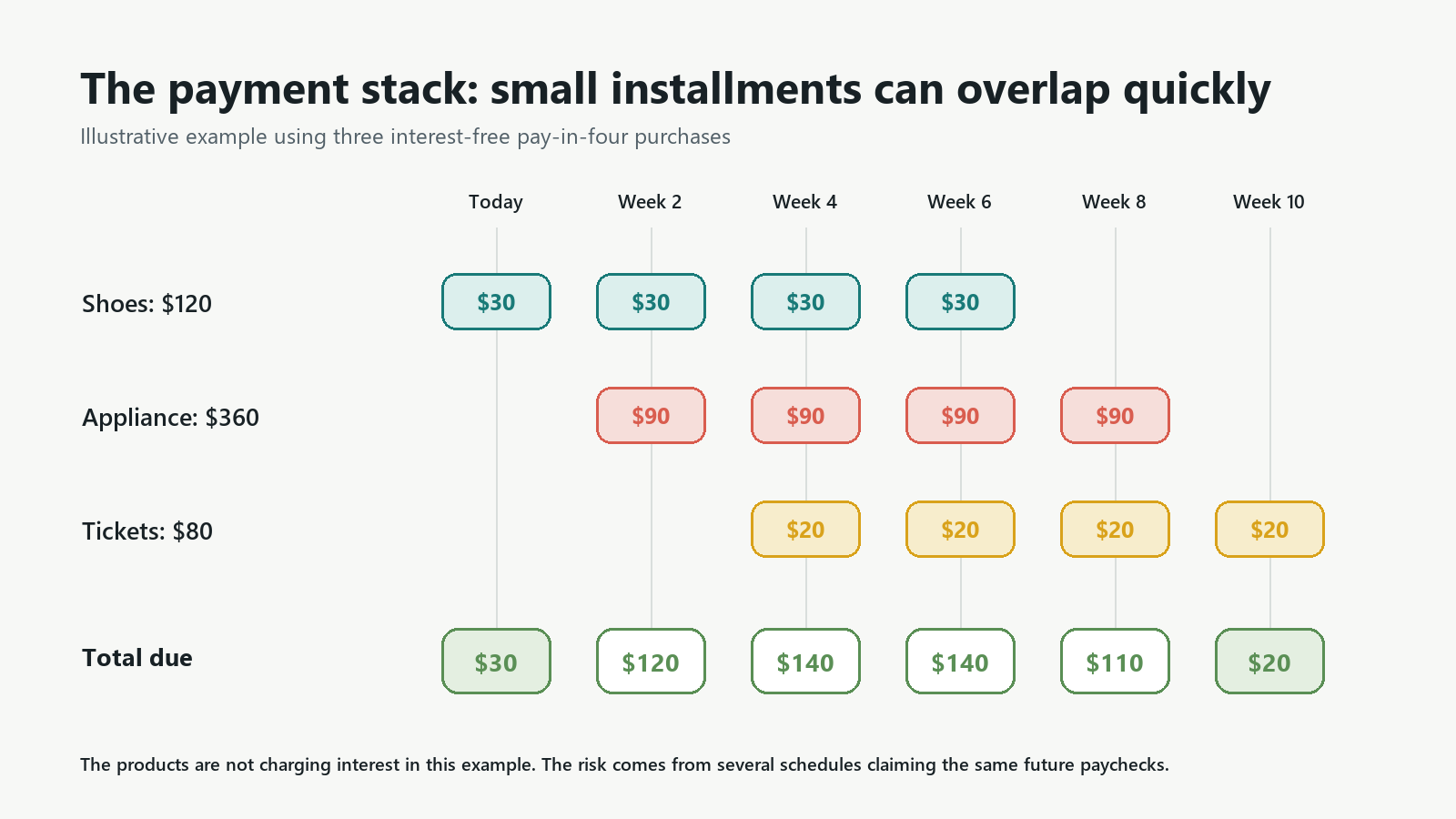
In the illustration, three purchases create obligations ranging from $20 to $140 every two weeks. None carries interest. All three can still strain the same checking account. This is the central BNPL risk: each decision is made separately, but your paycheck must absorb them together.
2. Zero interest can still produce fees
Most pay-in-four plans rely on automatic payments. If the linked account runs low, the provider may charge a late fee, the bank may charge an overdraft or non-sufficient-funds fee, or both. The Federal Reserve found that 11% of BNPL users had a payment trigger an overdraft or NSF fee in 2025. Among users who were charged extra for paying late, 38% also experienced an overdraft or NSF fee triggered by a BNPL payment.
The loan may advertise 0%, but a $35 bank fee attached to a $30 installment is very expensive credit in everything but name. Your own provider and bank terms determine the actual amounts.
3. Financing essentials is a warning light
BNPL began as an easier way to finance clothing, electronics, and furniture. It is now used for groceries, food delivery, medical care, and veterinary bills. One in five BNPL users in the Fed survey used it for groceries or food delivery. Of those users, 45% said the main reason was that BNPL was the only way they could afford the purchase.
The Federal Reserve’s August 2026 analysis found that people using BNPL for groceries or food delivery were more likely to face late-payment charges or a BNPL-triggered overdraft or NSF fee, even when compared with people at similar incomes. Among users who financed medical or veterinary procedures, 34% incurred one of those costs during the prior year.
Using BNPL once for an urgent necessity may be understandable. Repeatedly borrowing for food suggests a structural budget gap: the bills are larger than the income available to cover them. A six-week repayment schedule moves the shortage around; it does not repair it.
4. Your other lenders may not see the whole picture
Most pay-in-four lenders still do not routinely report these loans to the nationwide credit bureaus, according to the Federal Reserve. That can sound like a benefit, but it cuts both ways. On-time payments generally do not build your traditional credit history, and lenders may not see the full stack of BNPL obligations when evaluating a new loan.
Many consumers misunderstand this. In the 2025 Fed survey, 53% of BNPL users incorrectly believed that making on-time payments helped their credit score, and another large group was unsure. Only 14% answered both credit-history questions correctly. An unpaid account sent to collections can still damage credit even when ordinary on-time payments do not help it.
5. Returns and protections may not feel like a credit card
Returning a purchase does not necessarily stop the next automatic payment immediately. The merchant must process the return, the provider must apply the adjustment, and the timing may not match the debit date. Dispute procedures, refund timing, late fees, and hardship options vary by provider and product.
The regulatory picture also changed recently. The CFPB issued a 2024 interpretive rule addressing credit-card-style protections for certain BNPL accounts, then withdrew that guidance in May 2025. Federal and state consumer laws still apply in various ways, but shoppers should not assume every BNPL product provides the identical rights or procedures of a conventional credit card. Read the current terms and keep order, return, and payment records.
When Buy Now, Pay Later Can Be a Smart Tool
After that list of risks, it would be easy to declare BNPL bad. That would be too simple. Used deliberately, a genuine 0% pay-in-four plan can provide short-term flexibility without revolving interest.
- The purchase was already planned. You chose the item and price before seeing the financing button.
- The full cost fits your budget. You could pay cash, but spreading the timing helps preserve a reasonable checking-account buffer.
- The plan is truly free. There is no interest, origination fee, inflated price, or membership charge, and you understand the late-fee terms.
- Your income is predictable. Each payment date falls after money you reasonably expect to receive, not money you hope will appear.
- You track every installment together. One calendar or budget shows all providers and due dates.
- The item will outlast the loan. Financing a durable appliance for six weeks is easier to justify than paying for last month’s takeout with next month’s income.
BNPL can also be less costly than putting a necessary purchase on a high-interest credit card and carrying the balance, assuming the installments are paid on time and do not trigger fees. The comparison must include behavior, not just advertised rates. A 0% plan you miss can cost more than a card you repay promptly.
BNPL vs. Credit Cards, Layaway, and Saving First
| Option | Main advantage | Main risk or tradeoff |
|---|---|---|
| Pay-in-four BNPL | Often 0% interest with a short, fixed schedule | Autopay, stacking, fees, and fragmented tracking |
| Credit card paid in full | Grace period, one statement, and established dispute systems | Easy to begin carrying an expensive revolving balance |
| Credit card balance | Flexible minimum payment | Interest can compound and repayment can stretch for years |
| Layaway | No need to borrow or receive the item before it is paid for | You wait for the product and may face cancellation terms |
| Save first | No debt, no payment schedule, strongest negotiating position | You must delay the purchase and the item may sell out |
Saving first is usually the cleanest option for a nonessential purchase because it eliminates repayment risk. It is not always realistic for an urgent repair or medical expense. In those situations, compare the complete cost and protections of every available option, including a payment plan from the provider, a credit union small-dollar loan, or a hardship program.
If high-interest debt is already part of your budget, remember that interest can compound against you just as powerfully as it can work for savings. Our guide to how compound interest works shows why carrying an expensive balance for a long time matters more than the minimum payment makes it appear.
A Simple Test Before You Click “Pay in Four”
Use the word PLAN as a quick checkout test:
- P — Planned purchase: Would you buy it at the full price without the installment offer?
- L — Linked-account buffer: Will money remain in the payment account after every installment and regular bill clears?
- A — All payments visible: Have you added this plan to one list with every other BNPL, subscription, card, and bill?
- N — No rollover of necessities: Are you avoiding a cycle in which groceries, utilities, or old installments consume the next paycheck?
If any answer is no, pause. Put the item in the cart and wait 24 hours. Add the full price, not merely today’s installment, to your budget. The site’s real-world budgeting case study offers a simple way to map income, essentials, debt, saving, and discretionary spending before another obligation joins the list.
For plans you do accept, turn on payment alerts, keep a buffer in the linked account, save the terms and receipt, and check the provider’s app after a return. Consider using only one provider so the total is easier to see. A spreadsheet or calendar can work just as well as a finance app; the important part is one complete view.
What to Do If BNPL Payments Are Already Too Much
First, stop adding new plans. List every remaining payment, provider, due date, linked account, and possible fee. Compare that calendar with rent, utilities, food, transportation, insurance, and minimum debt payments. Essentials and consequences with the greatest severity come first.
Contact the provider before the payment fails and ask about changing the date, pausing a payment, or a hardship option. Availability varies, and changing autopay inside your bank account does not erase the debt. If a return or billing error is involved, document the merchant communication and open the provider’s dispute process promptly.
Also inspect the underlying budget gap. If recurring necessities exceed income, rearranging due dates buys time but does not solve the arithmetic. Look for benefits, community assistance, bill negotiation, income changes, or guidance from a reputable nonprofit credit counselor. Avoid taking a high-cost loan merely to make a 0% installment disappear unless you fully understand the new loan’s total cost.
Tools such as AI can help organize a payment list or draft a monthly plan, but they should not receive account credentials or make the decision for you. See our guide to using AI for personal finance safely for a sensible “ask, verify, decide” process.
Buy Now, Pay Later FAQ
Does Buy Now, Pay Later affect your credit score?
Most pay-in-four products do not routinely report on-time payments to the three major credit bureaus, so they generally do not help build a traditional credit history. Practices can change and longer-term installment products may work differently. A seriously delinquent debt sent to collections can still appear on a credit report.
Is Buy Now, Pay Later better than a credit card?
It can be cheaper than carrying a high-interest card balance if the BNPL plan truly charges 0% and every payment clears on time. A credit card paid in full may provide a grace period, consolidated tracking, rewards, and more familiar dispute procedures. Compare the complete terms and your own repayment habits.
What happens if you miss a BNPL payment?
Possible consequences include a late fee, an overdraft or NSF fee from the linked bank, suspension of future purchases, collection activity, or credit damage if the account reaches collections. The exact outcome depends on the provider, product, bank, and state law.
How many BNPL plans are too many?
There is no magic number. One plan is too many if it makes essentials or other bills difficult to pay. A useful personal limit is the number you can see in one place and repay from money already accounted for, with a buffer left in the linked account.
The Bottom Line
Buy Now, Pay Later is best understood as real credit wearing a convenient checkout interface. The short schedule and 0% offer can be useful, especially for a planned purchase with predictable cash flow. The danger is not necessarily the first four-payment plan. It is forgetting that every new plan places another claim on income you have not received yet.
Judge the full price, not the smallest number on the screen. Track all installments together. Keep money in the linked account. Treat groceries financed repeatedly as a budget alarm, not a clever payment trick. If the purchase works only when you ignore the other three plans already running, the honest answer is that it does not fit yet.
This article provides general educational information, not individualized financial or legal advice.
Sources and Further Reading
- Federal Reserve: Economic Well-Being of U.S. Households in 2025 — Credit
- Federal Reserve: Consumer & Community Context — Buy Now, Pay Later
- CFPB: The Buy Now, Pay Later Market
- CFPB: Consumer Use of Buy Now, Pay Later and Other Unsecured Debt
- Federal Reserve Bank of New York: Understanding Consumer Demand for Buy Now, Pay Later
- NBER: The Economics of Buy Now, Pay Later — A Merchant’s Perspective
- CFPB: Will a BNPL Loan Affect My Credit Scores?