

Why is homeowners insurance so expensive in 2026? If your renewal notice produced a moment of disbelief, you are not alone. Across much of the United States, homeowners are paying more to insure the same address. Some are also accepting larger deductibles, new exclusions, or less generous roof coverage. Others are discovering that their insurer will not renew the policy at any price.
It is tempting to blame one villain: inflation, climate change, greedy insurers, lawyers, regulators, or the old roof over your head. The uncomfortable answer is that homeowners insurance sits where all of those forces meet. A premium is the price of expected damage, uncertainty, capital, local market rules, and the coverage written into your contract.
That sounds abstract until the bill lands in your escrow account. So let us follow the money. We will look at what the latest national evidence shows, why prices vary so much by location, how an insurer builds a premium, and what homeowners can realistically do without accidentally buying a policy that looks cheap only because it covers less.
Homeowners Insurance Is Getting More Expensive and Harder to Find
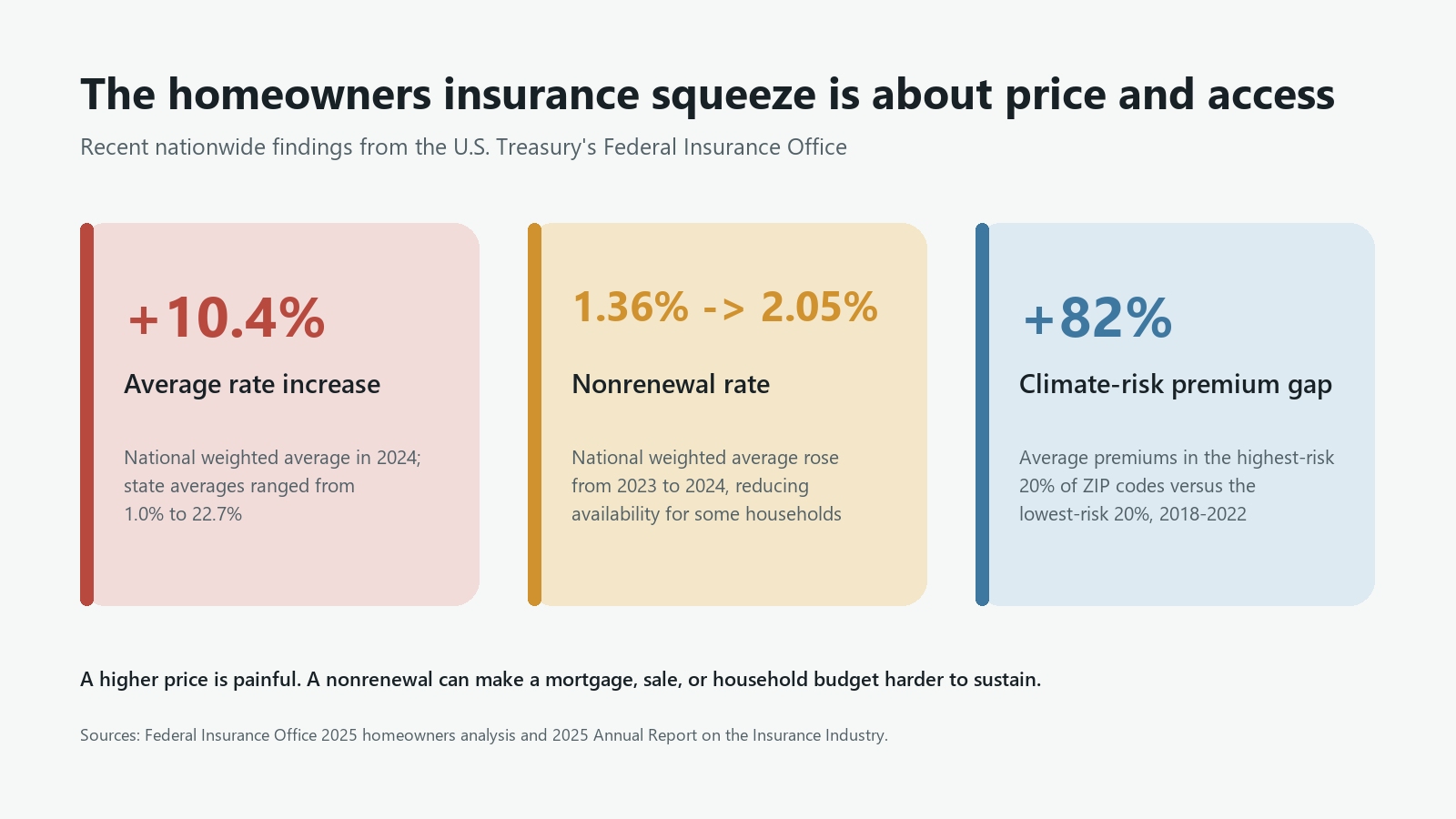
The broad trend is clear. The Federal Insurance Office’s 2025 Annual Report on the Insurance Industry says the national weighted-average homeowners rate increase was 10.4% in 2024. State averages ranged from 1.0% to 22.7%. The national weighted-average nonrenewal rate rose from 1.36% in 2023 to 2.05% in 2024.
A nonrenewal rate of 2.05% may sound small, but national averages hide concentrated problems. Ten states had average nonrenewal rates of at least 2% in 2024, compared with only two states one year earlier. For a homeowner with a mortgage, losing coverage is not merely inconvenient. Most lenders require insurance, so the owner must find a replacement policy, enter a state-backed residual market where available, or risk force-placed coverage that may be expensive and protect the lender more than the household.
The data will improve. In March 2026, state regulators launched what the National Association of Insurance Commissioners calls the most comprehensive national homeowners data collection to date. It covers policy years 2018 through 2025 and requests ZIP-code-level information on premiums, claims, deductibles, cancellations, nonrenewals, limits, replacement costs, and mitigation discounts. A public report is planned for 2027.
That timing matters. We have strong evidence that the market has tightened, but anyone claiming to know the complete 2026 national picture is getting ahead of the final data.
How a Homeowners Insurance Premium Is Built
Home insurance is a promise. You pay a known amount today so the insurer will pay an uncertain, potentially enormous amount later if a covered loss occurs. To price that promise, the company estimates how often claims will happen and how severe they will be.
Expected claims are only the beginning. The insurer also pays employees, agents, adjusters, technology vendors, taxes, and regulatory expenses. It maintains reserves and capital so one brutal hurricane or wildfire season does not make it insolvent. It may buy reinsurance, which is insurance for insurance companies. Finally, it needs a reasonable return for taking risk.
Your home’s market value is not the same as its insured replacement cost. Land may represent a large part of a home’s sale price, but the land does not need to be rebuilt after a fire. Conversely, a modest house in an expensive or remote construction market may cost far more to reconstruct than its depreciated structure appears to be worth.
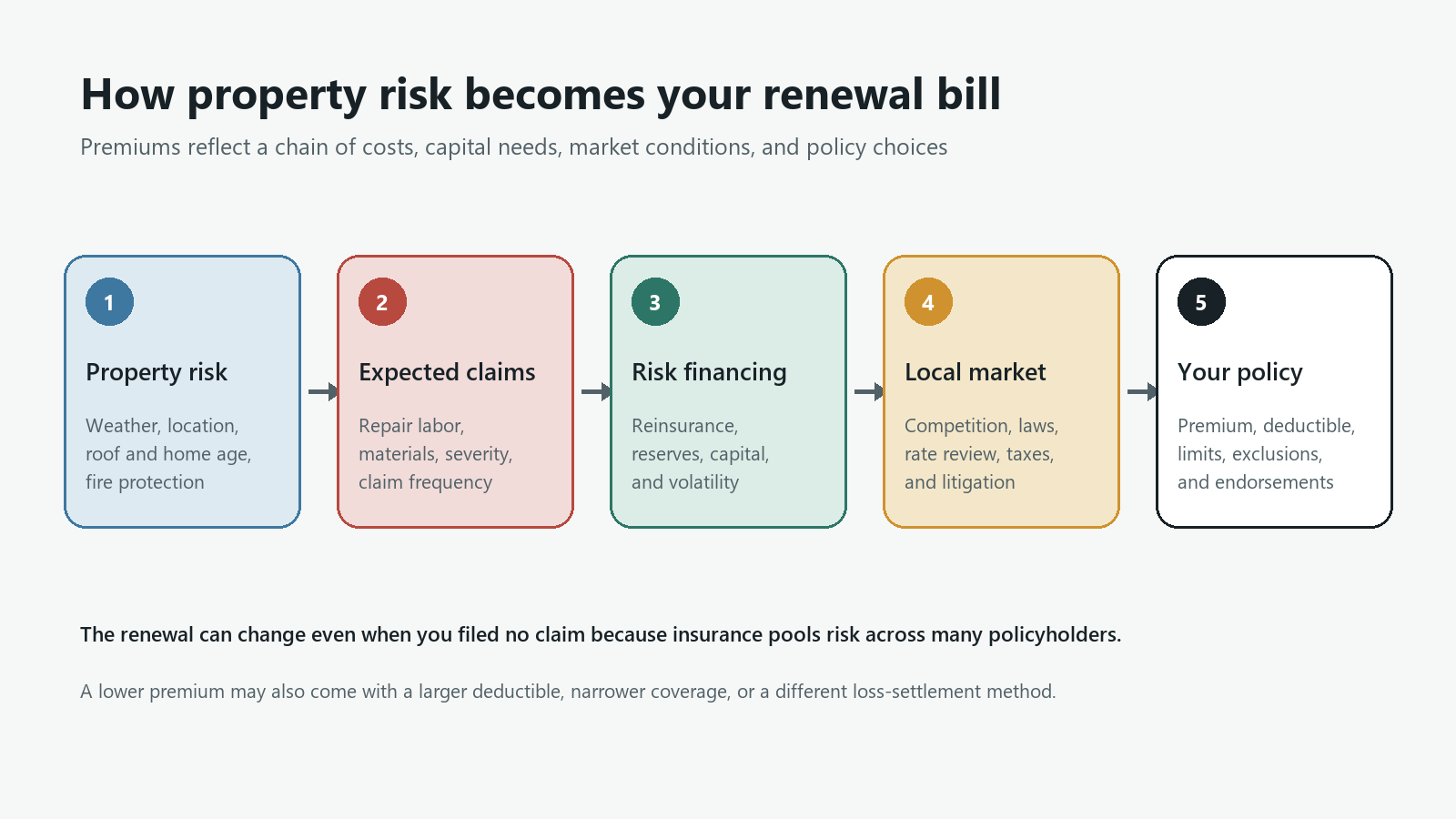
This chain explains why your renewal can rise even if you never filed a claim. Insurance pools risk. Your premium reflects not only your history but also the expected losses of similar homes, the insurer’s geographic concentration, updated catastrophe models, repair costs, and the price of capital across the portfolio.
Reason 1: Catastrophe Losses Are Larger and More Concentrated
Hurricanes and wildfires make headlines, but severe thunderstorms, hail, straight-line winds, freezes, and other regional events can generate a steady stream of expensive claims. The insurance problem is not simply that storms exist. More homes, infrastructure, and household wealth are located where damage can occur, while some hazards are becoming more severe or difficult to model.
The Treasury’s nationwide analysis of 246 million policy records from 2018 through 2022 found a striking risk gradient. Households in the 20% of ZIP codes with the highest expected annual climate-related building losses paid an average premium of $2,321, or 82% more than households in the lowest-risk 20% of ZIP codes. Average claim severity was about $24,000 in the highest-risk areas versus roughly $19,000 in the lowest-risk areas.
Nonrenewal rates were also about 80% higher in the highest-risk ZIP codes. That is the availability side of the problem. When an insurer believes it cannot charge enough to cover a location’s risk, it can tighten underwriting, reduce new business, require mitigation, or leave that slice of the market.
Reason 2: A Damaged Home Costs More to Repair
An insurer pays today’s repair bill, not the bill from when you bought the house. Lumber, roofing, appliances, electrical equipment, transportation, and skilled labor all affect claim severity. After a major regional disaster, demand surges just when roads, suppliers, and contractors are under strain. That can produce a temporary “demand surge” in rebuilding prices.
Building codes add another layer. Reconstructing an older home may require upgraded wiring, stronger roof connections, modern energy standards, or other improvements. Those changes can make the rebuilt home safer, but somebody must pay for them. Ordinance-or-law coverage is designed for some of these added costs, subject to the policy’s terms and limits.
This is why reducing the dwelling limit just to lower the premium can backfire. An outdated replacement-cost estimate may save a little now and leave a large gap after a total loss. Review the estimate, but challenge its assumptions rather than choosing a number solely because it produces a comfortable bill.
Reason 3: Reinsurance and Capital Have a Price
Insurance companies do not keep every dollar of catastrophe risk. They transfer part of it to reinsurers or capital-market investors. Reinsurance can keep a regional disaster from overwhelming one carrier, but the protection is not free.
When reinsurers reassess hurricane, wildfire, hail, or global catastrophe risk, the cost and terms of that protection can change. Primary insurers then face a choice: charge more, retain more risk, reduce coverage, write fewer policies, or add capital. The NAIC lists rising reinsurance costs alongside extreme weather, repair expenses, inflation, interest rates, and litigation as factors behind higher home and auto premiums.
Capital matters because claims arrive unevenly. A carrier can be profitable for several ordinary years and then face enormous losses in one season. Regulators require insurers to remain able to pay claims, so riskier portfolios generally need more financial cushioning.
Reason 4: Insurance Is Local, Regulated, and Unevenly Competitive
There is no single national homeowners price. States regulate insurance, and their systems differ. Some require prior approval before rates take effect. Others use file-and-use, use-and-file, flexible rating, or more competitive approaches. State law also affects claims, litigation, building standards, residual markets, and which rating factors are allowed.
Rate review protects consumers from prices that are excessive, inadequate, or unfairly discriminatory. But timing creates a difficult tradeoff. If approved rates lag far behind expected losses, insurers may restrict new policies or exit. If large catch-up increases arrive at once, households receive a severe affordability shock. The NAIC released a new draft white paper on homeowners rate regulation for public comment on September 25, 2026, showing how active this debate remains.
Competition matters too. When many financially healthy insurers want your business, shopping can produce meaningful savings. When only a few carriers remain willing to cover a particular roof age, coastline, wildfire zone, or claim history, the homeowner has less bargaining power.
Your Price Can Rise Even When Your House Had No Claim
A claims-free history helps, but it does not isolate you from the pool. Insurers may update the replacement cost of your home, revise roof-age rules, change territory boundaries, alter discounts, inspect exterior conditions, or adopt a newer catastrophe model. Your area’s fire protection, hydrant distance, vegetation, storm exposure, theft experience, and construction type can all matter.
In states that permit it, a credit-based insurance score may also affect pricing. Renovations and additions can raise the amount at risk. Even an insurer’s own portfolio matters: a company that already covers too many nearby houses may limit additional concentration, while another carrier may be eager to enter the neighborhood.
That is why two neighbors with similar homes can receive very different quotes. They may have different limits, deductibles, endorsements, claim histories, discounts, roof ages, or insurers with different appetites for the area.
The Hidden Increase: Higher Deductibles and Narrower Coverage
Premiums are only one part of the renewal. A policy can become more expensive in practice even when the price increase looks modest.
- Percentage deductibles: A 2% wind deductible on a home insured for $400,000 means the homeowner pays the first $8,000 of a covered wind loss.
- Actual cash value: Some roof settlements subtract depreciation rather than paying full replacement cost.
- Peril exclusions: Wind, hail, water backup, wildfire, or other hazards may require separate terms or coverage.
- Lower sublimits: Jewelry, electronics, home-business property, or temporary living expenses may have limits below what the homeowner expects.
- Stricter conditions: The insurer may require roof replacement, brush clearance, updated wiring, or other work to renew.
A Federal Reserve Bank of Minneapolis survey of multifamily housing owners illustrates the pattern. It was a small convenience sample, so it should not be treated as a national estimate, but respondents reported higher premiums, rising deductibles, and more wind and hail exclusions. Those costs can eventually affect renters too.
Why Headline Inflation May Not Match Your Insurance Bill
Homeowners sometimes ask how their premium can jump while inflation appears much lower. Part of the answer is timing and local risk. Another part is statistical design.
The Bureau of Labor Statistics explains that the Consumer Price Index uses a rental-equivalence approach for owner-occupied housing. Insurance covering physical damage to the structure and liability is generally outside that measure. Renters insurance and the portion of homeowners premiums associated with personal belongings are included, but most structural homeowners coverage is not.
So the CPI is not saying your renewal did not rise. It is measuring consumer housing costs using a framework that does not place the full structural premium in the basket. This is one reason household experience and a familiar inflation headline can diverge.
Insurance Costs Now Shape the Housing Market
Insurance used to be a smaller line item in many home-buying calculations. In expensive or hazard-prone markets, it can now determine whether a monthly payment works at all. A buyer may qualify for principal and interest but fail the total-payment test after taxes, insurance, association fees, and flood or wind coverage are included.
Existing owners can feel the increase through escrow. If the mortgage servicer paid a larger premium than expected, the next escrow analysis may require both a higher ongoing payment and repayment of the shortage. The change can arrive months after the insurance renewal, which makes it feel mysterious.
At the community level, scarce insurance can reduce buyer demand, complicate closings, weaken property values, and pressure rental operating costs. This connects directly to the broader affordability issues in our guides to the future of home prices and the 2026 housing market.
What Homeowners Can Do About Rising Premiums
You cannot negotiate away regional catastrophe risk, but you can make a better buying decision. Start with an apples-to-apples comparison. A quote is not cheaper if it quietly changes replacement cost to actual cash value, removes water backup, raises a wind deductible, or cuts a useful endorsement.
- Shop before renewal. Compare several insurers or use an independent agent. Check financial strength and complaint information through your state insurance department.
- Compare the declarations pages line by line. Match dwelling limits, loss settlement, deductibles, liability, additional living expenses, exclusions, and endorsements.
- Choose a deductible you can actually fund. A higher deductible can reduce the premium, but it converts insured risk into household risk. Keep that amount accessible.
- Ask about mitigation credits. Roof upgrades, storm shutters, fortified construction, water shutoff devices, alarms, updated electrical systems, or defensible space may qualify for discounts depending on the state and insurer.
- Review the replacement-cost estimate. Correct errors in square footage, construction type, finishes, or features, but do not underinsure the home simply to reach a desired premium.
- Review bundles as a total. A home-auto discount is useful only if the combined price and coverage are competitive.
- Create a home inventory. Photos, serial numbers, receipts, and records can make a claim easier and help you choose an appropriate personal-property limit.
- Ask what is not covered. Flood, earthquake, sewer backup, and certain wind risks may require separate coverage or endorsements.
Flood coverage deserves special attention. The National Flood Insurance Program emphasizes that most homeowners policies do not cover flood damage. From 2014 through 2024, almost one-third of NFIP claims came from outside high-risk flood zones. “Not required by my lender” is not the same as “no risk.”
If you receive a nonrenewal, act quickly. Ask for the reason in writing, correct factual errors, document completed repairs or mitigation, contact other carriers, and consult your state insurance department about consumer assistance or residual-market options. Do not let the policy lapse while you argue with the old insurer.
What Would Make Home Insurance More Affordable?
There is no painless policy fix because the underlying damage still has to be paid by someone: policyholders, insurers, reinsurers, taxpayers, property owners, or disaster victims. Holding premiums artificially low without reducing risk can drive insurers away or shift losses to public programs. Purely risk-based prices, however, can become unaffordable for households that cannot relocate or rebuild.
The most durable strategy combines transparent pricing with physical risk reduction. Stronger building codes, roof standards, defensible space, drainage, flood control, accurate maps, mitigation grants, and faster permitting can reduce expected losses. Targeted assistance can help vulnerable households without hiding the price signal from every property. Better public data can reveal where competition, coverage, and nonrenewals are deteriorating.
Land-use decisions matter as well. Building more homes in high-risk areas may ease a housing shortage today while creating larger insurance and disaster costs tomorrow. Those costs are externalities: part of the price appears later and may be shared across insurers, governments, and other policyholders. Our explainer on how externalities shape markets provides the economic framework.
The Bottom Line
Homeowners insurance is expensive in 2026 because the promise behind the policy is more expensive to keep. Insurers face larger and more concentrated catastrophe losses, higher repair bills, costly reinsurance and capital, and very different local legal and market conditions. Homeowners may also be paying more while carrying larger deductibles or narrower protection.
The practical response is not to chase the lowest number on a quote. Compare equal coverage, understand the deductible, verify replacement cost, ask about mitigation, and check the gaps that a standard policy leaves behind. A good policy is not the one with the smallest premium. It is the one that protects the risks you cannot comfortably absorb yourself at a price your household can sustain.
Sources and Further Reading
- U.S. Treasury: Homeowners Insurance Markets and Climate-Related Risks
- Federal Insurance Office: 2025 Annual Report on the Insurance Industry
- NAIC: 2026 Nationwide Homeowners Market Data Call
- NAIC: Why Are My Insurance Premiums Increasing?
- NAIC Homeowners Insurance Consumer Resources
- BLS: How Tenant and Household Insurance Is Measured in CPI
- Federal Reserve Bank of Minneapolis: Rising Property Insurance Costs
- National Flood Insurance Program: Buying Flood Insurance