
AI financial advice is having a very normal 2026 moment: people are using it, people are curious about it, and people are still not completely sure they trust it. That is probably the healthiest place to be. Tools like ChatGPT, Claude, Gemini, Copilot, and specialized finance apps can explain confusing terms, organize a budget, compare options, and help you ask better questions. But your money is not a low-stakes experiment. A confident-sounding chatbot can still be wrong, outdated, too generic, or missing the one detail that matters most in your situation.
So, can you trust AI with your money? The practical answer is: trust it as a helper, not as the final decision-maker. Use AI like a patient money coach, calculator checker, document explainer, and second set of eyes. Do not use it like a licensed financial planner, tax professional, attorney, insurance agent, or guaranteed stock picker.
This guide walks through where ChatGPT and other AI tools can genuinely help with personal finance, where AI financial advice gets risky, and how to build a simple “ask, verify, decide” process before acting on anything that affects your bank account, credit, taxes, investments, insurance, retirement, or debt.
Why People Are Turning to AI for Money Help
Money questions are often stressful because they combine math, rules, emotions, and real consequences. A person might understand that they need a budget, but still feel embarrassed looking at the numbers. Someone may want to compare credit cards, but get lost in rewards terms, interest rates, annual fees, and fine print. A new worker may hear “401(k), Roth IRA, HSA, vesting schedule, index fund, and expense ratio” all in the same week and quietly wonder if everyone else got a secret finance handbook.
That is where AI feels useful. It does not get impatient. It can explain the same concept five different ways. It can turn a messy list into a table. It can help you prepare questions before calling a bank, insurance company, student loan servicer, or financial advisor. It can also make financial education feel less intimidating, which matters because a lot of people avoid money decisions until the pressure gets uncomfortable.
The trend is already visible. Gallup reported in August 2026 that 18% of U.S. adults who sought financial guidance had used AI tools such as ChatGPT or Claude. The same Gallup study found that internet research was still the top source of money guidance, used by 73% of U.S. guidance-seekers, while 32% used professional financial advisors.
That mix says a lot. People are not replacing all money guidance with AI. They are adding AI to the same messy stack they already use: Google searches, family advice, social media, bank websites, financial apps, and professionals. The goal should be to make that stack smarter, not noisier.
The Trust Gap: AI Use Is Growing Faster Than AI Confidence
The most important thing to understand about AI money management in 2026 is the trust gap. Adoption is high, but confidence in fully automated financial decisions is much lower.
TD Bank’s 2026 AI Insights Report found that 78% of Americans reported using AI-powered tools in daily life, and 55% said they use AI to help manage their finances. TD also found that 62% believe AI can provide reliable information. But only 18% said they were comfortable allowing AI to make important financial decisions independently. Nearly half said human review of AI-generated guidance would increase their confidence.
Gallup found a similar caution. AI is being used for financial guidance, especially by younger adults, but no more than three in 10 adults in the U.S. or Canada reported at least some confidence in AI’s money expertise. In the U.S., only 3% said they had a great deal of confidence in AI as a financial guidance source. That is not anti-technology panic. It is reasonable caution.
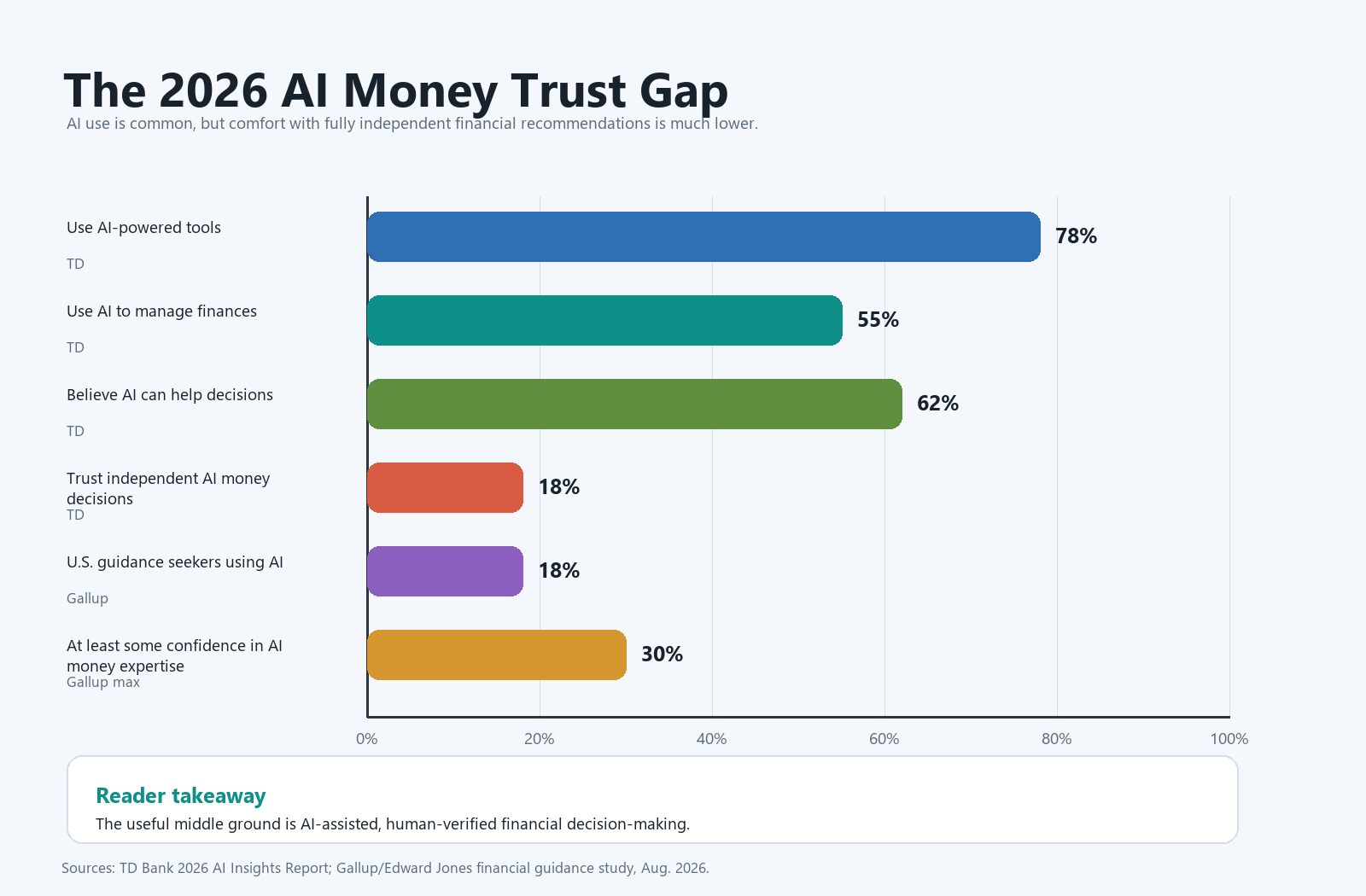
In plain English, people are saying: “Yes, I want AI to help me understand things faster. No, I do not want it moving money, picking investments, filing taxes, or deciding my retirement plan without human judgment.” That is the right instinct.
What ChatGPT Can Actually Help With
Used carefully, ChatGPT personal finance help can be very practical. The sweet spot is not “Tell me exactly what to do with my life savings.” The sweet spot is “Help me understand, organize, compare, and prepare.”
For budgeting, AI can turn a list of expenses into categories, suggest questions to ask about spending habits, and help build a monthly budget template. For debt, it can explain the difference between avalanche and snowball payoff methods, show how interest changes the timeline, and help draft a call script for negotiating a lower rate or asking about hardship options. For savings, it can help set goals, estimate timelines, and create reminders for emergency funds, sinking funds, or large purchases.
AI can also help with financial literacy. Ask it to explain “compound interest” like you are new to investing. Ask it to compare a traditional IRA and a Roth IRA at a high level. Ask it to define terms on a mortgage estimate. Ask it to summarize a benefits document and create a checklist of follow-up questions for HR. OpenAI’s official ChatGPT use-case library includes workflows such as reviewing budget-versus-actuals and tracking bills, subscriptions, and spending, which fits this practical support role.
Where AI shines is translation. It can translate financial jargon into normal language. It can translate a pile of transactions into a pattern. It can translate a vague worry, like “I feel broke even though I make decent money,” into concrete categories to inspect: housing, transportation, food, subscriptions, debt, taxes, childcare, healthcare, impulse spending, or irregular expenses.
A Good Rule: Let AI Draft, Explain, and Check
The safest everyday uses of AI budgeting tools are the ones where you remain the decision-maker. Here are good examples:
- Draft: Create a starter budget, email, savings plan, bill-negotiation script, or checklist.
- Explain: Translate terms, summarize documents, define concepts, and walk through calculations step by step.
- Check: Review your math, identify missing categories, challenge assumptions, and list questions for a human expert.
That last one is underrated. You can ask, “What could be wrong with this plan?” or “What assumptions am I making?” or “What information would a financial planner ask for before giving advice?” Those prompts turn AI from an answer machine into a thinking tool.
This is also a good way to use AI without pretending it is perfect. The value is not that it produces flawless answers. The value is that it helps you slow down, structure the problem, and notice things you might have skipped.
Where AI Financial Advice Gets Risky
The risk starts when AI moves from “help me understand” to “tell me exactly what to do.” Personal finance depends on details: income stability, tax filing status, state law, account types, age, health, debt terms, risk tolerance, family responsibilities, insurance coverage, job benefits, emergency savings, and goals. A chatbot may not know which of those details matter unless you provide them. Even then, it may fail to weigh them correctly.
The Journal of Financial Planning reviewed the emerging research on AI-based financial advice and noted both promise and concern. The paper described AI as accessible and low-cost, but also summarized studies finding weaknesses such as cookie-cutter recommendations, limited empathy, missing relevant details, and calculation errors in financial-planning scenarios.
The Consumer Financial Protection Bureau has raised related concerns about chatbots in consumer finance. In its report on chatbots in consumer finance, the CFPB warned that automated systems can struggle with complex problems, provide inaccurate or insufficient information, and make it harder for customers to reach a human when a problem needs real intervention.
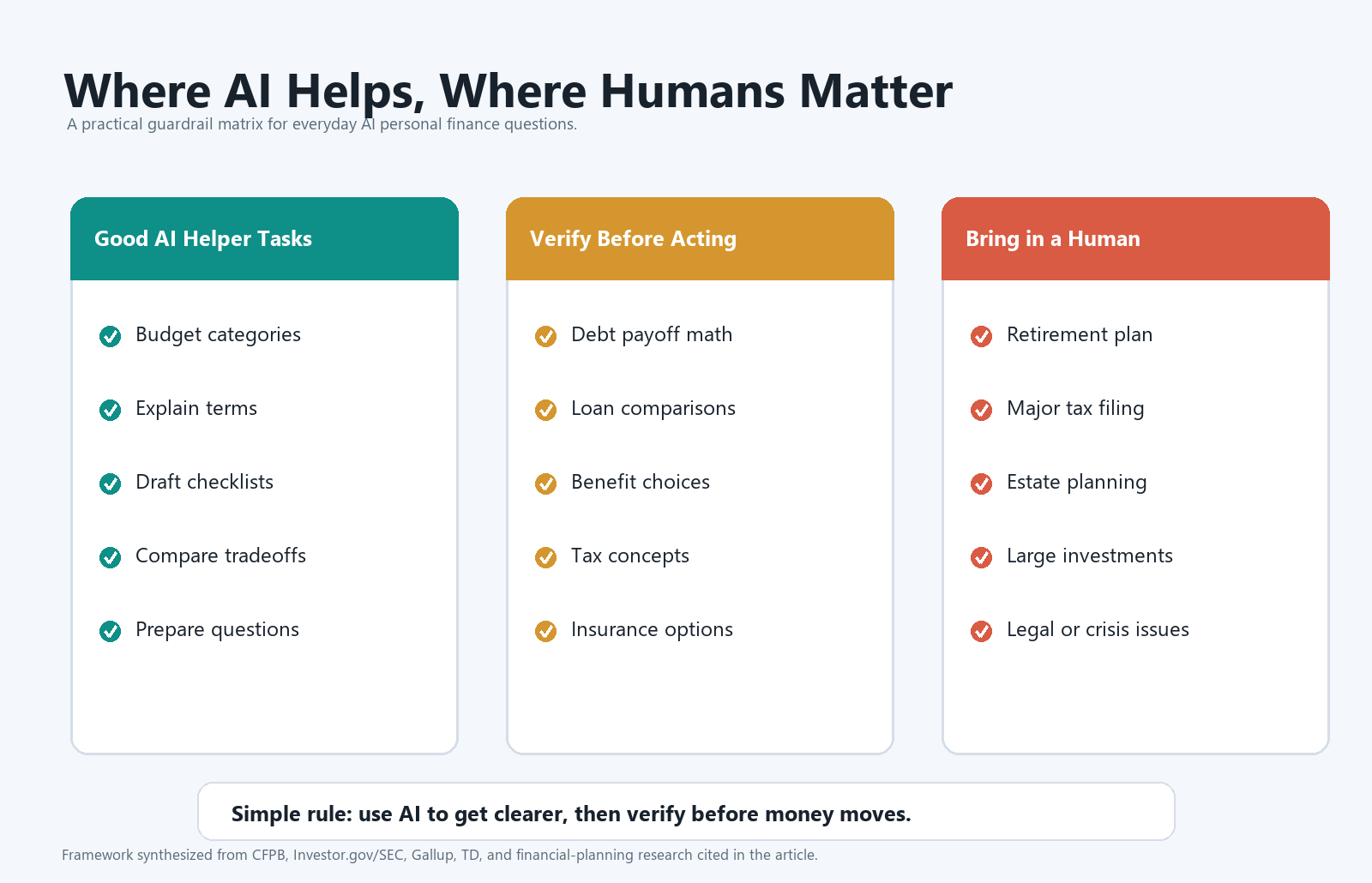
That does not mean “never use AI.” It means use the right tool for the right layer of the decision. AI is helpful for education, organization, brainstorming, and preparation. It is less appropriate for irreversible or highly personalized choices without verification.
Investing Is the Danger Zone
Investing is where people should be especially careful. A chatbot can explain index funds, diversification, expense ratios, bonds, risk tolerance, and why fees matter. It can help you compare broad concepts. But asking AI to pick stocks, predict the market, time crypto trades, or chase “guaranteed” returns is a different game.
Investor.gov’s AI and investment fraud alert, issued by the SEC Office of Investor Education and Advocacy with NASAA and FINRA, warns investors not to rely solely on AI-generated information for investment decisions. The alert notes that AI-generated information may be inaccurate, incomplete, misleading, outdated, or even made up, and it warns about scammers using AI buzzwords to promote fake trading systems and guaranteed-return claims.
That warning is worth taking seriously. AI can make bad advice sound polished. It can also make scams look more professional. Fake websites, deepfake videos, cloned voices, and realistic-looking investment pitches are easier to create than they used to be. If someone says an AI trading system “cannot lose,” that is not innovation. That is a red flag wearing a shiny jacket.
Fraud, Privacy, and the Personal Data Problem
Financial AI safety is not only about whether the answer is mathematically correct. It is also about what information you share and who might exploit it.
The FTC reported that people lost about $16 billion to fraud in 2025, with $3.5 billion reported lost to imposter scams alone. The CFPB’s updated scam guidance says common warning signs include pressure to act quickly, requests for money or personal information, unusual payment methods, and urgent emotional stories. The CFPB also notes that advances in AI make it easier for scammers to clone voices and alter images to impersonate people you know.
For everyday AI use, keep sensitive details out of the chat unless you fully understand the tool, account settings, and data policy. Do not casually paste Social Security numbers, full account numbers, tax returns, medical bills, loan applications, private employer documents, passwords, or children’s personal information into a general chatbot. Redact. Summarize. Use placeholders. Ask general questions first.
A safer prompt is: “I have three debts: one high-interest credit card, one student loan, and one car loan. What information should I gather before choosing a payoff strategy?” A riskier prompt is pasting full statements with identifying details and asking the chatbot to decide for you.
The Ask, Verify, Decide Framework
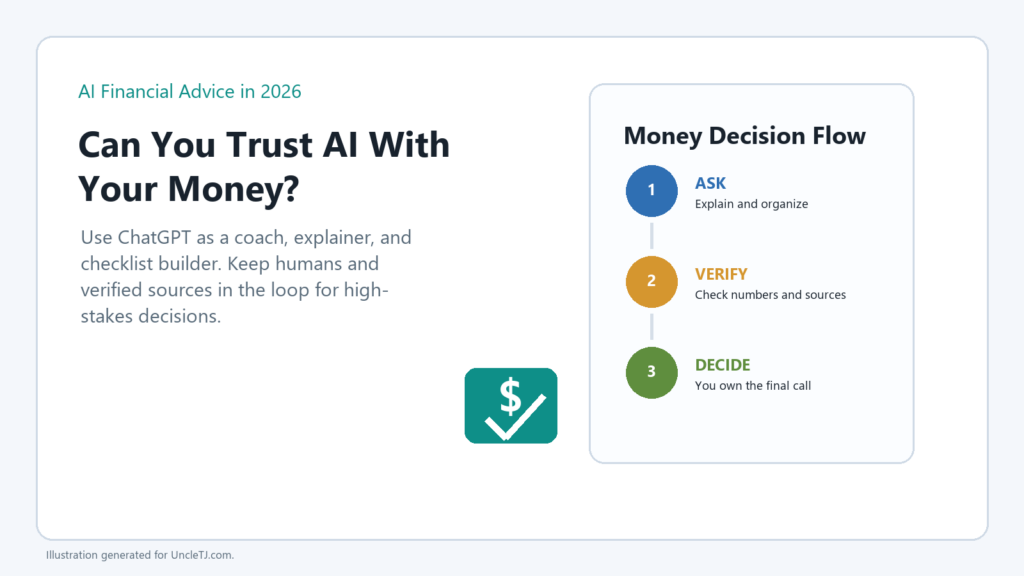
Here is a simple framework for using ChatGPT financial advice without handing it the steering wheel.
- Ask: Use AI to explain the issue, organize facts, create options, and identify questions.
- Verify: Check numbers against statements, official calculators, primary sources, or a qualified professional.
- Decide: Make the final decision yourself, especially when money moves, taxes are filed, credit is affected, or investments change.
That middle step is the magic. Verification turns AI from a tempting shortcut into a useful assistant. If AI says refinancing saves money, ask it to show the math, then check the lender’s numbers. If AI explains a tax rule, confirm it with IRS guidance or a tax professional. If AI compares investment ideas, verify fees, risks, time horizon, and whether the product is registered or suitable for you.
One helpful prompt is: “Before I act on this, list the facts I need to verify and the sources I should check.” Another is: “What would make this recommendation wrong?” A third is: “Give me a conservative version, an aggressive version, and the assumptions behind each.” Good prompts do not remove your responsibility. They make your responsibility easier to carry.
A Practical Prompting Playbook for Money Questions
If you want to use ChatGPT for personal finance, start with prompts that create clarity instead of commands that demand certainty.
- Budget: “Help me create a simple monthly budget template with categories for fixed bills, variable spending, debt, savings, and irregular expenses.”
- Spending review: “Here is a redacted list of expenses. Group them into categories and point out patterns I should inspect.”
- Debt: “Explain the debt snowball and debt avalanche methods, then give me a checklist of information needed to compare them.”
- Benefits: “Summarize these redacted benefit options in plain English and list questions to ask HR before enrolling.”
- Investing education: “Explain diversification, index funds, and expense ratios for a beginner. Do not recommend specific securities.”
- Professional prep: “Help me prepare questions for a certified financial planner about retirement, insurance, taxes, and emergency savings.”
Notice the pattern. You are not asking AI to become the authority. You are asking it to make you a better question-asker.
When to Bring in a Human Professional
Some situations deserve a human expert. Talk to a qualified professional when the decision is expensive, legally complex, tax-sensitive, emotionally charged, or hard to reverse. That includes retirement planning, estate planning, major tax decisions, business ownership, divorce, disability, inheritance, insurance gaps, high-interest debt distress, large investment changes, and buying or refinancing a home.
A human professional is not automatically perfect, of course. You should still ask questions, understand fees, check credentials, and watch for conflicts of interest. But the best human advisors bring context, accountability, regulatory obligations, empathy, and judgment that a chatbot does not fully provide.
Gallup’s findings are useful here: financial advisors had far higher confidence ratings than AI, and financially fulfilled adults were more likely to include professional guidance in their mix. That does not mean everyone needs a full-time advisor. It means the most confident money decisions often combine self-education, trusted people, and professional support when the stakes justify it.
Quick FAQ: Can You Trust AI With Money?
Is ChatGPT good for budgeting?
Yes, ChatGPT can be helpful for creating a budget template, organizing expense categories, brainstorming ways to reduce spending, and explaining tradeoffs. It should not be treated as a bank-connected budgeting system unless you are using a trusted app designed for that purpose.
Can AI give investment advice?
AI can explain investing concepts, but you should be very cautious about specific investment recommendations. Verify information through primary sources and consider talking with a registered professional before making major investment decisions.
What should I never paste into an AI chatbot?
Avoid pasting Social Security numbers, full account numbers, passwords, tax returns, medical details, private employer files, children’s personal information, or anything that could cause harm if mishandled. Use redacted summaries and placeholders instead.
Final Takeaway
AI can be a very useful personal finance assistant. It can explain, organize, summarize, calculate, brainstorm, and help you prepare better questions. For many people, that is a real step forward because financial information often feels scattered, intimidating, or written for someone else.
But trust should rise with verification, not with confidence of tone. ChatGPT and other AI tools are strongest when they help you understand your money, not when they replace your judgment. Use AI to get clearer. Use trusted sources to verify. Use human professionals when the stakes are high. That balance gives you the best of the new tools without treating your financial life like a beta test.
Sources and Further Reading
- Gallup: Where Americans and Canadians Turn for Financial Guidance
- TD Bank: 2026 AI Insights Report
- Journal of Financial Planning: AI-Based Financial Advice: Who Is Interested?
- Consumer Financial Protection Bureau: Chatbots in Consumer Finance
- CFPB: Classic Warning Signs of Fraud and Scams
- Investor.gov: Artificial Intelligence and Investment Fraud
- Investor.gov: Phishing, Smishing, and Vishing Scams
- Federal Trade Commission: 2025 Imposter Scam Losses
- Official OpenAI documentation: ChatGPT use cases