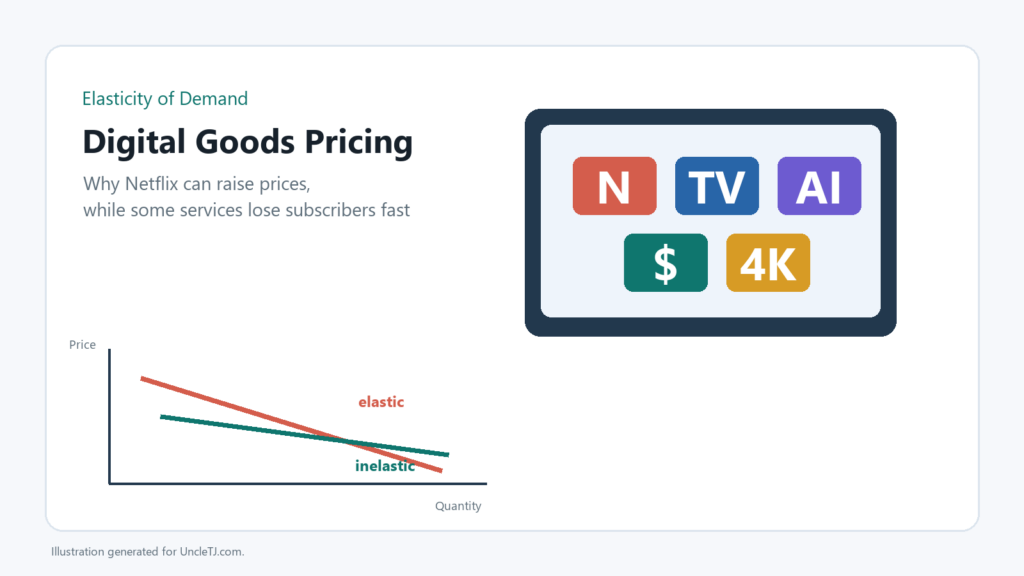

Elasticity of demand for digital goods sounds like a textbook phrase, but it explains something we all feel in real life: why Netflix can raise prices and many people keep paying, while another streaming app raises prices and suddenly everyone remembers the cancel button exists.
The same idea shows up in electronics, cable TV, video games, cloud storage, software subscriptions, music apps, e-books, and even smartphone upgrades. Some digital products are sticky. Some are easy to replace. Some feel essential. Others feel like clutter on the credit card bill. That difference is elasticity.
Here is the friendly version: demand is inelastic when customers do not reduce purchases very much after a price increase. Demand is elastic when customers quickly cut back, switch, delay, cancel, or find a substitute. For digital goods, elasticity depends less on the fact that the product is digital and more on whether the customer feels locked in, delighted, dependent, or surrounded by alternatives.
What Price Elasticity of Demand Means
In economics, price elasticity of demand measures how much the quantity demanded changes when price changes. If a company raises price by 10% and loses only 3% of customers, demand is relatively inelastic. If it raises price by 10% and loses 20% of customers, demand is elastic.
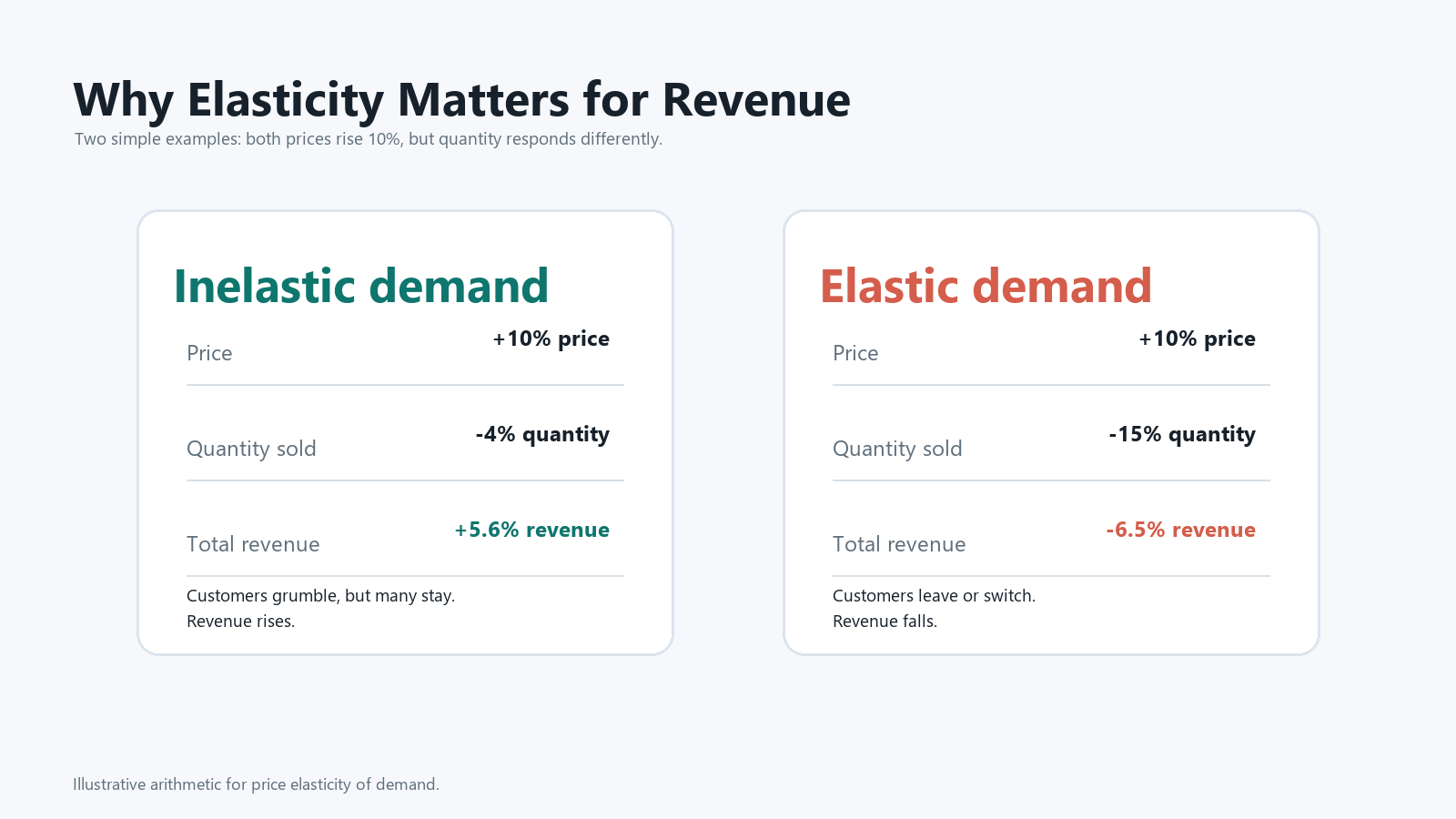
This matters because price increases do not automatically increase revenue. If customers barely leave, revenue rises. If customers leave faster than price rises, revenue falls. That is why pricing is not just math. It is psychology, substitutes, habits, income, brand loyalty, search costs, switching costs, and timing all tangled together.
Digital goods make the puzzle even more interesting because the marginal cost of serving one more customer can be tiny. Once the software, show, song, or cloud platform exists, delivering another copy is cheap compared with making the original. That sounds like prices should fall toward zero, but they often do not. Why? Because customers are not paying for the copy. They are paying for access, convenience, identity, ecosystem fit, exclusivity, and time saved.
Why Digital Goods Behave Differently From Physical Goods
A physical product has obvious limits. If a retailer sells a laptop, it must source another laptop. If a cable company sends a technician, it uses labor and equipment. Digital goods are different. A streaming movie, software license, downloadable game, online course, or e-book can be delivered again and again with very low incremental delivery cost.
But low delivery cost does not mean low business cost. Netflix still spends heavily on content. Software companies pay engineers, cloud bills, security teams, support staff, and sales teams. Video game makers spend years building a title before launch. The economics are often high fixed cost and low marginal cost. That creates a strong incentive to scale and a strong temptation to raise prices once customers are attached.
Digital goods also make switching unusually easy in some cases and unusually hard in others. It takes seconds to cancel a streaming service. That makes demand more elastic. But it may take weeks to move a business from one cloud platform to another. That makes demand more inelastic. A family may cancel a niche streaming app after one show ends, but keep Netflix because it has broad use across ages, moods, and devices.
Why Netflix Can Raise Prices While Other Services Struggle
Netflix is the obvious example because it has repeatedly tested pricing power. Its current U.S. help page lists Standard with ads at $8.99 per month, Standard at $19.99, and Premium at $26.99. In its Q2 2026 shareholder letter, Netflix said Q2 revenue grew 13% year over year to $12.6 billion, driven by membership growth, pricing, and ad revenue. It also said first-half price changes in markets including the U.S. had gone as expected.
That does not mean Netflix subscribers love price hikes. Nobody throws a party for a higher bill. The point is that Netflix has several defenses against elastic demand.
- Breadth: Netflix is not one show. It has movies, series, documentaries, comedy, animation, international content, kids programming, reality shows, live events, games, and more.
- Habit: It is already installed on TVs, phones, tablets, game consoles, and cable boxes. Habit lowers the mental cost of staying.
- Household value: One subscription may serve multiple people with different tastes. That spreads the perceived cost.
- Originals and exclusives: Unique content reduces substitutes. If the show you want is only there, the competing service is not a perfect replacement.
- Ad tier: A lower-priced plan gives price-sensitive customers somewhere to go other than leaving completely.
This is pricing power. It does not make demand perfectly inelastic, but it bends the response. A smaller service with one hit franchise may face a very different curve. Once the season ends, customers can churn, return later, or swap to a competitor.
Streaming Services: Substitutes Make Demand More Elastic
Streaming is crowded now. A household can choose Netflix, Disney+, Hulu, Max, Peacock, Paramount+, Apple TV+, Prime Video, YouTube, Tubi, Pluto TV, Roku Channel, sports packages, video games, podcasts, social video, or simply less screen time. The more substitutes customers see, the more elastic demand becomes.
Deloitte’s 2026 Digital Media Trends survey makes this tension clear. It reported that the average subscribing household spends $69 per month on streaming video services, 41% of consumers canceled a paid streaming service in the last six months, and 61% said they would cancel their favorite service if its monthly price increased by $5. That is a flashing sign that many streaming subscriptions are discretionary.
The funny part is that streaming can be both sticky and fragile. A service can feel essential during a major show, sports season, or live event. Then it becomes optional again. That is why companies care so much about release cadence, bundles, sports rights, password-sharing rules, ad tiers, and personalized recommendations. They are all attempts to reduce elasticity.
Cable TV Shows What Happens When Substitutes Arrive
Cable used to have much more pricing power because it bundled local channels, sports, news, entertainment, and household convenience into one package. For many years, the choice was cable or very little. That made demand less elastic.
Then streaming, broadband, smart TVs, and live TV apps changed the substitute set. Nielsen’s April 2026 Gauge report said streaming had 47.6% of TV viewing while cable had 21.6%. Industry tracking cited by Light Reading reported U.S. pay-TV providers lost about 2.03 million subscribers in Q1 2026. The old bundle did not become useless, but it became much easier to replace.
This is cross-price elasticity in action. When the price or attractiveness of substitutes improves, demand for the older product weakens. A cable bundle can still be valuable for sports, news, older viewers, and convenience. But the price increase that once stuck may now trigger cord-cutting.
Electronics: Hardware Demand Has Its Own Elasticity Story
Electronics are not pure digital goods, but they are part of the same ecosystem. Phones, TVs, tablets, routers, game consoles, and laptops are gateways to digital services. Their demand often behaves differently from streaming subscriptions because the purchase is larger, less frequent, and easier to delay.
A $2 monthly streaming increase may feel annoying but manageable. A $1,200 phone upgrade feels like a decision. If last year’s phone still works, demand for the new model may be elastic. People wait for discounts, trade-in offers, carrier promotions, or a larger feature jump. That is why consumer electronics sellers often compete through financing, bundles, ecosystems, upgrade programs, and trade-ins instead of simple sticker-price increases.
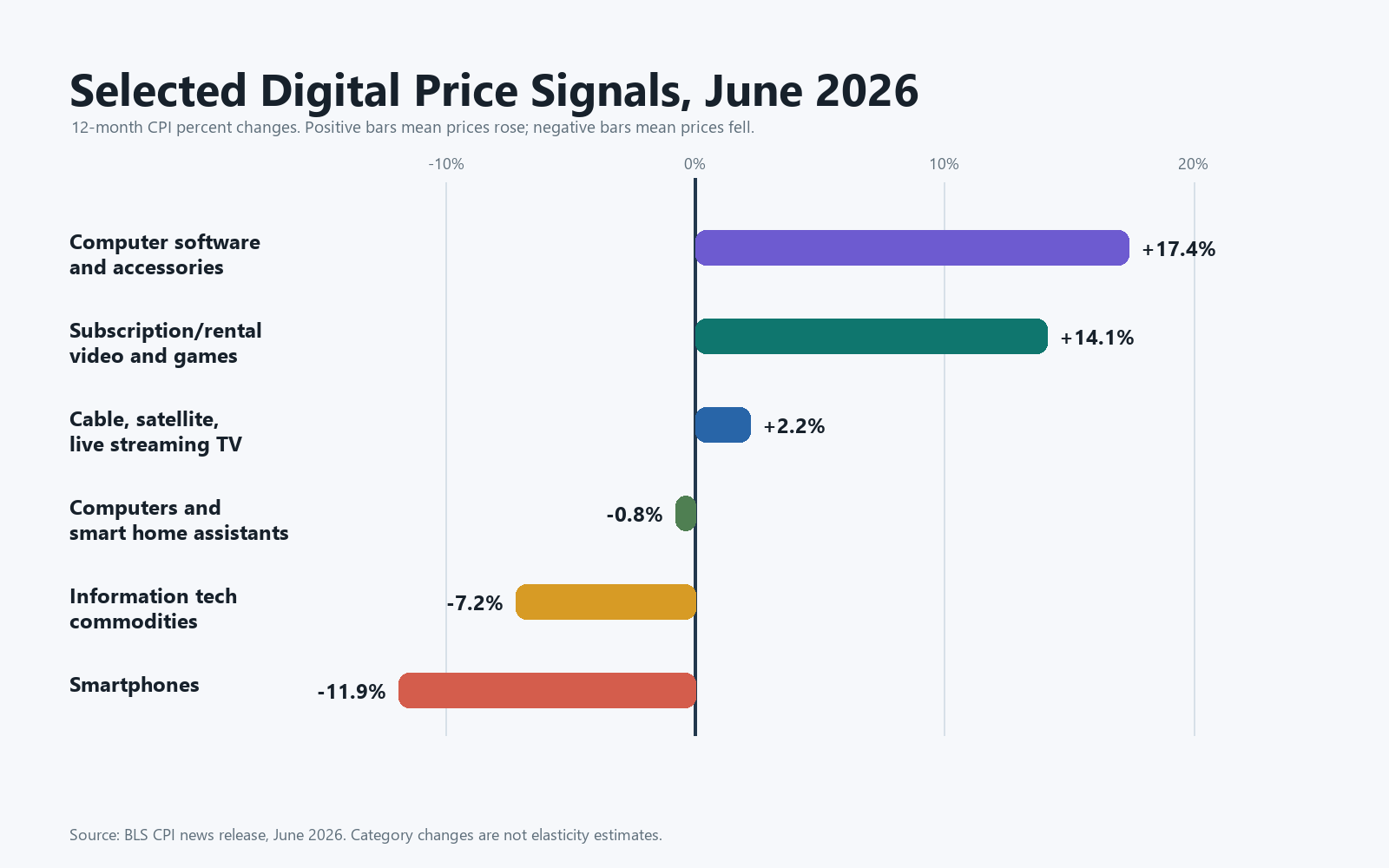
The BLS June 2026 CPI release shows how different these categories can look. Subscription and rental of video and video games was up 14.1% over 12 months, while information technology commodities were down 7.2% and smartphones were down 11.9%. Those CPI figures are not elasticity estimates, but they show very different pricing environments.
What Makes Demand Less Elastic for Digital Goods?
If you want to understand why one digital product can charge more than another, look for these elasticity reducers:
- Few good substitutes: Exclusive shows, must-have software, unique games, or specialized professional tools.
- High switching costs: Files, playlists, workflows, business data, team habits, saved settings, and integrations.
- Network effects: A platform becomes more useful because other people are already there.
- Small share of income: A low monthly fee may not be worth the time it takes to reconsider.
- Bundling: A product tied to internet, mobile, cloud storage, shipping, music, or sports can hide the price of each piece.
- Emotional attachment: Fans do not behave like casual users. They are more willing to pay for access, identity, and continuity.
This is why a professional software tool can raise prices more easily than a casual mobile app, and why a streaming service with a deep catalog can behave differently from one that relies on a single release. The product with more embedded value has a steeper demand curve.
What Makes Demand More Elastic?
Now flip the list. Demand becomes more elastic when customers can easily compare prices, switch quickly, or live without the product. That is bad news for undifferentiated digital goods. A meditation app with dozens of similar competitors, a news subscription with free alternatives, or a streaming service with a thin catalog may have trouble raising prices.
AI may make this even more intense. If AI tools can generate acceptable graphics, music, writing, code snippets, summaries, study guides, or templates, then some digital goods face more substitutes. But AI can also make demand less elastic for platforms that use it to improve personalization, recommendations, search, content production, customer service, or productivity. As usual, the tool is not the whole story. The business model matters.
Quick Examples: Elastic or Inelastic?
Netflix: More inelastic than many streaming peers because it has breadth, habit, originals, international content, and multiple price tiers. Still not invincible.
A small streaming service with one hit show: More elastic. Viewers can subscribe for one month, binge the show, and leave.
Cable TV: Historically inelastic, now more elastic because streaming and live TV apps provide substitutes.
Smartphones: Mixed. Essential once owned, but upgrades can be elastic because many people can delay replacing a working device.
Professional software: Often inelastic for businesses because workflows, training, compliance, and file compatibility raise switching costs.
Casual apps and simple digital content: Often elastic because substitutes are everywhere and cancellation is easy.
Final Takeaway
The elasticity of demand for digital goods is really a story about customer power. When customers have lots of substitutes, low switching costs, and weak attachment, they punish price increases quickly. When a product is useful, habitual, unique, bundled, or emotionally important, customers may grumble but stay.
That is why Netflix can often raise prices while weaker streaming services struggle. It is not because digital goods are magically immune to the law of demand. It is because Netflix has built enough value, habit, and breadth to make its demand curve less elastic than many competitors.
For consumers, the lesson is simple: subscriptions are small one at a time but large as a stack. For businesses, the lesson is sharper: if your digital product is easy to replace, price increases are dangerous. If you want pricing power, build something customers would actually miss.
Sources and Further Reading
- OpenStax: Price Elasticity of Demand and Supply
- Netflix Help Center: Plans and Pricing
- Netflix Q2 2026 Shareholder Letter
- Deloitte: 2026 Digital Media Trends press release
- Nielsen: April 2026 Gauge report
- Light Reading: U.S. pay-TV subscriber losses in Q1 2026
- BLS: Consumer Price Index, June 2026
- BLS: Measuring price change for computers and smart home assistants