

It is easy to talk about the super wealthy as if they live in a separate economy. In some ways, they do. A billionaire’s net worth can move by more in one market day than many families will earn in a lifetime. But the rise of the super wealthy is not just a rich-list story. It is also a story about income inequality, wealth inequality, housing, wages, retirement accounts, stock ownership, business formation, and whether everyday people feel that economic growth is showing up in their lives.
The short version is this: the economy can grow while the rewards become more concentrated. That is why headlines about record stock markets, record billionaire wealth, or strong corporate profits can sit right next to headlines about families feeling squeezed by rent, groceries, medical bills, child care, and student debt. Both stories can be true at the same time.

To make sense of it, we need to separate two ideas that often get mixed together. Income is money coming in, such as wages, salaries, business income, dividends, and interest. Wealth is what you own after subtracting what you owe. Wealth includes homes, retirement accounts, stocks, businesses, cash, and other assets. A household can have a good income but little wealth if most of its money goes to bills. Another household can have modest yearly income but large wealth because it owns assets that have grown for decades.
That distinction matters because the rise of the super wealthy is mainly a wealth story. High salaries matter, but the biggest fortunes usually come from owning appreciating assets: company stock, private businesses, real estate, intellectual property, and investment portfolios. When those assets rise, owners benefit. When most households own few assets outside a home or retirement account, the gains are uneven from the start.
Income inequality is visible, but wealth inequality is bigger
The U.S. Census Bureau’s latest annual income report is a useful starting point. In Income in the United States: 2024, Census reported median household income of $83,730 in 2024, not statistically different from 2023 after inflation adjustment. The same report said the Gini index, a common income inequality measure, was also not statistically different from 2023. That sounds stable, and for one year it was.
But one year of relative stability does not erase the longer trend. Census also reported that household income at the 90th percentile rose 4.2% from 2023 to 2024, while income at the 10th and 50th percentiles did not change significantly. In plain English, higher-income households had a better year than many households closer to the middle or bottom.
Even that does not fully capture what people feel. Income data generally tell us about annual cash flow. Wealth data tells us who has the cushion, who can absorb a layoff, who can help children buy a home, who can invest during downturns, and who can wait while assets compound. That is why wealth inequality often feels more powerful than income inequality. It shapes options.
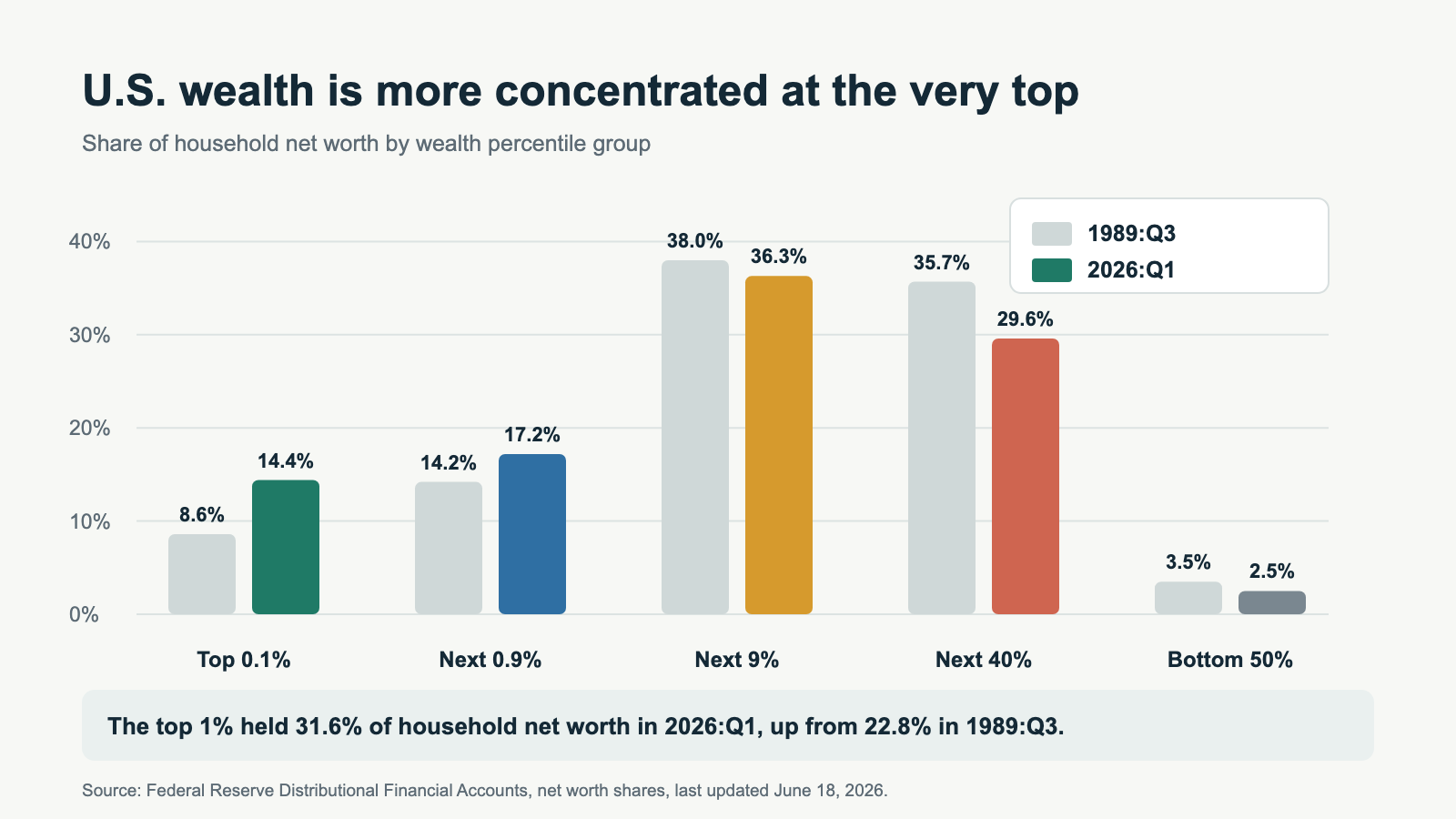
The Federal Reserve’s Distributional Financial Accounts show the change clearly. In 1989:Q3, the top 1% held 22.8% of U.S. household net worth. By 2026:Q1, that share had risen to 31.6%. The top 0.1% alone held 14.4% in 2026:Q1, up from 8.6% in 1989:Q3. Meanwhile, the bottom 50% held 2.5% of household net worth in 2026:Q1.
Why the super wealthy are pulling away
The rise of the super wealthy is not caused by one simple thing. It is the result of several forces working together over many years. Some are about technology. Some are about tax policy. Some are about globalization. Some are about market structure. Some are about who owns assets before a boom begins.
Technology has made scale more valuable. A software company, digital platform, chip designer, or artificial intelligence business can serve customers across the world without adding workers in the same proportion as revenue. That can create enormous wealth for founders, early employees, and investors. It can also create fantastic products and productivity gains. The tricky part is that the ownership of those gains is usually concentrated.
Financial markets are another driver. The super wealthy tend to own more stocks, private equity, venture capital stakes, and business equity. When asset prices rise, they benefit first and most. A middle-class household might own stock through a 401(k), which is helpful, but the scale is different. A 10% gain on a $50,000 retirement balance is meaningful. A 10% gain on a $5 billion equity stake is life-changing at a different order of magnitude.
Business ownership also compounds. If you own a company, you may earn income from it, borrow against it, sell part of it, or pass it to heirs. When the company becomes more valuable, your balance sheet expands even if your paycheck does not. That is why a conversation about income equality quickly becomes a conversation about asset ownership.
Executive pay plays a role too. The Economic Policy Institute reported that average realized compensation for CEOs at the top 350 U.S. firms was $22.98 million in 2024, and that CEOs were paid 281 times as much as a typical worker. Because much executive compensation is tied to stock awards and options, executive pay also connects the labor market to the asset market.
The billionaire boom is not just a U.S. story
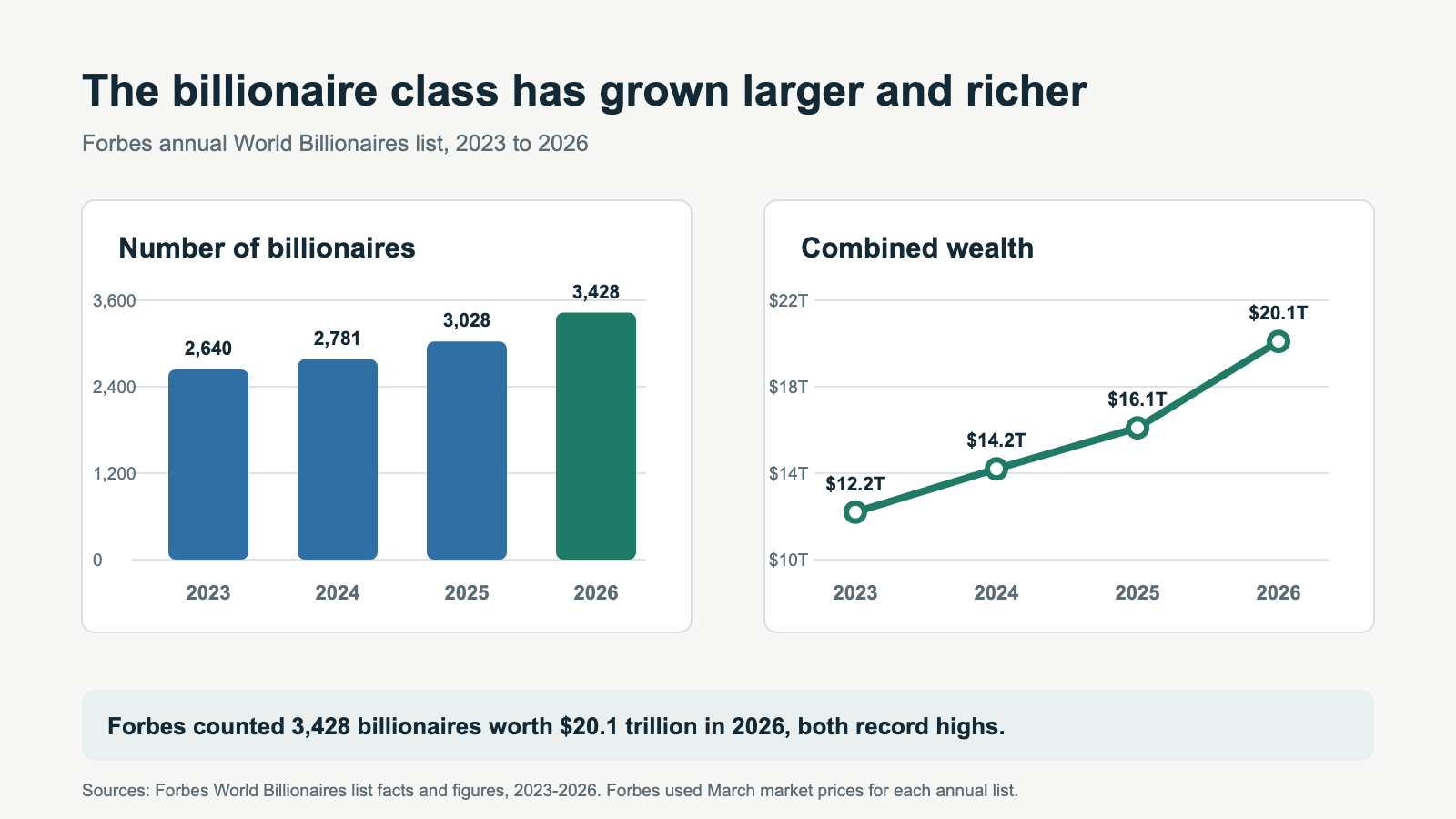
The growth of billionaire wealth has become a global trend. Forbes’ annual billionaires data shows how fast the top end has expanded in just a few years. In 2023, Forbes counted 2,640 billionaires worldwide with a combined net worth of $12.2 trillion. In 2024, the count rose to 2,781 and combined wealth reached $14.2 trillion. In 2025, Forbes counted 3,028 billionaires worth $16.1 trillion. By the 2026 World Billionaires list, Forbes counted 3,428 billionaires worth $20.1 trillion.
That is a large jump in a short period. It does not mean every billionaire got richer every year, and rich-list estimates are not perfect. Private assets are difficult to value. Stock prices move constantly. Some people fall off the list while others enter. Still, the direction is hard to miss: the global billionaire class has grown larger, and its combined wealth has grown faster.
The United States remains central to that story. Forbes reported a record 989 U.S. billionaires in 2026. That reflects the country’s deep capital markets, large technology sector, entrepreneurial culture, venture capital ecosystem, and willingness to reward founders and investors when companies scale. Those strengths can create innovation and jobs. They can also widen the wealth gap when ownership is concentrated among a relatively small group.
Why this matters for everyday households
Some people hear “wealth inequality” and think it is just about envy. That misses the point. The issue is not that one person has a larger house or a nicer vacation. The issue is what happens when economic security, opportunity, and influence become too unevenly distributed.
First, wealth is a buffer. A family with savings and assets can handle a medical bill, car repair, job loss, or slow month in a small business. A family without wealth has fewer choices. It may rely on credit cards, payday loans, family help, or going without. That difference can turn one emergency into years of financial strain.
Second, wealth helps people invest in the future. It can pay for college, a down payment, job training, child care, relocation, or starting a business. When wealth is concentrated, opportunity can become concentrated too. Children from wealthier families often begin adulthood with less debt and more support. Children from less wealthy families may work just as hard but start farther back.
Third, wealth can buy patience. Investors with large balance sheets can wait out recessions, buy assets when prices fall, and hold investments through volatility. Households living paycheck to paycheck often have to sell, borrow, or delay at exactly the wrong moment. Over time, that can reinforce the gap.
Finally, wealth can become influence. Large donors, major shareholders, corporate leaders, and asset owners have louder voices in politics, media, philanthropy, universities, and local development. That influence is not always bad. Many wealthy people fund medical research, scholarships, museums, climate work, and local charities. But in a democracy, extreme concentration raises a fair question: whose preferences shape the rules?
What causes the gap to feel worse than the numbers
One reason inequality feels so frustrating is that the official numbers can lag lived experience. A household may see its income rise on paper, but if rent, insurance, groceries, health care, and child care rise faster, the household does not feel richer. A worker may get a raise while home prices move out of reach. A young adult may earn more than their parents did at the same age but face higher student debt and a harder housing market.
Another reason is visibility. Social media, business media, luxury branding, and rich lists make extreme wealth more visible than ever. People are not just comparing themselves to neighbors anymore. They are comparing themselves to founders, celebrities, investors, influencers, and heirs whose lifestyles are broadcast constantly. That can make the gap feel personal, even when the underlying issue is structural.
There is also a geographic layer. Wealth often clusters in high-growth cities and regions. When high earners and asset owners concentrate in one place, local housing and service costs can rise. That creates a strange squeeze: a city can be booming, yet teachers, nurses, restaurant workers, artists, public employees, and younger professionals may find it harder to live there.
Can growth and fairness move together?
The best answer is yes, but it takes choices. A healthy economy should reward innovation, risk-taking, hard work, and smart investment. Most people do not want a system that punishes success. The concern is whether the system gives enough people a real chance to participate in success.
That starts with wages and bargaining power. When workers have skills, mobility, strong local job markets, and the ability to negotiate, income gains spread more broadly. Education and training matter, but so do job quality, competition among employers, labor standards, and access to affordable child care and transportation.
Asset ownership matters just as much. More households need practical ways to build wealth: affordable housing pathways, retirement savings access, employee ownership models, broad stock-market participation, small-business support, and emergency savings. A paycheck pays the bills. Assets build resilience.
Tax and transfer policy also shape the final distribution. Taxes fund infrastructure, education, health programs, research, courts, public safety, and the other systems that make private wealth possible. The policy debate is not only about rates. It is about what gets taxed, what gets exempted, how capital gains are treated, how inheritance works, how small businesses are protected, and how public dollars are invested.
Competition policy matters too. When a few companies dominate markets, profits and power can concentrate. When markets stay competitive, new firms have a better chance, consumers get more choices, and workers may have more employers competing for their labor.
The practical takeaway
The rise of the super wealthy is not just a headline about billionaires. It is a sign of how modern growth is distributed. The people who own scarce, scalable, appreciating assets have done extremely well. Many workers have made progress too, but often not at the same pace, and not with the same cushion.
For households, the lesson is practical: income matters, but ownership matters more over long periods. Building emergency savings, investing consistently, avoiding high-interest debt, buying productive skills, and owning even small pieces of broad markets can help close the gap at the personal level. Those steps will not solve national wealth inequality by themselves, but they can improve individual resilience.
For policymakers and communities, the bigger challenge is to make growth feel shared again. That does not require treating every fortune as a problem. It does require asking whether enough people can earn a stable living, build assets, afford a home, start businesses, educate their children, and retire with dignity.
If the economy keeps producing more billionaires while ordinary households feel stuck, trust will keep eroding. If growth creates innovation and broader ownership at the same time, the story can look very different. The goal should not be less success. The goal should be more people with a real stake in it.
Sources and further reading
- U.S. Census Bureau: Income in the United States: 2024
- Federal Reserve: Distributional Financial Accounts
- Forbes: 2023 World Billionaires facts and figures
- Forbes: 2024 World Billionaires facts and figures
- Forbes: 2025 World Billionaires facts and figures
- Forbes: 2026 World Billionaires facts and figures
- Economic Policy Institute: CEO pay in 2024