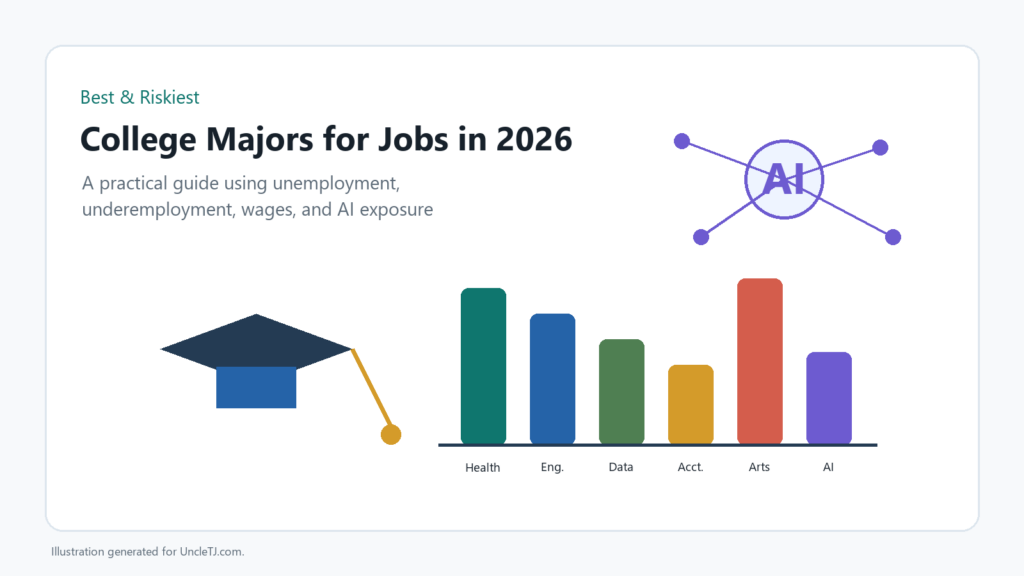

Best college majors in 2026 is a trickier topic than it used to be. A few years ago, the easy answer was: pick computer science, engineering, nursing, finance, or anything with “data” in the name. That advice is not completely wrong, but the job market has changed. Entry-level hiring is softer, artificial intelligence is reshaping white-collar work, and some high-paying majors now come with a tougher first-job search than students might expect.
So instead of pretending there is one magical major, this guide looks at the best and worst college majors for job prospects in 2026 using a practical lens: unemployment, underemployment, early-career wages, long-term demand, and AI impact. “Worst” does not mean the subject is worthless. It means the path may require more planning, stronger internships, a graduate-degree strategy, or a clear portfolio before graduation.
The short version: majors tied to healthcare, engineering, accounting, construction, analytics, cybersecurity, and certain education fields look strong. Majors with high underemployment or heavy exposure to AI-generated content look riskier unless the student builds specific, marketable skills around the degree.
The 2026 Job Market: Low Unemployment, Tougher Entry-Level Hiring
The overall U.S. labor market is not in collapse. The Bureau of Labor Statistics Employment Situation for June 2026 reported a 4.2% unemployment rate and payroll growth of 57,000 jobs. That is a slow-growth job market, not a 2008-style disaster.
But the headline number does not capture what many new graduates feel. The New York Fed’s Labor Market for Recent College Graduates shows that recent college graduates face a tougher transition than experienced degree-holders. Its March 2026 data show recent-grad unemployment around 5.6% and underemployment around 41.5%, compared with about 3.1% unemployment and 34.3% underemployment for college graduates overall.
That is the key context for choosing a major in 2026. The degree still matters, but the first job after college has become a bottleneck. Employers want proof that a graduate can do useful work quickly. Internships, projects, certifications, clinical experience, co-ops, research, portfolios, and AI fluency now matter more than they did when hiring was hotter.
How I Ranked the Best and Riskiest Majors
I used the New York Fed’s outcomes-by-major data as the backbone because it reports unemployment, underemployment, and median wages by college major. The major table is updated annually, while the broader unemployment and underemployment charts are updated quarterly. I also checked BLS occupational projections and the World Economic Forum’s Future of Jobs Report 2025 for broader demand trends through 2030.
One warning: no major is a guarantee. A nursing major who avoids clinical experience will struggle. A fine arts major with a strong design portfolio, client work, and AI-production skills may do well. Major choice sets the slope of the hill, but the student still has to climb it.
For this article, a “best” major generally has some combination of low unemployment, low underemployment, strong early-career wages, and clear occupational demand. A “riskiest” major generally has higher unemployment, high underemployment, lower early-career wages, or a job path that is being crowded by automation and oversupply.
Best College Majors for Job Prospects in 2026
The strongest majors in 2026 tend to connect directly to licensed work, hard technical systems, regulated business functions, or growing infrastructure needs. Here are the fields that look especially practical.
1. Nursing and healthcare-related majors
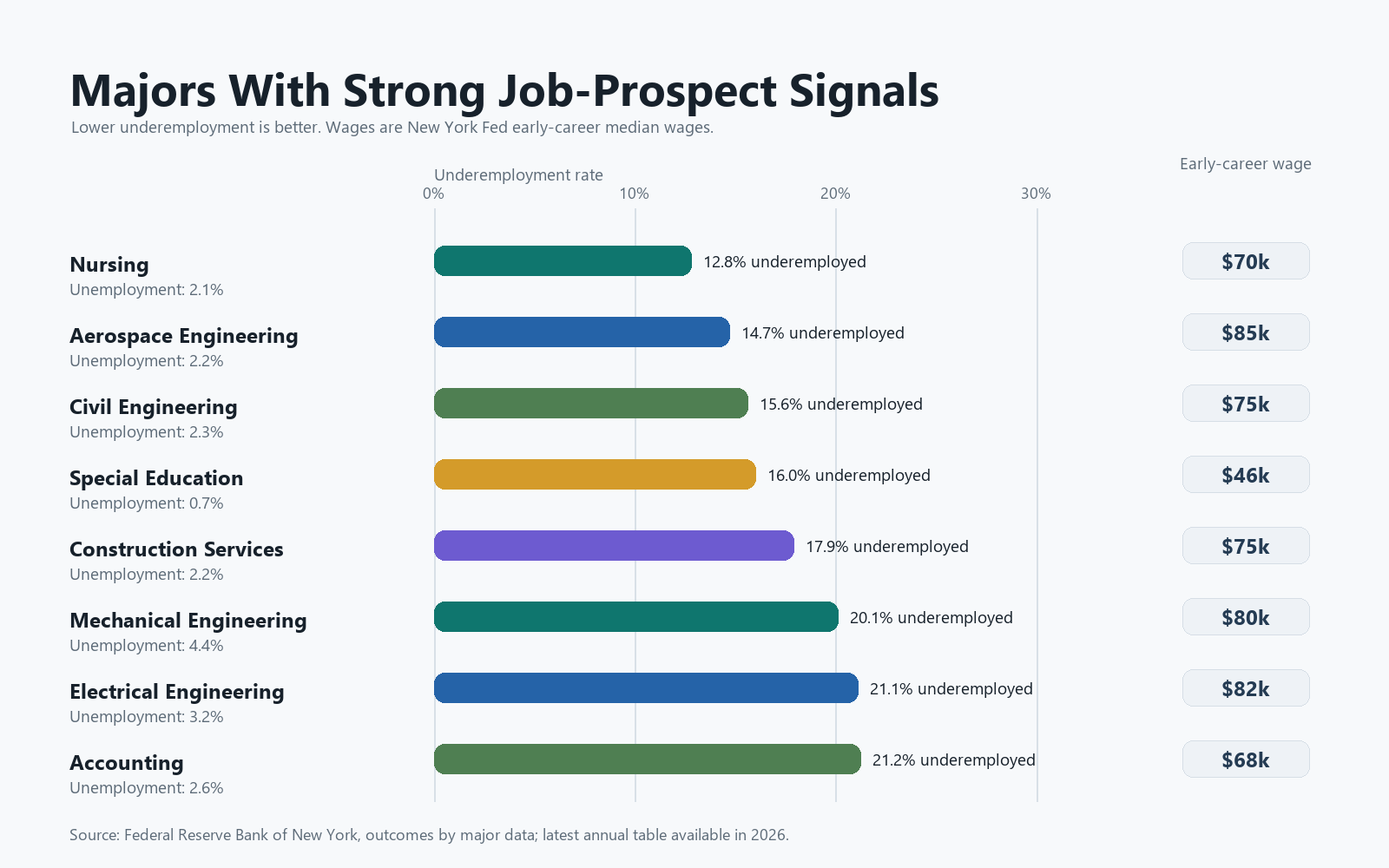
Nursing remains one of the clearest job-prospect majors because demand is tied to demographics, healthcare access, and licensing. In the New York Fed table, nursing has a low 2.1% unemployment rate, a very low 12.8% underemployment rate, and a $70,000 early-career median wage. BLS projections also keep healthcare roles near the top: nurse practitioners, for example, are listed among the fastest-growing occupations for 2024-2034.
The catch is that healthcare majors are not casual choices. They require clinical work, licensing exams, emotional stamina, and comfort with patients. But from a job-prospects standpoint, healthcare has one major advantage AI cannot easily copy: physical presence and human trust.
2. Engineering, especially civil, electrical, mechanical, aerospace, and construction-related fields
Engineering still looks strong because it connects math to physical systems: bridges, power grids, aircraft, manufacturing, transportation, buildings, water systems, energy, and defense. Civil engineering shows 2.3% unemployment, 15.6% underemployment, and a $75,000 early-career median wage in the New York Fed data. Aerospace engineering shows 2.2% unemployment, 14.7% underemployment, and $85,000 early-career wages.
Electrical and mechanical engineering also remain attractive, with early-career median wages above $80,000. These majors can be demanding, but they teach problem-solving in ways that transfer across industries. AI may help engineers draft, simulate, and analyze, but it does not replace the responsibility of signing off on real-world systems.
3. Accounting, finance, business analytics, and economics
The best business-related majors are the ones with technical substance. Accounting is a good example: it has 2.6% unemployment, 21.2% underemployment, and a $68,000 early-career wage in the Fed data. Finance and economics also show solid early-career wages, especially when paired with internships, Excel, SQL, Python, statistics, or industry-specific knowledge.
Business analytics is attractive because companies still need people who can turn messy data into decisions. But students should not rely on the label alone. A strong analytics graduate should know statistics, databases, visualization, business communication, and enough AI tooling to speed up analysis without blindly trusting model output.
4. Cybersecurity, data science, and information systems
Tech is complicated in 2026. The BLS fastest-growing list includes data scientists and information security analysts, and the World Economic Forum identifies AI and big data, networks and cybersecurity, and technological literacy as among the fastest-growing skill areas. Those are good signs.
But students should notice the difference between “tech skills are valuable” and “every entry-level tech job is easy to get.” The New York Fed data show high early-career wages for computer science and computer engineering, but also elevated unemployment in the latest major table: about 7.0% for computer science and 7.8% for computer engineering. That does not mean students should avoid tech. It means the lazy version of tech advice is dead. A student needs projects, internships, GitHub work, cybersecurity labs, cloud skills, data pipelines, or domain expertise.
5. Education fields with clear demand, especially special education
Education majors are not always high-paying, but several show strong employment signals. Special education has only 0.7% unemployment and 16.0% underemployment in the Fed data, while elementary and secondary education also show low unemployment. The tradeoff is wage growth. Students choosing education should go in with clear eyes about pay, certification rules, location, and burnout risk.
Still, from a pure “Can I get a job?” perspective, licensed education fields can be much stronger than people assume. The need for teachers, especially in hard-to-staff areas, is real.
Riskiest College Majors for Job Prospects in 2026
Now for the uncomfortable part. Some majors are more likely to produce a messy first job search. That does not mean students should never choose them. It means they should build a practical plan from day one.
The riskiest majors in the New York Fed data often have high underemployment. Criminal justice has a 65.8% underemployment rate. Performing arts is at 63.9%, fine arts at 58.9%, anthropology at 55.3%, communications at 53.0%, sociology at 52.0%, environmental studies at 50.5%, and psychology at 48.3%.
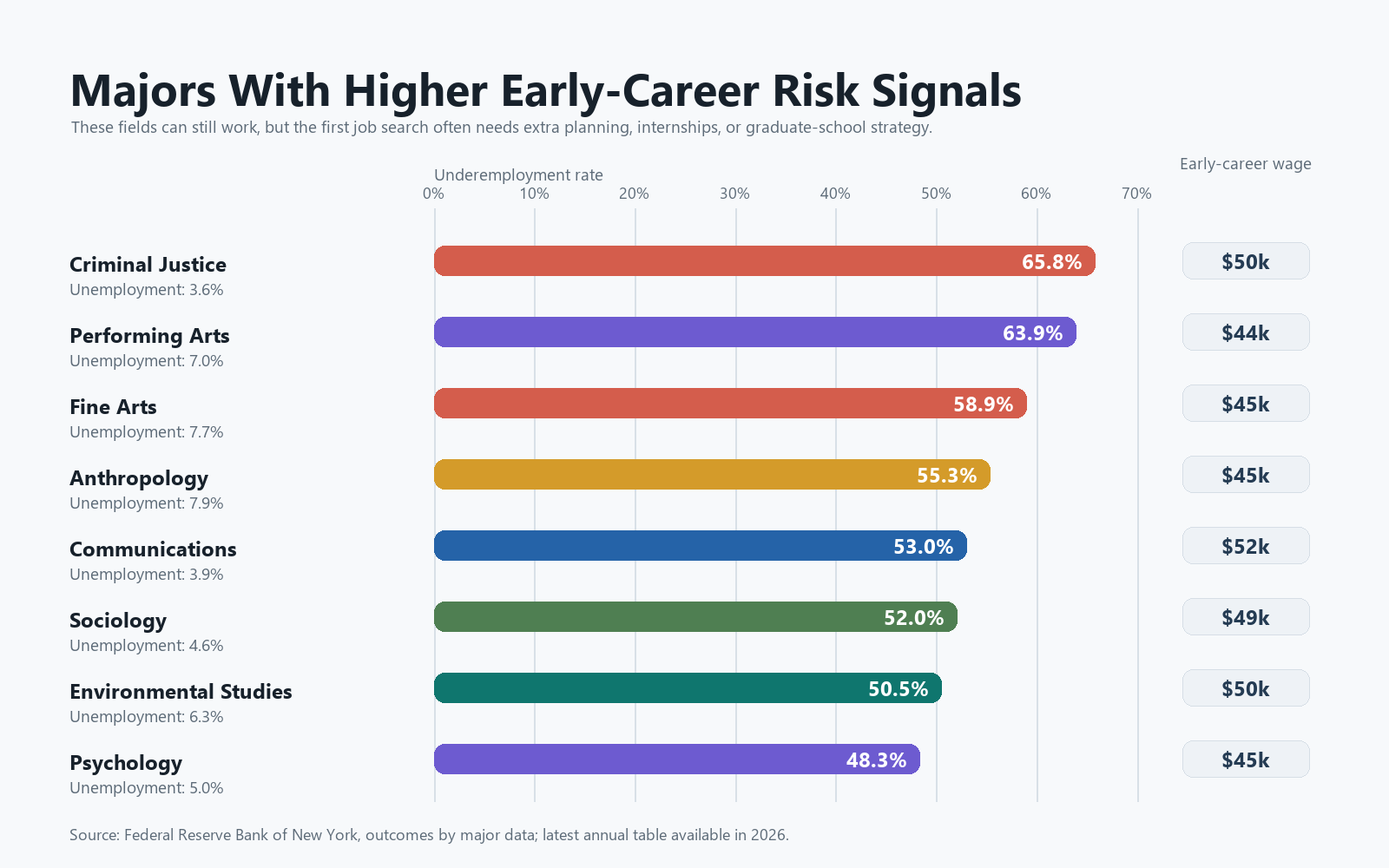
These majors can still be meaningful and useful. The problem is that they often do not map directly to a first job that requires that specific bachelor’s degree. Psychology and biology, for example, can be excellent foundations for graduate school, healthcare, research, counseling, data analysis, or education. But if the plan is “graduate with a bachelor’s degree and see what happens,” the labor market may be unkind.
Arts, media, and communications fields face an extra 2026 complication: generative AI can produce drafts, images, music, code, summaries, ad copy, and social media content quickly. That does not eliminate human creativity, but it raises the bar. The graduate who can direct AI tools, edit tastefully, manage clients, understand copyright, build a brand, and ship polished work has a much better story than the graduate who only has classroom assignments.
The AI Impact: Which Majors Are Safer?
AI does not simply attack “easy” majors and reward “hard” majors. It changes tasks. The Anthropic Economic Index, based on Claude usage, found especially heavy AI use in computer and mathematical tasks, as well as arts, media, education, office administration, life sciences, and business-finance tasks. It also found that AI use leaned slightly toward augmentation rather than full automation: about 57% augmentation versus 43% automation in its task analysis.
That is why the smartest 2026 major strategy is not “avoid AI.” It is “avoid being the person whose only value is a task AI can do cheaply.” Majors look safer when they combine AI with judgment, accountability, human relationships, physical-world constraints, licensing, or regulated decision-making.
Healthcare is safer because patients are physical and trust matters. Engineering is safer because real systems have consequences. Accounting and finance are safer when graduates understand regulation, controls, audit trails, and business context. Education is safer when the work involves human development, classroom management, and specialized support. Tech is still valuable, but entry-level tech workers now need to show they can use AI to build, test, secure, and explain systems rather than just complete coding exercises.
How to Choose a Major in 2026 Without Panicking
If you are picking a major now, do not treat this article as a command. Treat it as a map. The best choice depends on your ability, interests, tolerance for school length, debt, geography, and willingness to build experience outside class.
- Pick a major with a job path, not just a subject you enjoy. “I like psychology” is a start. “I want clinical psychology, UX research, HR analytics, occupational therapy, or school counseling, and here is the path” is much stronger.
- Use internships as your reality check. A mediocre major plus two excellent internships can beat a strong major with no evidence of work ability.
- Add quantitative and AI skills. Statistics, spreadsheets, databases, coding, automation tools, data visualization, and AI prompting help many majors become more employable.
- Watch underemployment, not just unemployment. A graduate can be employed and still not working in a role that uses a degree. That is why underemployment is such an important signal.
- Consider licensing and credentials. Nursing, accounting, teaching, engineering, therapy pathways, and cybersecurity certifications can create clearer hiring gates.
Quick FAQ: Best and Worst College Majors in 2026
Is computer science still a good major in 2026?
Yes, but it is no longer an automatic golden ticket. Computer science still has high early-career wages, but entry-level hiring is more competitive and AI tools have changed junior coding work. Students should add internships, real projects, systems knowledge, AI tooling, security, cloud, or domain expertise.
What major has the best job prospects overall?
Nursing is one of the strongest overall when you combine unemployment, underemployment, wages, licensing, and long-term demand. Several engineering fields also look excellent, especially civil, aerospace, electrical, and mechanical engineering.
Should students avoid arts or humanities majors?
Not necessarily. But students in arts, humanities, communications, and social sciences need a career plan earlier. Pair the major with writing samples, design work, research methods, data skills, internships, teaching credentials, nonprofit experience, legal preparation, marketing analytics, or graduate-school plans.
Final Takeaway
The best college majors for job prospects in 2026 are not just the ones with the highest salaries. They are the majors that help students get through the entry-level bottleneck and into work that is hard to automate, useful to employers, and connected to real demand.
That makes nursing, engineering, accounting, business analytics, cybersecurity, data science, finance, construction-related fields, and certain education paths especially attractive. It makes arts, anthropology, criminal justice, psychology, communications, sociology, and environmental studies riskier if students do not build a practical bridge to employment.
The better question is not only “What should I major in?” It is “What job evidence will I have by graduation?” In 2026, the strongest graduates are not just degree holders. They are degree holders with proof.
Sources and Further Reading
- Federal Reserve Bank of New York: The Labor Market for Recent College Graduates
- New York Fed: Outcomes by Major CSV
- BLS: Employment Situation Summary, June 2026
- BLS Occupational Outlook Handbook: Fastest Growing Occupations
- World Economic Forum: Future of Jobs Report 2025
- Anthropic Economic Index: AI usage across the labor market