
Singapore economic transformation is one of the most famous development stories of the modern era. In 1965, Singapore became independent under conditions that would make any economic planner sweat: no natural resources, little land, a tense regional neighborhood, high unemployment, housing shortages, and no guaranteed domestic market. By the end of the 1990s, it had become a high-income, globally connected city-state known for trade, finance, advanced manufacturing, efficient infrastructure, and unusually strong public institutions.
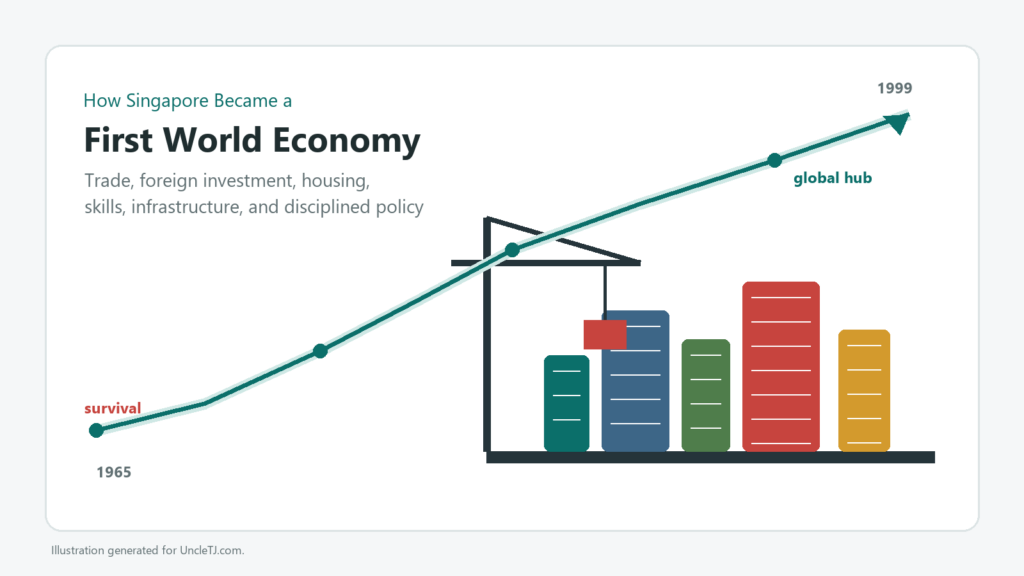
So how did Singapore become a First World economy? The short answer is not “one miracle policy.” It was a disciplined bundle of policies: export-led growth, openness to foreign investment, public housing, forced savings, education, infrastructure, clean administration, and careful macroeconomic management. The longer answer is more interesting, because Singapore did not grow exactly like South Korea, Taiwan, Hong Kong, China, or the oil-rich Gulf states. It built a development model that fit its strange advantages and harsh limits.
One quick note on language: “Third World to First World” is a famous phrase associated with Singapore’s story, but it is also dated. Here, it simply means the country’s move from a poor, vulnerable postcolonial economy toward advanced-economy living standards. The real story is policy, timing, geography, discipline, tradeoffs, and execution.
Singapore’s Starting Point in 1965 Was Brutal
Singapore separated from Malaysia on August 9, 1965, becoming a sovereign country almost overnight. That mattered economically because the island lost the larger common market that many leaders had hoped would support industrial growth. It also had no oil, no large farms, no mines, and no rural hinterland to draw from. Its biggest asset was location: a deep-water port sitting near one of the world’s most important shipping lanes.
The problems were immediate. Jobs were scarce. Housing was crowded. Communal tensions were real. Britain was still a major military presence, but its later withdrawal meant Singapore would lose a large source of spending and employment. The country could not hide behind a large domestic market. To grow, Singapore had to sell to the world.
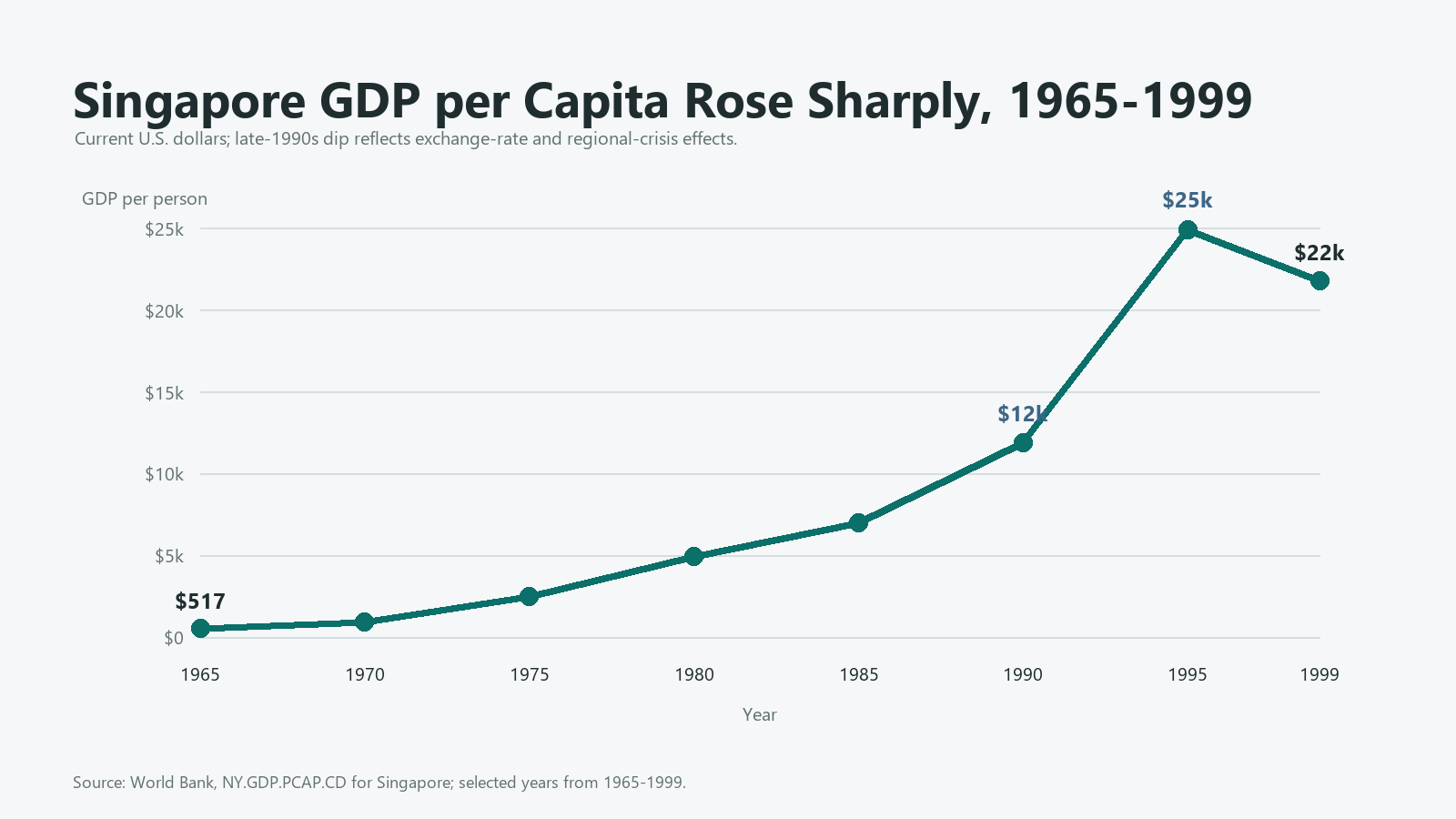
The numbers show the scale of the climb. According to World Bank GDP per capita data, Singapore’s GDP per person was about $517 in current U.S. dollars in 1965. By 1990, it was roughly $11,862. By 1995, it was about $24,915, before regional and exchange-rate effects showed up in the late 1990s data. Current-dollar figures are imperfect, but the direction is unmistakable.
Policy 1: Bet on Trade, Exports, and Foreign Investment
The central economic choice was simple but bold: Singapore would not try to become self-sufficient. It would become useful to the global economy. Instead of relying mainly on import substitution, the government pushed export-oriented industrialization. That meant making goods and services for world markets, not just the small local population.
The Economic Development Board, created before independence in 1961, became the main investment-promotion agency. Its job was not only to advertise Singapore. It helped coordinate land, factories, incentives, worker training, and investor aftercare. Singapore wanted multinational companies to see the island as a reliable production base, especially for electronics, precision manufacturing, petrochemicals, and later higher-value services.
This differed from the classic “protect infant industries forever” strategy. Singapore did use incentives, public planning, and state-owned companies, but the market test was external demand. If a factory could not compete internationally, the small local market could not hide that weakness for long.
Jurong is the best symbol of this phase. What had been swampy land in the west became an industrial zone. The government took a risk by building ahead of demand, then worked to fill the space with firms that could employ workers and export. The later creation of JTC strengthened the industrial-estate model. It was not glamorous, but it was practical: clear land, build infrastructure, attract factories, train workers, repeat.
Policy 2: Treat Housing and Savings as Economic Policy
One of Singapore’s smartest moves was recognizing that economic development is not just factories and GDP. Workers need homes, basic security, transport, sanitation, and a reason to feel invested in the country’s future. The Housing & Development Board, established in 1960, became central to that mission.
Public housing served several economic goals at once. It improved living conditions. It reduced the instability that crowded settlements could create. It made urban planning easier in a land-scarce city. It also helped produce a society where many households had a direct stake in national stability through home ownership.
The Central Provident Fund, Singapore’s compulsory savings system, also mattered. CPF contributions helped households save for housing, retirement, and healthcare, while increasing the pool of domestic savings available in the economy. This was not a laissez-faire model where the state simply stepped aside. It was a market-facing model with a very active government building the social and physical base needed for growth.
That mix helped Singapore avoid one trap common in fast industrialization: rising output alongside urban chaos. Housing was not a side project. It was part of productivity policy.
Policy 3: Upgrade Skills Before Cheap Labor Ran Out
In the early years, Singapore had to create jobs quickly, so labor-intensive manufacturing made sense. But the government also knew that a small city-state could not compete forever on low wages. Bigger countries with more workers would eventually be cheaper. Singapore had to climb the value chain.
That is why education, technical training, English-language capability, and industrial upgrading were so important. English helped connect Singapore to global business. Technical education helped workers move from simple assembly toward electronics, engineering, logistics, finance, and management.
The late 1970s “Second Industrial Revolution” captured this shift. Singapore began pushing away from the cheapest labor-intensive activities and toward more capital-intensive, skill-intensive work. That transition was not painless. Higher wage policies and restructuring could squeeze firms that were used to low costs. But the bigger idea was sound: a tiny country with limited land cannot build prosperity by being the cheapest place forever.
Policy 4: Build Infrastructure That Made Geography Pay
Singapore had one natural advantage: location. But location by itself does not unload ships, process cargo, move people, or reassure investors. The government had to convert geography into usable infrastructure.
The port, roads, utilities, industrial estates, telecommunications, and airport all became part of the growth machine. The opening of Changi Airport in 1981 was especially important. It supported Singapore’s role as a regional air hub, which helped business travel, logistics, tourism, and high-value services. The point was not simply to build impressive facilities. It was to make Singapore frictionless for trade.
This is one reason Singapore differed from many larger developing economies. A big country can sometimes grow with uneven infrastructure because one region carries the rest. A city-state has less room for that. Singapore’s compactness made coordination easier, but it also made mistakes highly visible.
Policy 5: Keep Money, Wages, and Institutions Credible
Investors care about taxes and wages, but they also care about trust. Can contracts be enforced? Will rules change randomly? Is the currency managed responsibly? Are officials asking for bribes? Is inflation eating away at real returns?
Singapore built a reputation for clean, predictable administration. That reputation became an economic asset. It lowered the uncertainty premium investors normally attach to young countries. It also supported the country’s shift into finance and other trust-heavy sectors. The Monetary Authority of Singapore, established in 1971, became central to financial regulation and monetary management. Singapore’s exchange-rate-centered monetary policy, described by MAS, fit an extremely open economy where import prices and trade competitiveness matter a lot.
Wage coordination also played a role. The National Wages Council, formed in 1972, helped align wage growth with productivity goals. In plain English: Singapore tried to keep wages rising, but not in a way that destroyed the jobs machine before productivity could catch up.
How Singapore Was Different From Other Fast-Growing Economies
Singapore is often grouped with the “Asian Tigers,” alongside South Korea, Taiwan, and Hong Kong. That grouping is useful, but it can hide important differences.
- Compared with South Korea, Singapore relied less on giant domestic industrial conglomerates and more on multinational corporations. Korea built national champions like Samsung and Hyundai. Singapore built a platform where global firms wanted to operate.
- Compared with Taiwan, Singapore had fewer small domestic manufacturers and less rural-industrial spillover. Taiwan’s development drew heavily from networks of local firms. Singapore leaned harder on state planning, foreign direct investment, and infrastructure.
- Compared with Hong Kong, Singapore was more state-directed. Hong Kong became famous for freer-market minimalism, while Singapore combined openness with public housing, compulsory savings, industrial policy, and state-linked enterprises.
- Compared with China after 1978, Singapore was tiny, urban, and already plugged into global trade routes. China had vast labor reserves and regional experimentation. Singapore had speed, coordination, and a single-city operating system.
- Compared with oil-rich states, Singapore had no resource rents to distribute. Its “resource” was credibility: efficient government, strategic location, skilled labor, and reliable rules.
That difference matters because Singapore’s model is admired but not easily copied. A large country cannot simply become Singapore by building an airport and offering tax incentives. Singapore’s small size, location, administrative capacity, and political tradeoffs all shaped the outcome.
Historical Milestones From 1965 to 1999
Here is a quick timeline of the economic turning points that shaped the Singapore development model:
| Year | Milestone | Why it mattered economically |
|---|---|---|
| 1965 | Singapore becomes independent on August 9. | The country loses the Malaysian common-market dream and must survive as a small, open city-state. |
| 1967 | National Service begins and Singapore co-founds ASEAN. | Security and regional diplomacy support investor confidence. |
| 1968 | Jurong Town Corporation is established. | Industrial land, factories, and estates become easier to plan and scale. |
| 1971 | British military withdrawal is completed; MAS is established. | Singapore loses a major employer but strengthens financial and monetary institutions. |
| 1972 | National Wages Council is formed. | Wage coordination becomes part of productivity and competitiveness policy. |
| Late 1970s | Singapore pushes industrial upgrading. | The economy begins moving beyond low-wage manufacturing. |
| 1981 | Changi Airport opens. | Air connectivity reinforces Singapore’s role as a logistics and business hub. |
| 1985-1986 | Singapore suffers a recession and responds with restructuring. | The downturn forces a review of costs, productivity, and growth strategy. |
| 1991 | Strategic Economic Plan era. | Singapore sets a more advanced-economy vision for global city status and higher value-added activity. |
| 1997-1999 | Asian Financial Crisis tests the region. | Singapore is hit, but its institutions and reserves help it weather the shock better than many neighbors. |
The Tradeoffs Behind the Success
Singapore’s economic success does not mean every choice was easy, painless, or universally loved. The model placed heavy emphasis on social order, technocratic planning, meritocracy, and competitiveness. It also produced debates about political openness, cost of living, inequality, pressure in education, dependence on foreign labor, and the role of state-linked firms.
That is important because “Singapore did it, so everyone should do it” is too simple. Singapore’s success came from a fit between policy and context. The same tools can work differently in a larger, poorer, more rural, more politically fragmented, or less trade-connected country.
The useful lesson is not to copy Singapore line by line. It is to notice the pattern: identify your real constraints, build institutions that reduce friction, invest in people, stay open to markets, and keep upgrading before the old model runs out of room.
Quick FAQ: How Did Singapore Become Rich?
What were the main Singapore economic policies behind growth?
The biggest policies were export-led industrialization, aggressive attraction of foreign direct investment, public housing, compulsory savings through CPF, investment in education and technical skills, world-class port and airport infrastructure, clean administration, and credible macroeconomic management.
Did Singapore grow because of free markets or government planning?
Both. Singapore stayed very open to trade, capital, and global competition, but the state was deeply involved in housing, land, infrastructure, education, industrial estates, investment promotion, and long-term planning. It was not a hands-off model.
Why did Singapore attract so much foreign investment?
It offered a strong location, efficient port access, political stability, skilled English-speaking workers, tax and investment incentives, reliable public services, and a low-corruption business environment. For multinational companies, Singapore reduced a lot of the uncertainty that often comes with operating in emerging markets.
Final Thought
Singapore’s rise from a vulnerable 1965 city-state to a First World economy by the end of the twentieth century was not inevitable. It was built through a practical development bargain: connect to the world, make investors confident, house the population, train the workforce, keep infrastructure excellent, and keep moving up the value chain.
The story is inspiring partly because it is not mystical. Singapore did not discover a secret formula hidden from everyone else. It made a series of hard, focused choices and executed them unusually well. That is why the Singapore development model still gets studied today: not because every country can copy it, but because it shows how much economic destiny can change when policy, institutions, and strategy point in the same direction.
Sources and Further Reading
- World Bank: GDP per capita, current U.S. dollars, Singapore
- Singapore Economic Development Board: Our History
- Housing & Development Board: History
- JTC: About JTC
- Monetary Authority of Singapore: History
- MAS: Singapore’s exchange-rate-based monetary policy
- Changi Airport Group: Our History
- Singapore Statutes Online: Independence of Singapore Agreement 1965