
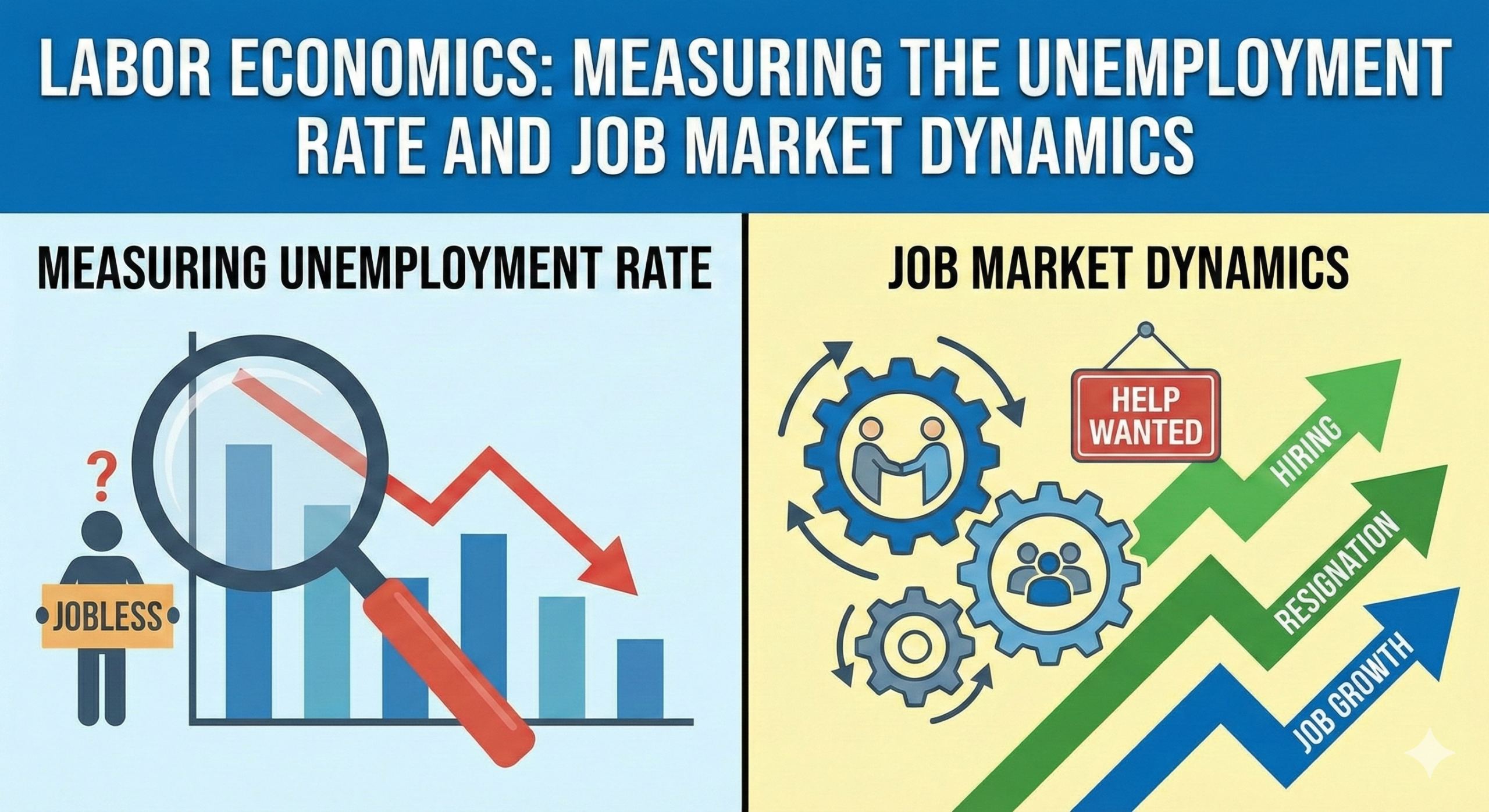
The study of unemployment within a modern economy transcends simple binary classifications of work. It represents a complex interaction between human capital, institutional frameworks, and macroeconomic shifts. To understand the labor market is to understand the primary mechanism through which economic output is generated and household welfare is sustained. This report provides an exhaustive examination of how unemployment is conceptualized, tracked, and utilized as a pivot point for national policy, while also scrutinizing the inherent limitations of standard metrics and the disparate realities faced by different demographic segments.
The Foundations of Labor Economics: Tracking the Unemployment Rate
The foundation of any labor market analysis lies in the precision of its data collection. In the United States, the primary authority for these metrics is the Bureau of Labor Statistics (BLS), which manages two distinct yet complementary surveys: the Current Population Survey (CPS) and the Current Employment Statistics (CES).1 These surveys provide the raw material for constructing the national unemployment rate and understanding industrial payroll trends.
The Household Survey and the Current Population Survey (CPS)
The CPS, commonly referred to as the “household survey,” is a monthly project conducted by the U.S. Census Bureau for the BLS, sampling approximately 60,000 households.3 This survey is critical because it identifies the labor force status of individuals based on their activities during a specific reference week—typically the week including the 12th day of the month.1
The CPS categorizes the civilian non-institutional population—individuals aged 16 and older who are not on active duty in the military or residing in institutions like prisons or nursing homes—into three categories: the employed, the unemployed, and those not in the labor force.1 Employment is defined broadly; an individual is considered employed if they performed any work for pay or profit during the reference week, worked 15 hours or more as an unpaid worker in a family business, or were temporarily absent from a job due to vacation, illness, or labor disputes.1
Unemployment, conversely, is defined by three strict criteria: the individual must not have been employed during the reference week, must have been available for work, and must have made a specific, active effort to find employment during the four-week period ending with the reference week.1 The distinction between “active” and “passive” search is vital. Active efforts include contacting employers directly, attending job interviews, or utilizing employment agencies. Passive efforts, such as merely reading job advertisements or attending a job training program, do not qualify an individual as unemployed; instead, they are classified as being “not in the labor force”.1
| Labor Status Component | Definitions and Criteria for Classification |
| Employed | Worked for pay/profit, or worked 15+ unpaid hours in a family business, or temporarily absent from a job.1 |
| Unemployed | No job during the reference week, available for work, and active job search in the last 4 weeks.1 |
| Labor Force | The total sum of all employed and unemployed individuals within the surveyed population.1 |
| Not in the Labor Force | Individuals who are neither working nor actively seeking work, including retirees and students.1 |
| Participation Rate | (Labor Force ÷ Civilian Non-institutional Population) × 100.1 |
| Unemployment Rate | (Unemployed ÷ Labor Force) × 100.1 |
The unemployment rate serves as a percentage that reflects the portion of the labor force that is without work but searching. However, the BLS acknowledges that a single number cannot encapsulate the various dimensions of labor underutilization. Consequently, it publishes a hierarchy of alternative measures, ranging from U-1 to U-6, to provide a more granular perspective on labor market slack.3
| Metric | Specific Scope and Population Targeted |
| U-1 | Persons unemployed for 15 weeks or longer as a percentage of the labor force.3 |
| U-2 | Job losers and persons who completed temporary jobs as a percentage of the labor force.3 |
| U-3 | Official National Unemployment Rate: Total unemployed as a percentage of the labor force.3 |
| U-4 | U-3 plus “discouraged workers” who have stopped searching due to poor economic prospects.3 |
| U-5 | U-4 plus all other “marginally attached” workers who want a job but haven’t searched recently.3 |
| U-6 | U-5 plus “part-time for economic reasons” workers (the underemployed).3 |
The Bathtub Model of Labor Dynamics
To move beyond static measurements, economists employ the “Bathtub Model” to analyze the evolution of unemployment over time.11 This model views the unemployment rate as the “water level” in a bathtub, which is determined by the rate of inflow (workers losing jobs) and the rate of outflow (workers finding jobs or leaving the labor force).11
The mathematical representation of this change is:
$$\Delta u_{t+1} = s_t(1 – u_t) – f_t u_t$$
In this equation, $u_t$ is the current unemployment rate, $s_t$ is the separation (inflow) rate, and $f_t$ is the job-finding (outflow) rate.11 During an economic downturn, a spike in the separation rate typically causes a rapid rise in unemployment. However, the subsequent recovery speed is largely dictated by the outflow rate. Historical data indicates that the majority of fluctuations in the U.S. unemployment rate are driven by changes in the job-finding rate rather than job losses alone.11 A “flow-consistent” unemployment rate ($u^*$) represents the equilibrium point the market would reach if current rates remained constant. When the actual rate is significantly above $u^*$, it often signals an impending sharp decline in joblessness as the market corrects.11
Labor Economics Theory: Okun’s Law and Job Market Hysteresis
The relationship between economic output and employment is guided by theoretical frameworks that help policymakers determine if the labor market is performing at its potential. The most prominent of these is Okun’s Law and the concept of unemployment hysteresis.12
The Instability of Okun’s Law
In 1962, Yale economist Arthur Okun described a statistical relationship where changes in the unemployment rate were inversely related to real GDP growth.12 Specifically, his early findings suggested that a 1% increase in unemployment was associated with a 3% decrease in GNP, though modern iterations typically use a 2-for-1 rule of thumb: for every 2% that real GDP falls below its trend, the unemployment rate rises by 1%.14
Okun’s Law is predicated on the idea that because labor is a primary input for production, output and employment should move in tandem.15 However, empirical evidence from the 21st century suggests that this relationship is increasingly unstable.11 For instance, during the 2007–2009 recession, real GDP contracted by only 0.5 percentage points in 2009, yet the unemployment rate jumped by 3 percentage points—double what Okun’s Law would predict.12 Conversely, in 2011, the unemployment rate fell significantly despite GDP growing at only half the rate previously thought necessary to keep unemployment steady.12
| Economic Variable | Role in Okun’s Law Framework |
| Real GDP Growth | The independent variable traditionally used to forecast changes in employment.11 |
| Potential GDP | The level of output an economy can produce at full employment.15 |
| Okun’s Coefficient | The ratio (often ~0.5) relating output deviations to unemployment changes.11 |
| Breakeven Growth | The GDP growth rate (traditionally ~3.4%) needed to hold unemployment constant.12 |
This breakdown in the relationship is often attributed to surges in labor productivity. In 2009, firms were able to maintain relatively steady output while laying off large numbers of workers by increasing the intensity of work for the remaining staff or adopting new technologies.14 Such shifts make Okun’s Law a less reliable forecasting tool than it was in the 1960s, when the labor force was more homogeneous and productivity growth was more predictable.11
Hysteresis and the Human Capital Perspective
The concept of hysteresis suggests that temporary economic shocks can have permanent effects on the unemployment rate.13 When an economy enters a recession and workers remain unemployed for extended periods, they may experience “scarring effects”—long-lasting damage to their future career prospects and earning potential.17
A primary driver of hysteresis is the depreciation of human capital. As workers stay away from the labor market, their skills may erode, or they may lose touch with the latest industry practices.19 Research from the National Bureau of Economic Research (NBER) suggests that hiring a worker is akin to a “risky investment” with long-duration returns.19 In recessions, the price of risk increases, leading firms to cut vacancies and causing unemployment to spike. If workers remain unemployed, the resulting human capital depreciation reduces the benefits of hiring them in the future, even after the economy recovers.19
| Theoretical Concept | Mechanism of Action |
| Experience-Based Wages | Wages typically grow with experience; unemployment halts this accumulation.19 |
| Skill Depreciation | The erosion of cognitive or technical skills due to prolonged disuse.11 |
| State Dependence | The theory that the state of being unemployed itself reduces the probability of finding work.18 |
| Negative Signaling | Employers use unemployment duration as a proxy for unobserved low quality or productivity.17 |
While some studies, particularly in Germany and the U.S., find that general cognitive skills (like memory or non-cognitive traits) remain relatively stable during unemployment, the “signal” of being long-term unemployed remains deeply damaging.16 Long-term unemployed workers—those jobless for 27 weeks or more—face re-employment wages that are often 20% lower than their short-term counterparts.16 This scarring is attributed not just to skill loss but also to a decrease in search intensity and a decay in the social capital provided by professional networks.18
How the Unemployment Rate Shapes Monetary Policy
Unemployment data is perhaps the most critical indicator for the Federal Reserve as it navigates its “dual mandate”: to promote maximum employment and stable prices.22
The Evolution of the Dual Mandate
The roots of the Fed’s current mandate lie in the immediate aftermath of the Great Depression, culminating in the 1978 Full Employment and Balanced Growth Act (Humphrey-Hawkins).22 This act codified the requirement that the Fed manage money with an eye toward economic growth and jobs, working on the assumption that there is a trade-off between inflation and unemployment—a concept known as the Phillips Curve.22
The Phillips Curve traditionally suggested that policymakers could “buy” lower unemployment by accepting modestly higher inflation.22 However, this trade-off proved to be a “false bargain” during the 1970s. As firms and workers learned to expect inflation, they adjusted prices and wages accordingly, shifting the Phillips Curve upward and requiring ever-higher inflation to maintain the same level of employment.22
Anchored Expectations and Modern Strategy
In the modern era, the Federal Open Market Committee (FOMC) seeks to anchor long-term inflation expectations to a 2% target.24 When expectations are “anchored,” the Fed has more flexibility to address unemployment spikes without fearing a permanent rise in inflation.26
When the economy experiences a negative shock, the Fed typically employs expansionary monetary policy—lowering short-term interest rates—to stimulate demand and hiring.24 If rates reach the “effective lower bound,” the Fed may use “forward guidance” or “quantitative easing” to lower long-term interest rates and bond yields.24 The central bank’s reaction function is often modeled using the Taylor Rule, which suggests how much the Fed should adjust rates based on the “output gap” (the difference between actual and potential GDP) and the “inflation gap”.8
| Monetary Policy Tool | Intended Impact on Labor Market |
| Federal Funds Rate | Adjusting short-term rates to influence borrowing, spending, and investment.24 |
| Forward Guidance | Signaling the future path of rates to influence long-term interest rate expectations.24 |
| Quantitative Easing | Purchasing assets to lower bond yields and further stimulate the economy.24 |
| The Taylor Rule | A formulaic approach to rate setting based on inflation and output deviations.24 |
The primary risk in this strategy is overestimating the “Full Employment Unemployment Rate” (FEUR) or NAIRU.8 If the Fed believes the FEUR is 5% when it is actually 4%, it may raise interest rates prematurely to fight inflation that isn’t coming, thereby unnecessarily throwing Americans out of work and reducing wage growth.8
Fiscal Policy: Stabilizing the Job Market with Incentives
While monetary policy acts on the broad economy through interest rates, fiscal policy involves direct government spending and taxation to manage employment levels.27
The Role of Automatic Stabilizers
Automatic stabilizers are fiscal mechanisms that naturally expand during a downturn and contract during an upturn without new legislation.29 The most familiar of these is the Unemployment Insurance (UI) system, alongside programs like Medicaid and the Supplemental Nutrition Assistance Program (SNAP).30
As output falls, tax revenues decline and UI spending increases. This injects liquidity into the hands of those most likely to spend it, helping to cushion the fall in aggregate demand.29 The standard UI program provides up to 26 weeks of benefits, but “Extended Benefits” (EB) can be triggered during periods of high unemployment.31
| UI Trigger Type | Threshold and Mechanism for Activation |
| Mandatory IUR | Triggered if the 13-week Insured Unemployment Rate is 5% and 120% of the prior 2 years.32 |
| Optional IUR | At a state’s discretion, triggered if the IUR is at least 6%.32 |
| Optional TUR | Triggered if the 3-month Total Unemployment Rate is 6.5% and 110% of the prior 2 years.32 |
| High TUR | Triggered if the TUR is at least 8% and 110% of the prior 2 years, providing up to 20 weeks.32 |
The Federal-State Extended Unemployment Compensation Act of 1970 (EUCA) dictates that the federal government pays half the cost of these extended benefits from the Federal Unemployment Tax Act (FUTA) revenues.32 During exceptional crises, such as the COVID-19 pandemic, programs like the CARES Act and the American Rescue Plan have provided even further extensions and supplemental benefits (e.g., the $300-$600 weekly additions).31
Discretionary Incentives and Targeted Credits
Governments also use discretionary policy to spur hiring through tax incentives. A prominent example is the Work Opportunity Tax Credit (WOTC), a federal credit for employers who hire from “targeted groups” facing barriers to employment.34
| WOTC Target Group | Max Credit Amount | Specific Eligibility Criteria |
| Qualified Veteran | $2,400 – $9,600 | Includes SNAP recipients, long-term unemployed, or disabled veterans.34 |
| Long-term Unemployed | $2,400 | Unemployed for 27+ consecutive weeks with some UI receipt.36 |
| Ex-Felon | $2,400 | Hired within one year of conviction or release from prison.34 |
| SNAP Recipient | $2,400 | Individuals aged 18-39 who received benefits for 6 months.34 |
| Vocational Rehab | $2,400 | Referrals from state or federal disability rehabilitation programs.34 |
At the state level, Job Creation Tax Credits (JCTCs) are widely used to encourage local investment. Research indicates that these credits are most effective in high-unemployment areas, where new jobs are more likely to go to local residents rather than in-migrants.38 However, policymakers must avoid “deadweight loss”—providing credits for hiring that would have occurred anyway.39 Some states use a “rolling base” calculation, which reduces the credit’s impact by eliminating tomorrow’s incentive for a hire made today.39 In Georgia, for instance, studies have shown that JCTCs often have a small statistically significant effect because the value of the credit is low compared to the total cost of a new employee.40
Limitations of the Unemployment Rate and Job Market Indicators
Despite their importance, traditional unemployment metrics like the U-3 rate are frequently criticized for overstating the strength of the labor market and failing to capture the true degree of “economic slack”.7
The Exclusion of Hidden Slack
The most glaring limitation is the exclusion of discouraged workers—those who want a job but have stopped looking because they don’t believe any are available.6 Because they haven’t searched in the last 4 weeks, they are classified as “not in the labor force.” When a large number of unemployed workers give up their search, the official unemployment rate (U-3) actually falls, creating a misleading impression of a robust labor market.6 Between 2009 and 2015, the civilian labor force participation rate dropped by 2.6 percentage points, suggesting that many workers were sidelined rather than successfully employed.8
| Phenomenon | Impact on U-3 Measurement | Economic Consequence |
| Discouraged Workers | Lowers the measured rate.6 | Understates labor market distress.6 |
| Involuntary Part-time | Counts as “Employed”.6 | Masks underutilization of hours.7 |
| Underemployment | Counts as “Employed”.6 | Results in lower productivity and wages.6 |
| Labor Force Exit | Lowers the measured rate.6 | Can signify a shrinking potential economy.8 |
Furthermore, the “U-6” measure is often cited by analysts as a more accurate reflection of labor slack because it includes both the marginally attached and those working part-time for economic reasons.7 In late 2025, while the U-3 rate was 4.4%, the U-6 rate was 8.4%, indicating that a significant portion of the workforce remained underutilized.10
Alternative and High-Frequency Indicators
The lag in official government surveys—and their vulnerability to government shutdowns—has led economists to rely on alternative data.21
- JOLTS (Job Openings and Labor Turnover Survey): This survey provides data on job openings and “quits.” A high “quit rate” is generally a sign of a healthy market, as it indicates workers feel confident enough to switch jobs for better pay or conditions.43 In November 2025, the quit rate was 2.0%, consistent with pre-pandemic levels.44
- Google Trends: Analysis of search data for “unemployment benefits” or “job sites” has proven to be a highly correlated, real-time indicator of labor market disruptions, particularly during the COVID-19 pandemic.45
- Employment-Population Ratio: Some researchers argue this is a more stable indicator than the unemployment rate because it avoids the “not in the labor force” measurement issues.46
Job Market Disparities: Segmented Unemployment Rate Trends
The national unemployment rate is an average that masks deep structural inequities across race, ethnicity, education level, and industry.47
Racial and Ethnic Gaps
Persistent gaps in unemployment rates between racial groups have been a feature of the U.S. economy for decades. Black or African American workers consistently experience unemployment rates roughly double those of White workers.26
| Race/Ethnicity (2025 Q3) | Unemployment Rate (%) | Ratio to White Rate |
| White | 3.5% | 1.0x |
| Asian | 3.8% | 1.1x |
| Hispanic/Latino | 5.2% | 1.5x |
| Black/African American | 6.7% | 1.9x |
| AAPI | 3.8% | 1.1x |
In 2025, the Black unemployment rate rose while other groups remained more stable, reaching 7.5% in December.21 In some regions, the disparity is even more stark; for example, the Black-White unemployment ratio in Maryland was 3.1-to-1 in the third quarter of 2025.47 Young Black workers (aged 16-24) faced an average unemployment rate of 15% in 2025, peaking at 20.8% in November.49
The Protection of Educational Attainment
Education remains the single most effective buffer against unemployment. Higher levels of education are correlated with both lower rates of joblessness and higher rates of labor force participation.48
| Education Level (2023) | Unemployment Rate (%) | Participation Rate (%) |
| < High School Diploma | 5.6% | 47.1% |
| HS Graduate, No College | 3.9% | 56.7% |
| Some College, No Degree | 3.3% | 60.6% |
| Associate’s Degree | 2.7% | 66.0% |
| Bachelor’s Degree+ | 2.1% | 73.0% |
The “skill premium” also affects the duration and frequency of unemployment. Black workers with a bachelor’s degree have a significantly lower unemployment rate (3.8%) compared to those with less than a high school diploma (13.2%).48 Interestingly, the gap between racial groups narrows as education level increases; for those with a bachelor’s degree, the gap between Black and White unemployment was only 0.8 percentage points in 2019.48
Industry Volatility and Gender Dynamics
The impact of economic shifts is often sector-specific. In 2025, employment continued to trend upward in food services, healthcare, and social assistance, while retail trade lost jobs.21 These industrial shifts have profound effects on different demographic groups. For example, healthcare and social assistance employ large numbers of women, whereas manufacturing and construction are traditionally more male-dominated.51
In late 2025, the unemployment rates for adult men and adult women were both 3.9%, but their participation rates differed: 68.1% for men versus 57.3% for women in 2023.21 Furthermore, Black women have the highest participation rate (59.1%) among major female racial groups, reflecting a higher economic necessity for labor force attachment.51
Conclusion: The Future of Labor Economics and the Job Market
Unemployment is not merely a number but a reflection of the economy’s structural health and the efficacy of its social safety nets. The tracking and calculation of unemployment through the CPS and alternative measures provide the essential data for the Federal Reserve’s monetary adjustments and the government’s fiscal interventions. However, the breakdown of traditional rules of thumb like Okun’s Law and the persistence of demographic disparities suggest that a “one-size-fits-all” approach is insufficient.
Policymakers must navigate the complexities of labor market slack, skill depreciation, and the trade-offs between inflation and employment. While automatic stabilizers like unemployment insurance provide a first line of defense, targeted incentives like the WOTC and education-focused structural reforms are necessary to address the long-term scarring effects of joblessness. As the labor market continues to evolve in the face of technological change and shifting global dynamics, the tools used to monitor and manage it must remain equally adaptive to ensure sustainable and equitable economic growth.
Works cited
- Concepts : Handbook of Methods: U.S. Bureau of Labor Statistics, accessed February 2, 2026, https://www.bls.gov/opub/hom/cps/concepts.htm
- CPS Home : U.S. Bureau of Labor Statistics, accessed February 2, 2026, https://www.bls.gov/cps/
- 8.7 – Measuring Unemployment – Labour Economics for Leaders – eCampusOntario Pressbooks, accessed February 2, 2026, https://ecampusontario.pressbooks.pub/laboureconomics/chapter/22-2-measuring-unemployment-social-sci-libretexts/
- Concepts and Definitions (CPS) : U.S. Bureau of Labor Statistics, accessed February 2, 2026, https://www.bls.gov/cps/definitions.htm
- Unemployment Rate (UNRATE) | FRED | St. Louis Fed, accessed February 2, 2026, https://fred.stlouisfed.org/series/UNRATE
- 2.3.4. Limitations of the Unemployment Rate | AP Macroeconomics Notes | TutorChase, accessed February 2, 2026, https://www.tutorchase.com/notes/ap/macroeconomics/2-3-4–limitations-of-the-unemployment-rate
- U-3 vs. U-6 Rates: Unemployment & Underemployment | Britannica Money, accessed February 2, 2026, https://www.britannica.com/money/u3-unemployment-vs-u6-underemployment
- The Anomaly of U-3: Why the Unemployment Rate is Overstating the Strength of Today’s Labor Market – CEPR.net, accessed February 2, 2026, https://cepr.net/documents/anomaly-of-U-3-2015-12.pdf
- Alternative Measures of Unemployment and Labor Underutilization, accessed February 2, 2026, https://dol.ny.gov/system/files/documents/2021/03/overview-of-alternative-measures-of-unemployment-and-labor-underutilization.pdf
- United States Unemployment Rate – Trading Economics, accessed February 2, 2026, https://tradingeconomics.com/united-states/unemployment-rate
- Okun’s Law and Long Expansions – Liberty Street Economics, accessed February 2, 2026, https://libertystreeteconomics.newyorkfed.org/2012/03/okuns-law-and-long-expansions/
- An Unstable Okun’s Law, Not the Best Rule of Thumb, accessed February 2, 2026, https://www.clevelandfed.org/publications/economic-commentary/2012/ec-201208-an-unstable-okuns-law-not-the-best-rule-of-thumb
- Revisiting Okun’s Law: An Hysteretic Perspective – eScholarship.org, accessed February 2, 2026, https://escholarship.org/uc/item/2fb7n2wd
- Okun’s Law and the Unemployment Surprise of 2009 – San Francisco Fed, accessed February 2, 2026, https://www.frbsf.org/research-and-insights/publications/economic-letter/2010/03/okun-law-unemployment-2009/
- Understanding Okun’s Law: How GDP Growth Affects Unemployment – Investopedia, accessed February 2, 2026, https://www.investopedia.com/articles/economics/12/okuns-law.asp
- NBER WORKING PAPER SERIES SKILL DEPRECIATION DURING UNEMPLOYMENT: EVIDENCE FROM PANEL DATA Jonathan P. Cohen Andrew C. Johnston, accessed February 2, 2026, https://www.nber.org/system/files/working_papers/w31120/w31120.pdf
- Scarring Effects of Remaining Unemployed for Long-Term Unemployed School-Leavers | Request PDF – ResearchGate, accessed February 2, 2026, https://www.researchgate.net/publication/228251930_Scarring_Effects_of_Remaining_Unemployed_for_Long-Term_Unemployed_School-Leavers
- The Consequences of Long-Term Unemployment: Evidence from Linked Survey and Administrative Data, accessed February 2, 2026, https://www.nber.org/system/files/working_papers/w22665/w22665.pdf
- NBER WORKING PAPER SERIES ASSET PRICES AND UNEMPLOYMENT FLUCTUATIONS, accessed February 2, 2026, https://www.nber.org/system/files/working_papers/w29794/w29794.pdf
- Consequences of Long-Term Unemployment | Urban Institute, accessed February 2, 2026, https://www.urban.org/sites/default/files/publication/23921/412887-Consequences-of-Long-Term-Unemployment.PDF
- The Employment Situation – December 2025 – Bureau of Labor Statistics, accessed February 2, 2026, https://www.bls.gov/news.release/pdf/empsit.pdf
- The Great Inflation | Federal Reserve History, accessed February 2, 2026, https://www.federalreservehistory.org/essays/great-inflation
- What economic goals does the Federal Reserve seek to achieve through its monetary policy?, accessed February 2, 2026, https://www.federalreserve.gov/faqs/what-economic-goals-does-federal-reserve-seek-to-achieve-through-monetary-policy.htm
- Chapter 12. United States: Federal Reserve’s Dual Mandate in: Advancing the Frontiers of Monetary Policy – IMF eLibrary, accessed February 2, 2026, https://www.elibrary.imf.org/display/book/9781484325940/ch012.xml
- Debate Brief · Monetary Policy – Calvin Coolidge Presidential Foundation |, accessed February 2, 2026, https://coolidgefoundation.org/wp-content/uploads/2022/09/Federal-Reserve-Dual-Mandate-Brief-FINAL.pdf
- Trade-offs in Fulfilling the Fed’s Dual Mandate | Richmond Fed, accessed February 2, 2026, https://www.richmondfed.org/publications/research/economic_brief/2023/eb_23-08
- Fiscal Policy: Economic Effects | Congress.gov, accessed February 2, 2026, https://www.congress.gov/crs-product/R45723
- All About Fiscal Policy: What It Is, Why It Matters, and Examples – Investopedia, accessed February 2, 2026, https://www.investopedia.com/terms/f/fiscalpolicy.asp
- Fiscal Policy: Taking and Giving Away – International Monetary Fund, accessed February 2, 2026, https://www.imf.org/en/publications/fandd/issues/series/back-to-basics/fiscal-policy
- FISCAL POLICIES STABILIZE the AMERICAN ECONOMY – Brookings Institution, accessed February 2, 2026, https://www.brookings.edu/wp-content/uploads/2019/05/AutomaticStabilizers_FullBook_web_20190508.pdf
- Extended Unemployment Benefits: What Employers Should Know – Indeed, accessed February 2, 2026, https://www.indeed.com/hire/c/info/extended-unemployment-benefits
- Conformity Requirements for State UI Laws – Unemployment Insurance Extended Benefits – workforcesecurity.doleta.gov, accessed February 2, 2026, https://oui.doleta.gov/unemploy/pdf/uilaws_extended.pdf
- Extensions and Special Programs – Unemployment Insurance, accessed February 2, 2026, https://oui.doleta.gov/unemploy/pdf/extensions.html
- Work Opportunity Tax Credit | Internal Revenue Service, accessed February 2, 2026, https://www.irs.gov/businesses/small-businesses-self-employed/work-opportunity-tax-credit
- Work Opportunity Tax Credit | U.S. Department of Labor, accessed February 2, 2026, https://www.dol.gov/agencies/eta/wotc
- Work Opportunity Tax Credit – NC Commerce, accessed February 2, 2026, https://www.commerce.nc.gov/grants-incentives/workforce-grants/work-opportunity-tax-credit
- Work Opportunity Tax Credit (WOTC) eligibility | Employment Security Department – | WA.gov, accessed February 2, 2026, https://esd.wa.gov/hire-new-employees/work-opportunity-tax-credit-hiring-hard-place-workers/work-opportunity-tax-credit-wotc-eligibility
- Job-creation incentives work best where unemployment is high | Research Highlights, accessed February 2, 2026, https://www.upjohn.org/research-highlights/job-creation-incentives-work-best-where-unemployment-high
- Fiscal Policies for Job Creation and Innovation: The Experiences of US States, accessed February 2, 2026, https://www.frbsf.org/wp-content/uploads/wp2023-01.pdf
- The Economic and Fiscal Impacts of Georgia’s Job Tax Credit Program, accessed February 2, 2026, https://www.audits.ga.gov/ReportSearch/download/28855
- Unemployment Mystery: Is the U.S. Labor Market Weaker Than We Think? | Veros, accessed February 2, 2026, https://www.veros.com/unemployment-mystery-is-the-u-s-labor-market-weaker-than-we-think
- US jobs report delayed again amid government shutdown, accessed February 2, 2026, https://www.theguardian.com/business/2026/feb/02/us-jobs-report-delayed-government-shutdown
- JOLTS Home : U.S. Bureau of Labor Statistics, accessed February 2, 2026, https://www.bls.gov/jlt/
- Current Unemployment Rate and Other Jobs Report Findings – NerdWallet, accessed February 2, 2026, https://www.nerdwallet.com/finance/learn/jobs-report-unemployment-rate
- Blending Traditional and Alternative Labor Market Data with CHURN – Federal Reserve Bank of Chicago, accessed February 2, 2026, https://www.chicagofed.org/publications/chicago-fed-letter/2025/506
- Alternate paths for the participation and unemployment rates – ResearchGate, accessed February 2, 2026, https://www.researchgate.net/figure/Alternate-paths-for-the-participation-and-unemployment-rates_fig6_341196459
- 2025 Q3 | State Unemployment by Race and Ethnicity | Economic Policy Institute, accessed February 2, 2026, https://www.epi.org/indicators/state-unemployment-by-race-and-ethnicity/
- Differences in Unemployment Rates by Educational Attainment, Race/Ethnicity, and Sex – Data Science – The Texas A&M University System, accessed February 2, 2026, https://www.tamus.edu/data-science/2021/09/01/differences-in-unemployment-rates-by-educational-attainment-race-ethnicity-and-sex/
- 2025 Jobs Day Analysis – Joint Center, accessed February 2, 2026, https://jointcenter.org/2025-jobs-day-analysis/
- Labor force characteristics by race and ethnicity, 2023 : BLS Reports …, accessed February 2, 2026, https://www.bls.gov/opub/reports/race-and-ethnicity/2023/
- Gender Differences In Unemployment Trends: Race, Jobs And The Economy Update For February 2024 – NCRC, accessed February 2, 2026, https://ncrc.org/gender-differences-in-unemployment-trends-race-jobs-and-the-economy-update-for-february-2024/
Leave a Reply
You must be logged in to post a comment.