
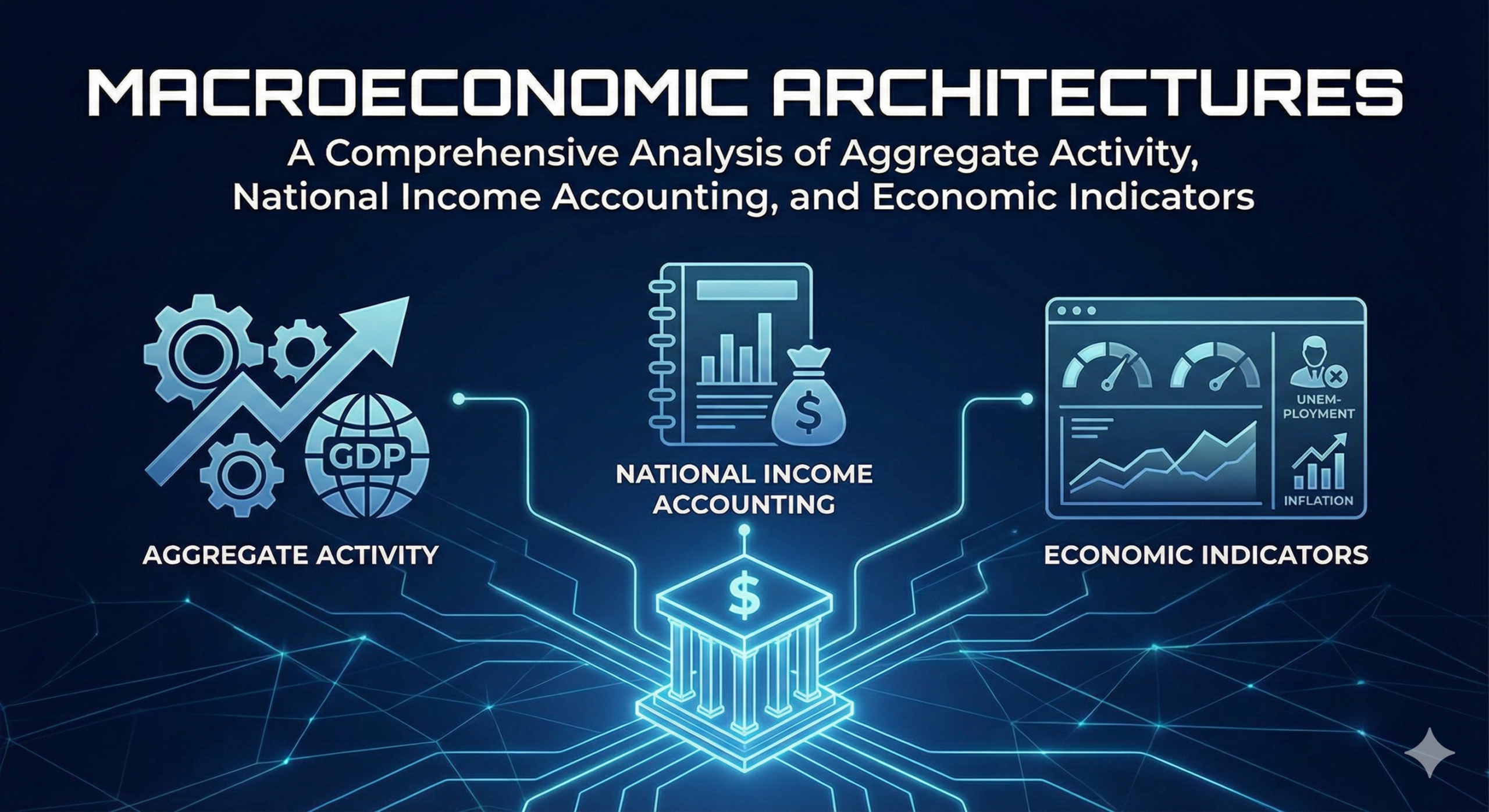
1. Introduction: The Macroeconomic Perspective
The discipline of economics is traditionally bifurcated into two distinct but interconnected realms: microeconomics and macroeconomics. While the former concerns itself with the granular optimization decisions of individual agents—households maximizing utility and firms maximizing profit—the latter ascends to the aggregate level, examining the behavior of the economy as a unified system. Macroeconomics is not merely the summation of microeconomic parts; it is the study of the complex emergent properties that arise when millions of independent decisions interact within an institutional framework. It focuses on the broad trajectory of economic life, encompassing the total output of goods and services, the aggregate level of prices, the rate of employment, and the interactions between the domestic economy and the rest of the world.1
The necessity of measuring these aggregate phenomena became painfully apparent during the Great Depression of the 1930s. Prior to this era, the “classical” economic view held that markets would naturally clear and that supply would create its own demand—a concept known as Say’s Law.2 However, the prolonged unemployment and stagnant production of the Depression defied these theoretical models, necessitating a new framework for understanding how an economy could settle at an equilibrium far below its potential capacity. This birthed the Keynesian revolution and, concurrently, the development of National Income and Product Accounts (NIPA). These accounting systems, spearheaded by economists like Simon Kuznets, provided the first reliable quantitative tools to measure the size and health of a nation’s economy, fundamentally altering the landscape of economic policy and analysis.
Today, the primary metric derived from these accounts—Gross Domestic Product (GDP)—serves as the global standard for economic health. It informs central bank interest rate decisions, government fiscal policies, and corporate investment strategies. However, as this report will explore, while GDP is a powerful tool for measuring market activity, it is an imperfect proxy for human welfare. Through a detailed examination of the circular flow of income, the tripartite methodologies of GDP calculation, and the nuances of the business cycle, this report aims to provide a definitive guide to the foundational mechanics of the macroeconomy. Furthermore, drawing on data from the third quarter of 2025, we will analyze how these theoretical concepts manifest in the contemporary economic landscape, particularly in the context of technological disruption and shifting global trade dynamics.
2. The Anatomy of Economic Flow
2.1 The Circular Flow of Income and Expenditure
To understand the macroeconomy, one must first visualize the continuous movement of resources, goods, and currency. The Circular Flow of Income model serves as the anatomical diagram of the economy, illustrating how distinct sectors interact in a closed loop of exchange. The fundamental axiom of this model is that for the economy as a whole, income must equal expenditure, which must equal the value of production. Every dollar spent by a buyer is a dollar of income for a seller.1
2.1.1 The Two-Sector Core
In its most elemental form, the model consists of two primary agents: Households and Firms.
- The Resource Market: Households are the owners of the factors of production—land, labor, capital, and entrepreneurship. They supply these factors to firms. In exchange, firms provide factor payments: rent for land, wages for labor, interest for capital, and profit for entrepreneurship. This flow of income (Y) represents the earnings side of the economy.1
- The Product Market: Firms utilize these factors to produce goods and services. Households, using their factor income, purchase these goods and services. This flow of consumption expenditure (C) represents the spending side.
Even in this simplified model, an important insight emerges: the interdependence of agents. If households decide to hoard cash rather than spend it, firms accumulate unsold inventory. In response, firms cut production and lay off workers (households), reducing household income and further depressing spending. This negative feedback loop illustrates the fragility of macroeconomic equilibrium.4
2.1.2 Expanding the Model: Injections and Leakages
Real-world economies are not closed loops of pure consumption. There are diversions of income, known as leakages (or withdrawals), and additions to expenditure, known as injections.1
Leakages (W):
- Savings (S): Households do not consume their entire income. A portion is saved in financial institutions. This removes immediate purchasing power from the circular flow.6
- Taxes (T): The government mandates a portion of household and corporate income be transferred to the state, reducing disposable income available for private consumption.1
- Imports (M): When domestic residents purchase goods produced abroad, currency flows out of the domestic economy to foreign producers.7
Injections (J):
- Investment (I): Financial institutions lend savings to firms, who use these funds to purchase capital goods (machinery, buildings). This spending re-enters the circular flow.6
- Government Spending (G): The government utilizes tax revenue (and borrowed funds) to purchase public goods and services, injecting money back into the economy.8
- Exports (X): Foreign residents purchase domestically produced goods, injecting foreign currency into the domestic circular flow.7
2.1.3 Macroeconomic Equilibrium
The economy reaches equilibrium when total leakages equal total injections:
S + T + M = I + G + X
If injections exceed leakages (J > W), the volume of the circular flow expands, leading to growth in national income. Conversely, if leakages exceed injections (W > J), the flow contracts, resulting in a recessionary trend. This dynamic highlights the critical role of financial intermediaries (banks) in converting savings into investment and the government’s role in balancing taxes with spending to maintain stability.1
Consider the analogy of “Jonathan,” a typical worker.4 His labor generates wages (income). He pays taxes (leakage), saves for retirement (leakage), and buys a smartphone made overseas (leakage). However, his savings are lent to a local bakery to buy a new oven (injection), his taxes pay a teacher’s salary (injection), and the software he codes is sold to a client in Europe (injection). The balance of millions of such “Jonathans” determines the aggregate trajectory of the economy.
3. Gross Domestic Product: The Yardstick of Activity
3.1 Defining GDP
Gross Domestic Product (GDP) is the absolute measure of economic size. It is defined as the market value of all final goods and services produced within a country in a given period of time.9 To fully grasp the utility and limitations of GDP, one must dissect each component of this definition.
- “Market Value”: An economy produces a heterogeneous mix of outputs—from bushels of wheat to legal consultations. To aggregate these distinct items, GDP uses market prices as a common denominator. If the price of an apple is $1 and a car is $30,000, the car contributes 30,000 times as much to GDP as the apple. This implies that GDP is sensitive to relative price changes; if the price of a good rises without an increase in quality or quantity, nominal GDP rises, necessitating price adjustments (discussed in Section 6).10
- “Final Goods and Services”: To avoid double-counting, GDP includes only goods sold to the end-user. Intermediate goods—those used in the production of other goods—are excluded. For example, if a miller sells flour to a baker for $1.00, and the baker uses it to make bread sold for $3.00, GDP counts only the $3.00. The value of the flour is already embedded in the price of the bread. Counting both would erroneously suggest $4.00 of economic activity.10
- “Produced”: GDP measures current productive activity. Financial transactions (buying stocks) and transfers of existing assets (buying a used home) are excluded because they do not represent the creation of new wealth, merely the exchange of ownership. However, the commissions paid to brokers or realtors facilitate these services and are included in GDP.8
- “Within a Country”: This geographic delineation distinguishes GDP from Gross National Product (GNP). GDP measures production within the borders, regardless of who owns the capital. A Honda factory operating in Ohio contributes to US GDP. Conversely, GNP measures production by a country’s nationals. That same factory contributes to Japanese GNP. In an increasingly globalized world, GDP is generally preferred as a measure of domestic economic health and employment potential.9
3.2 Stock vs. Flow Variables
It is imperative to distinguish between stock and flow concepts. GDP is a flow variable; it measures the rate of production over an interval (e.g., $28 trillion per year). It is analogous to the speed of a car or the flow of water through a pipe. In contrast, wealth is a stock variable, measuring the accumulated value of assets at a specific moment in time (e.g., the total value of housing stock or retirement accounts). A high GDP often leads to high wealth accumulation, but they are not identical; a nation can have high income but low wealth (if it spends everything), or high wealth but low income (a stagnant rentier economy).1
4. Calculating GDP: The Tripartite Approach
Theoretical consistency dictates that the value of production must equal the income generated, which must equal the expenditure incurred. Thus, economists employ three distinct approaches to calculate GDP. While they utilize different data sources, they should, in theory, arrive at the same figure. Discrepancies are recorded as a “statistical discrepancy”.7
4.1 The Expenditure Approach
The expenditure approach is the most common method for discussing GDP in public policy and media. It views GDP as the sum of all spending on final goods and services. The formula is the bedrock of macroeconomics:
GDP = C + I + G + (X – M)
4.1.1 Personal Consumption Expenditures ($C$)
Consumption is the largest component of GDP, particularly in developed economies like the United States, where it accounts for approximately 68-70% of total output.13 It represents spending by households on:
- Durable Goods: Tangible items with a lifespan exceeding three years (e.g., automobiles, furniture, appliances). This category is highly cyclical; during recessions, households delay durable purchases, causing sharp drops in this component.8
- Nondurable Goods: Tangible items consumed quickly (e.g., food, clothing, gasoline).
- Services: Intangible commodities (e.g., healthcare, education, financial services, haircuts). As economies mature, the share of services typically grows relative to goods. In Q3 2025, for instance, service spending on healthcare and international travel was a primary driver of US growth.15
4.1.2 Gross Private Domestic Investment ($I$)
In macroeconomics, “investment” does strictly not refer to buying stocks or bonds. It refers to the purchase of capital goods that will be used to produce future goods and services.8
- Fixed Investment: Spending by businesses on structures (factories, offices) and equipment (computers, machines). In 2025, a surge in “intellectual property products” investment, specifically related to Artificial Intelligence infrastructure, was a notable trend.14
- Residential Investment: Construction of new housing units. This is counted as investment (not consumption) because a house provides a stream of housing services over decades.
- Change in Private Inventories: This is a crucial accounting adjustment. GDP aims to measure production, not just sales. If Ford produces a truck in 2025 but does not sell it until 2026, the value of that truck is added to 2025 GDP as an “increase in inventory” (investment). In 2026, when the truck is sold, consumption (C) increases, but inventory investment (I) decreases by the same amount, ensuring the truck acts as a wash in 2026 and is correctly attributed to 2025 production.7
4.1.3 Government Consumption and Gross Investment ($G$)
This component includes spending by federal, state, and local governments on final goods (police cars, missiles) and services (teacher salaries, administrative labor).
- The Transfer Payment Exclusion: Crucially, government spending ($G$) excludes transfer payments like Social Security, unemployment insurance, and welfare. These payments are redistributions of existing income, not purchases of new production. They only effect GDP when the recipient spends the money on consumption (C).3
4.1.4 Net Exports (X – M)
This term adjusts for international trade.
- Exports (X): Goods produced domestically but sold abroad. These must be added.
- Imports (M): Goods produced abroad but purchased by domestic agents.
The subtraction of imports is often misunderstood. It is not that imports “subtract” from growth; rather, it is an accounting correction. The terms C, I, and G include spending on all goods, regardless of origin. If a US consumer buys a $1,000 French wine, C increases by $1,000. However, this wine was not produced in the US. Therefore, we subtract $1,000 in M to cancel out the increase in C, leaving GDP unchanged.7
Table 1: The Expenditure Approach Components (Concept & Example)
| Component | Symbol | Description | Example Transaction | Impact on GDP |
| Consumption | C | Household spending | Buying a haircut | Increases |
| Investment | I | Business capital & Housing | Building a factory | Increases |
| Government | G | Public goods & services | Paying Army salaries | Increases |
| Net Exports | X-M | Exports minus Imports | Selling corn to Japan | Increases |
| Buying oil from Saudi Arabia | Neutral* |
*Neutral impact implies that while Imports (M) is a negative term, the consumption (C) term rises by the same amount, resulting in zero net change to domestic production.
4.2 The Income Approach
The income approach sums the earnings of all factors of production. It operates on the principle that the price paid for a product is ultimately distributed to the workers, landlords, and capital owners who produced it.16 The formula is:
National Income = Wages + Rent + Interest + Profit
- Compensation of Employees (W): Wages, salaries, and fringe benefits (health insurance, pension contributions). This is typically the largest component.17
- Rents (R): Income received by households for supplying property resources.
- Interest (i): Net interest earned by households from private businesses.
- Proprietors’ Income and Corporate Profits (P): The income of sole proprietorships and the earnings of corporations (before taxes and dividends).18
Reconciliation with Expenditure:
To mathematically match the Expenditure number, two adjustments are required to move from “National Income” to GDP:
- Indirect Business Taxes: Sales taxes and excise taxes are part of the price consumers pay (Expenditure) but are not income received by the producer. They must be added.
- Depreciation (Capital Consumption Allowance): Businesses treat depreciation as an expense (reducing profit), but it is part of the gross value of investment. It must be added back.9
4.3 The Production (Value-Added) Approach
This method calculates GDP by summing the “value added” at every stage of the supply chain. Value added is defined as the Gross Value of Output minus the Cost of Intermediate Inputs. This method is particularly useful for analyzing the contribution of specific industrial sectors (e.g., how much does agriculture vs. tech contribute?).7
Case Study: The Bread Economy
Consider a simplified supply chain for a loaf of bread to illustrate how Value Added avoids double counting.16
| Stage of Production | Seller | Buyer | Transaction Price | Cost of Intermediate Goods | Value Added |
| 1. Farming | Farmer | Miller | $0.21 | $0.00 | $0.21 |
| 2. Milling | Miller | Baker | $0.49 | $0.21 | $0.28 |
| 3. Baking | Baker | Retailer | $0.92 | $0.49 | $0.43 |
| 4. Retailing | Retailer | Consumer | $1.00 | $0.92 | $0.08 |
| TOTAL | $1.00 |
- Expenditure Approach: Counts the final sale to the consumer: $1.00.
- Value Added Approach: Sums the value added at each stage ($0.21 + 0.28 + 0.43 + 0.08): $1.00.
- Error of Double Counting: If we simply summed the transaction prices ($0.21 + 0.49 + 0.92 + 1.00), we would calculate GDP as $2.62, effectively counting the wheat four times, the flour three times, and the bread twice. The Value Added method eliminates this distortion.16
5. Real vs. Nominal GDP: Adjusting for Price Levels
A critical distinction in macroeconomics is the difference between nominal and real values. Nominal GDP measures the value of output using current prices. Real GDP measures the value of output using constant prices from a fixed base year. This adjustment is necessary to differentiate between an economy that is actually producing more goods (Real growth) and an economy that is simply experiencing inflation (Nominal growth).19
5.1 The Mathematics of Real GDP
Suppose an economy produces only desks.
- Year 1 (Base Year): Production = 100 desks. Price = $50.
- Nominal GDP = $100 x 50 = $5,000.
- Real GDP = $100 x 50 = $5,000.
- Year 2: Production = 100 desks. Price = $60.
- Nominal GDP = $100 x 60 = $6,000. (Appears to grow by 20%)
- Real GDP = $100 x 50 (Base Year Price) = $5,000. (Zero growth)
In this scenario, Nominal GDP rose by 20%, but Real GDP remained flat. The standard of living did not improve; things just got more expensive. Economists and policymakers focus almost exclusively on Real GDP to assess economic health.20
5.2 The GDP Deflator
The GDP Deflator is a price index that tracks the average price level of all goods and services produced domestically. It is derived from the ratio of Nominal to Real GDP.19
GDP Deflator = (Nominal GDP / Real GDP) x 100
In the desk example above:
Deflator = (6000 / 5000) x 100 = 120
A deflator of 120 indicates that the aggregate price level has risen by 20% since the base year.
Comparison with CPI:
While the Consumer Price Index (CPI) measures the cost of a fixed “basket” of goods purchased by consumers (including imports), the GDP Deflator measures the price of everything produced domestically (including exports, factory machines, and government tanks). Therefore, a spike in the price of imported oil would severely impact CPI but have a smaller direct effect on the GDP Deflator. Conversely, a price spike in US-manufactured Boeing aircraft would affect the GDP Deflator but not the CPI.22
6. The Business Cycle: The Pulse of the Economy
Economic growth is rarely linear. It fluctuates around a long-term trend line in a recurring sequence known as the Business Cycle. These fluctuations define the immediate environment for businesses and workers.23
6.1 Phases of the Cycle
- Expansion: A period of sustained increase in Real GDP, employment, and income. As demand rises, firms increase production and hire more workers. In the US, expansions have historically lasted significantly longer than contractions (e.g., the 128-month expansion from 2009-2020).23
- Peak: The zenith of economic activity. The economy is operating at or near full capacity (“Potential GDP”). At this point, constraints in labor and capital often lead to inflationary pressures as demand outstrips supply.24
- Contraction (Recession): A period of declining economic activity. While a common rule of thumb defines a recession as two consecutive quarters of negative GDP growth, the National Bureau of Economic Research (NBER)—the official arbiter of US business cycles—defines it more broadly as “a significant decline in economic activity spread across the economy, lasting more than a few months”.23 This nuance allows them to declare recessions even if quarterly data is mixed but monthly indicators like employment are collapsing.
- Trough: The lowest point of the cycle. Growth stops declining and stabilizes, setting the stage for the next recovery.23
6.2 Causes of Fluctuation: Shocks
The shifts between these phases are often triggered by “shocks” to Aggregate Demand (AD) or Aggregate Supply (AS).
- Demand Shocks: Sudden changes in private sector confidence or government policy. A stock market crash (negative wealth effect) can shift AD left, causing a recession. A massive infrastructure bill (increase in G) can shift AD right, causing expansion.24
- Supply Shocks: Sudden changes in input costs. The oil crisis of the 1970s is the classic example: a sharp rise in oil prices shifted Short-Run Aggregate Supply (SRAS) to the left. This created “stagflation”—the pernicious combination of falling output (recession) and rising prices (inflation), a scenario that is particularly difficult for central banks to manage.24
7. Limitations of GDP: The Unmeasured World
While GDP is an indispensable tool for managing the economy, it is a deeply flawed metric for measuring human welfare. Its focus on market transactions leads to significant blind spots regarding social well-being, environmental sustainability, and equity.
7.1 The Robert F. Kennedy Critique
In a landmark 1968 speech at the University of Kansas, Robert F. Kennedy eloquently articulated the spiritual and moral vacuity of the metric. He noted that Gross National Product (GNP) counts “air pollution and cigarette advertising, and ambulances to clear our highways of carnage.” It counts “special locks for our doors and the jails for the people who break them.” It counts the destruction of the redwood and the production of napalm and nuclear warheads.25
Conversely, Kennedy argued, it does not allow for “the health of our children, the quality of their education or the joy of their play.” It is indifferent to the “beauty of our poetry or the strength of our marriages.” In sum, GDP “measures everything, in short, except that which makes life worthwhile.” This critique remains the philosophical foundation for modern movements seeking “Beyond GDP” metrics.25
7.2 Non-Market Activities and Gender Bias
GDP only values activity that has a price tag.
- Household Labor: Services such as child-rearing, cooking, and elder care, when performed by family members, are excluded from GDP. If a family hires a nanny, GDP rises; if a parent quits their job to care for the child, GDP falls, even though the service provided to the child remains the same. This exclusion systematically undervalues the labor traditionally performed by women.27
- The Underground Economy: Transactions in the “black market” (illegal drugs) or “grey market” (unreported cash labor) are missed. In some developing nations, the informal sector can account for 40-60% of actual economic activity, rendering GDP a severe underestimation of true living standards.11
7.3 Environmental Externalities
GDP operates on a “gross” basis regarding natural capital. It treats the depletion of resources as income rather than asset liquidation.
- The Broken Window Fallacy: GDP can paradoxically rise due to disasters. If a hurricane devastates a coast, the subsequent spending on rebuilding infrastructure and medical care for the injured boosts GDP. Similarly, the costs of cleaning up a massive oil spill are counted as economic activity.
- Pollution: A factory that produces valuable widgets increases GDP. The pollution it spews into the river is not subtracted. If the government spends money to clean the river, that spending also adds to GDP. Thus, environmental degradation can be recorded as a double benefit in national accounts.27
7.4 Inequality and Distribution
GDP is an aggregate figure. GDP per capita is a mean average. Neither metric reveals how the pie is sliced. A nation where one person owns 99% of the wealth and a nation with perfect equality can have identical GDPs. During the post-2008 recovery in the US, GDP rebounded relatively quickly, but median income stagnated, illustrating that growth can accrue disproportionately to capital owners rather than wage earners. A high GDP does not guarantee a high standard of living for the median citizen.28
8. Case Study: The US Economy in Q3 2025
To see these concepts in action, we examine the data from the third quarter of 2025. The Bureau of Economic Analysis (BEA) reported that US Real GDP increased at an annual rate of 4.3%, a robust acceleration from the 3.8% recorded in the previous quarter.13
8.1 Component Analysis
- Consumption (C): The engine of the US economy roared, contributing 2.39 percentage points to the total growth. This underscores the high marginal propensity to consume of US households. The growth was driven by services—specifically healthcare and international travel—and recreational goods.32
- Investment (I) and the AI Boom: While aggregate private investment appeared flat (-0.02% contribution), the sub-components reveal a massive structural shift. Investment in residential structures contracted (-5.1%) due to high interest rates. However, this was offset by a surge in “intellectual property products” (+5.4%) and “equipment” (+5.4%). Analysts attribute this directly to the generative AI revolution, as firms poured capital into data centers and GPU clusters. This illustrates how GDP data can signal technological paradigm shifts.14
- Government (G): Government spending contributed 0.39 percentage points, driven by defense spending. This highlights the “injection” role of state expenditure.32
- Net Exports (X-M): Trade was a major positive contributor (+1.59%). Exports surged (+8.8%) while imports decreased. Insights suggest this volatility was driven by supply chain maneuvering ahead of anticipated tariff policy changes in 2026, demonstrating how rational agents adjust behavior based on expected future policy “shocks”.13
8.2 Divergence with GDI
Interestingly, Real Gross Domestic Income (GDI) increased only 2.4%, compared to GDP’s 4.3%. Theoretically, these numbers should be identical (Income = Expenditure). The large gap, or “statistical discrepancy,” suggests measurement challenges in the post-pandemic, high-tech economy. Economists often average the two (3.4%) to get a truer picture of underlying momentum.31
9. Conclusion
Macroeconomics offers the blueprints for understanding the vast, interconnected machine of human cooperation we call the economy. The Circular Flow model reminds us that every cost is an income, and every savings must find an investment or the flow stalls. GDP, with its three calculation methods, provides the dashboard metrics necessary to steer this machine, allowing policymakers to distinguish between real growth and nominal inflation.
However, the dashboard is not the destination. As the breakdown of Q3 2025 shows, the economy is dynamic, constantly reshaping itself through technology (AI) and policy (trade). Yet, as the ghost of RFK reminds us, the dashboard has blind spots. It does not measure the sustainability of our path or the equity of our arrival. The prudent analyst, therefore, uses GDP as a tool, not a totem—acknowledging its unparalleled utility in measuring activity while remaining vigilant to the human and environmental realities it leaves uncounted.
Works cited
- Aggregate Demand and Aggregate Supply Models – LearnEconomicsOnline, accessed January 9, 2026, http://learneconomicsonline.com/nadas.php
- The Aggregate Market – Introduction to Macroeconomics – Penn State Pressbooks, accessed January 9, 2026, https://psu.pb.unizin.org/introductiontomacroeconomics/chapter/the-aggregate-demand-and-aggregate-supply-model/
- Lesson summary: The circular flow and GDP (article) – Khan Academy, accessed January 9, 2026, https://www.khanacademy.org/economics-finance-domain/ap-macroeconomics/economic-iondicators-and-the-business-cycle/21/a/the-circular-flow-and-gdp
- Circular Flow Model | Definition & Examples – Lesson – Study.com, accessed January 9, 2026, https://study.com/academy/lesson/circular-flow-diagram-in-economics-definition-example.html
- Circular Flow Model: Definition and Calculation – Investopedia, accessed January 9, 2026, https://www.investopedia.com/terms/circular-flow-of-income.asp
- How to Calculate GDP Using the Expenditure Approach – 365 Financial Analyst, accessed January 9, 2026, https://365financialanalyst.com/knowledge-hub/economics/how-to-calculate-gdp-using-the-expenditure-approach/
- The Expenditures Approach to Measuring GDP | U.S. Bureau of Economic Analysis (BEA), accessed January 9, 2026, https://www.bea.gov/news/blog/2025-06-03/expenditures-approach-measuring-gdp
- Measuring the Economy – Harper College, accessed January 9, 2026, http://www2.harpercollege.edu/mhealy/eco212i/lectures/ch7-18.htm
- GDP Formula – How to Calculate GDP, Guide and Examples – Corporate Finance Institute, accessed January 9, 2026, https://corporatefinanceinstitute.com/resources/economics/gdp-formula/
- PowerPoint Presentation, accessed January 9, 2026, https://lms.devry.edu/lms/content/1590/59068/ECON545/Karlan_3e_Econ_IPPT_CH24.pptx
- Shortcomings of GDP – Defintion, Limits, Other Models – Corporate Finance Institute, accessed January 9, 2026, https://corporatefinanceinstitute.com/resources/economics/gross-domestic-product-limitations/
- Gross Domestic Product: How it is Measured – CSO – Central Statistics Office, accessed January 9, 2026, https://www.cso.ie/en/interactivezone/statisticsexplained/nationalaccountsexplained/grossdomesticproducthowitismeasured/
- United States GDP Growth Rate – Trading Economics, accessed January 9, 2026, https://tradingeconomics.com/united-states/gdp-growth
- US GDP (Q3 2025 – first estimate) – EY, accessed January 9, 2026, https://www.ey.com/en_us/insights/strategy/macroeconomics/us-gdp
- Gross Domestic Product, 3rd Quarter 2025 (Initial Estimate) and Corporate Profits (Preliminary) | U.S. Bureau of Economic Analysis (BEA), accessed January 9, 2026, https://www.bea.gov/news/2025/gross-domestic-product-3rd-quarter-2025-initial-estimate-and-corporate-profits
- GDP Calculation Methods: Expenditure & Income | CFA Level 1, accessed January 9, 2026, https://analystprep.com/cfa-level-1-exam/economics/calculating-gdp-using-expenditure-and-income-approaches/
- Examples of Calculating GDP – EconPort, accessed January 9, 2026, http://www.econport.org/content/handbook/NatIncAccount/CalculatingGDP/Examples.html
- Gross domestic product – Wikipedia, accessed January 9, 2026, https://en.wikipedia.org/wiki/Gross_domestic_product
- Nominal GDP, Real GDP and GDP Deflator | CFA Level 1 – AnalystPrep, accessed January 9, 2026, https://analystprep.com/cfa-level-1-exam/economics/compare-nominal-and-real-gdp-and-calculate-and-interpret-the-gdp-deflator/
- Macroeconomics: GDP, GDP Deflator, CPI, & Inflation – VCC Learning Centre, accessed January 9, 2026, https://learningcentre.vcc.ca/media/vcc-library/content-assets/learning-centre/worksheets/by-coursex2fprogram/business/07_Macro_GDP_GDPDeflator_CPI_Inflation.pdf
- How to Calculate Inflation with GDP Deflators: Economics 101 | by Jon Law | Medium, accessed January 9, 2026, https://jonwlaw.medium.com/how-to-calculate-inflation-with-gdp-deflators-economics-101-12538495c928
- Example calculating real GDP with a deflator (video) – Khan Academy, accessed January 9, 2026, https://www.khanacademy.org/economics-finance-domain/ap-macroeconomics/economic-iondicators-and-the-business-cycle/real-vs-nominal-gdp/v/example-calculating-real-gdp-with-a-deflator
- Business Cycle: What It Is, How to Measure It, and Its 4 Phases – Investopedia, accessed January 9, 2026, https://www.investopedia.com/terms/b/businesscycle.asp
- Business Cycles and Growth in the AD–AS Model | Macroeconomics – Lumen Learning, accessed January 9, 2026, https://courses.lumenlearning.com/wm-macroeconomics/chapter/growth-and-recession-in-the-as-ad-diagram/
- Address at University of Kansas – Robert & Ethel Kennedy Human Rights Center, accessed January 9, 2026, https://rfkhumanrights.org/speech/address-at-university-of-kansas/
- Bobby Kennedy on GDP: ‘measures everything except that which is worthwhile’, accessed January 9, 2026, https://www.theguardian.com/news/datablog/2012/may/24/robert-kennedy-gdp
- What Are Limitations of Current Gdp? → Question – Climate → Sustainability Directory, accessed January 9, 2026, https://climate.sustainability-directory.com/question/what-are-limitations-of-current-gdp/
- Shortcomings of Gross Domestic Product | Macroeconomics – Haci – Lumen Learning, accessed January 9, 2026, https://courses.lumenlearning.com/hccs-macroeconomics-3/chapter/shortcomings-of-gross-domestic-product/
- Limitations of Real GDP and Real GDP per Capita as Measures of Living Standards, accessed January 9, 2026, https://vce.studypulse.au/learn/ECON/gdp_measurement_limits
- Limitations of GDP as an indicator | Understand Economic Metrics …, accessed January 9, 2026, https://www.marshalledu.com/limitationsofgdp
- Gross Domestic Product, 3rd Quarter 2025 (Initial Estimate) and Corporate Profits (Preliminary) – Bureau of Economic Analysis, accessed January 9, 2026, https://www.bea.gov/sites/default/files/2025-12/gdp3q25-ini.pdf
- An Inside Look at the Q3 2025 GDP Advance Estimate – dshort – Advisor Perspectives, accessed January 9, 2026, https://www.advisorperspectives.com/dshort/updates/2025/12/29/an-inside-look-at-the-q3-2025-gdp-advance-estimate