
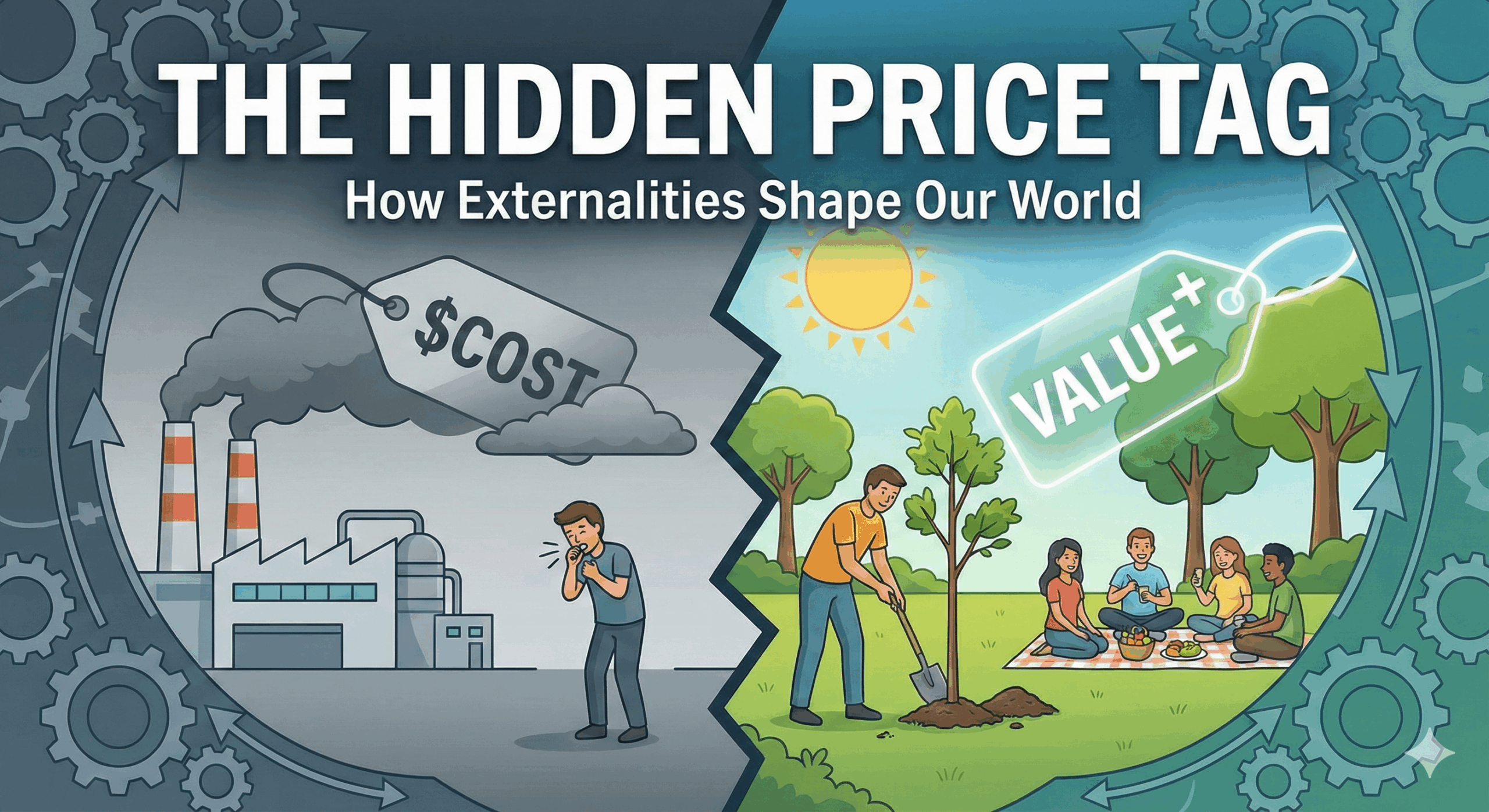
When you buy a cup of coffee or fill up your car with gas, the price you pay usually covers the cost of the beans or the oil, plus a little profit for the seller. But often, there are hidden costs—or benefits—that aren’t included on the receipt. These “invisible” price tags are what economists call externalities, and they are the secret engine behind many of the world’s biggest challenges, from climate change to public health.
Externality
An externality occurs when a transaction between two parties (a buyer and a seller) has a spillover effect on a third party who was not involved in the deal. Think of it as a side effect of economic activity that hits an innocent bystander.1
In a perfectly functioning market, prices are supposed to reflect everything. If you buy a burger, the price covers the meat, the labor, and the rent. But if the burger joint dumps its grease into the local sewer system, causing a clog that your taxes have to pay to fix, that is an externality. The burger joint didn’t pay for the clog, and neither did you, but a cost was still created.
Externalities break the core rule of the free market: that people pay for what they get and pay for the costs they create. When externalities exist, the price mechanism—the tool used to balance supply and demand—stops telling the truth about how valuable or costly a product really is.2
Example of Negative Externality
A negative externality is when the economic activity of one group imposes a harmful cost on another group without compensation. This is the most common type of market issue we encounter in daily life.
The classic example is industrial pollution. Imagine a factory that produces steel. To the factory owner, the cost of production involves iron ore, machinery, and wages. These are “private costs.” However, the smoke pouring out of the smokestacks causes respiratory issues for the town next door, leading to higher hospital bills and lower property values.
Because the factory does not have to pay for the town’s medical bills, it ignores this “external cost.” The factory produces cheap steel because it is effectively offloading some of its costs onto the neighbors. If the factory had to pay for the pollution (the “Social Cost”), the price of steel would be higher, and they would likely produce less of it.2
Other common examples include:
- Secondhand Smoke: A smoker buys cigarettes (private cost), but people nearby breathe the smoke and suffer health risks (external cost).4
- Traffic Congestion: When you drive during rush hour, you consider your own time. But by entering the road, you add to the traffic, slowing down hundreds of other people. You don’t pay for their lost time, creating a negative externality.5
Example of Positive Externality
Not all spillover effects are bad. A positive externality happens when an action by one person creates a free benefit for others.
A perfect example is vaccination. When you get a flu shot, you pay for the vaccine to protect yourself (private benefit). However, your decision also benefits your coworkers, family, and strangers on the bus because you are now a dead end for the virus. You are contributing to “herd immunity,” reducing the chance that others will get sick.
Because you don’t get paid for the safety you provide to others, the “Social Benefit” of your vaccination is much higher than the “Private Benefit” you receive. This leads to a unique problem: because people only value the private benefit, fewer people get vaccinated than society would ideally like.5
Other examples include:
- Beekeeping: A farmer keeps bees to make honey (private profit). But the bees fly to neighboring farms and pollinate the crops there for free, increasing the neighbors’ harvests.7
- Home Maintenance: If you renovate your home and plant a beautiful garden, you increase your own property value. But you also increase the property value of your neighbors by making the street look nicer.2
Externality Causing Market Failures
The existence of these positive and negative side effects leads to Market Failure. This doesn’t mean the stock market crashes; it means the market is failing to allocate resources efficiently. It is failing to match supply and demand in a way that is best for society.8
Here is how the failure happens for each type:
- Overproduction of Negative Externalities: Because the factory doesn’t pay for the pollution, it can sell steel at an artificially low price. When things are cheap, people buy more of them. The market ends up producing too much pollution and too much steel compared to what is socially optimal. This creates “Deadweight Loss”—a waste of societal resources where the harm done to the community outweighs the profit made by the firm.7
- Underproduction of Positive Externalities: Because the homeowner doesn’t get paid by the neighbors for planting a nice garden, they might decide it’s too expensive and skip it. Even though the garden would have created massive value for the neighborhood, the market discouraged it because the creator couldn’t capture that value. The market produces too few good things.8
How We Fix the Failure
To fix this, economists and governments try to “internalize” the externality—forcing the invisible cost or benefit to become visible in the price.
- Taxes (The Stick): We can place a “Pigouvian Tax” on pollution. If the factory has to pay a tax equal to the damage it causes, the price of steel will rise to its true cost. Supply will decrease to the safe, efficient level.10
- Subsidies (The Carrot): We can offer subsidies for vaccines or solar panels. By paying people to do the “good” thing, the government lowers the private cost, encouraging more people to buy in and raising consumption to the level society needs.7
- Property Rights (The Coase Theorem): Sometimes, if property rights are clear (e.g., “I have a right to clean air”), the polluter and the victim can just negotiate a payment without government tax interference. If the factory values polluting more than the neighbors value clean air, the factory can pay the neighbors for the right to pollute.11
By adjusting for these externalities, we try to make the market reflect the reality of our interconnected world, ensuring that prices tell the truth about the full cost of our choices.
Works cited
- Externalities: Prices Do Not Capture All Costs – International Monetary Fund, accessed December 4, 2025, https://www.imf.org/en/publications/fandd/issues/series/back-to-basics/externalities
- Externality – Wikipedia, accessed December 4, 2025, https://en.wikipedia.org/wiki/Externality
- Understanding Externalities: Positive and Negative Economic Impacts – Investopedia, accessed December 4, 2025, https://www.investopedia.com/terms/e/externality.asp
- Negative Externalities – Overview, Types, and Remedies – Corporate Finance Institute, accessed December 4, 2025, https://corporatefinanceinstitute.com/resources/economics/negative-externalities/
- 2.3 Positive and Negative Externalities – Public Economics – Fiveable, accessed December 4, 2025, https://fiveable.me/public-economics/unit-2/positive-negative-externalities/study-guide/iR1fk7GZgVeAZnGO
- 10.5 External effects: More examples and diagnoses – Microeconomics – The Economy 2.0, accessed December 4, 2025, https://books.core-econ.org/the-economy/microeconomics/10-market-successes-failures-05-examples-diagnoses.html
- Positive and Negative Externalities – AP/IB/College – ReviewEcon.com, accessed December 4, 2025, https://www.reviewecon.com/externalities
- Market Failure and Externalities: Understanding Inefficiencies in Markets – maseconomics, accessed December 4, 2025, https://maseconomics.com/market-failure-and-externalities-understanding-inefficiencies-in-markets/
- deadweight loss externalities | Bluefield Esports, accessed December 4, 2025, https://esports.bluefield.edu/textbooks-087/deadweight-loss-externalities.pdf
- Pigouvian tax – Wikipedia, accessed December 4, 2025, https://en.wikipedia.org/wiki/Pigouvian_tax
- he World According – to Coase – Chicago Unbound, accessed December 4, 2025, https://chicagounbound.uchicago.edu/cgi/viewcontent.cgi?filename=1&article=1070&context=lawschoolrecord&type=additional
- The Coase Theorem – Dr. Ju’s Blog – Obsidian Publish, accessed December 4, 2025, https://publish.obsidian.md/doctorstudio/2024+~.+Economics/The+Coase+Theorem